We use cookies to provide you with a better experience. By continuing to browse the site you are agreeing to our use of cookies in accordance with our Cookie Policy.
Cow comfort plays a critical role in your herd’s reproductive management. Comfortable cows are less stressed, making them healthier, which drives up pregnancy rates.
That’s why when you focus on cow comfort, your returns are more than just happier cows … Comfortable cows are profitable cows.
Johne's disease (pronounced yo-KNEES) is a condition of cattle and all other ruminants (both domestic and wild) that causes chronic diarrhea, weight loss, infertility, and eventual death in animals that are infected years earlier.
Our fields aren’t the only ones battling the dry conditions and increased temperatures.
Our livestock have also been suffering which poses a threat to many producers who are concerned about the consequences of economic losses.
As a general rule of thumb, producers need to keep in mind the Temperature-Humidity Index (THI).
“You cannot get out of trouble using the same thought process that got you into trouble.” —Albert Einstein
Over my 28 years as a hoof trimmer, 23 have been dealing with digital dermatitis and its effects on my clients’ cows.
For the international dairy industry, digital dermatitis (DD), more commonly known as strawberry foot, is one of these disease problems that has gone from a nuisance on a few cows in the late 1950s and 1960s to becoming the leading cause of lameness in dairy cattle in the world.
The average cost of DD per cow case is more than $105. However, when I do a farm analysis for a producer and we review the number of cows infected to examine herd costs, nearly all producers say that financial figure is too low.
After more than 28 years working as a hoof trimmer in the dairy industry and, like many others, seeing the many changes within the dairy industry, I think a simple question has to be asked: “Why is lameness increasing as an issue?”
The answer is the modern dairy industry still has not recognized the requirements for the hoof to function “normally.”
As many veterinarians, nutritionists, farmers and students would agree, management during the transition period is one of the most crucial roles to produce a successful lactation. Making your transition cow program a success relies heavily upon proper body condition score at calving, minimizing pre-calving energy intake and maximizing feed intake throughout the freshening period.
Although special attention is commonly given to transition cows, heifers calving for the first time are often not seen as high-risk animals. This may be due to the fact that heifers often suffer from lower rates of milk fever, or displaced abomasum during the fresh period, when compared to animals in their second or third lactation.
Dairy cows are often grouped according to age, days in milk, feed requirements and health status. To create these groupings, cows are often moved to new groups four or more times per lactation.
Johne’s disease is a persistent and debilitating bacterial disease that affects the intestines of ruminant animals. The common routes of infection are via ingestion of colostrum or milk contaminated by infected cows. For this reason, Johne’s prevention strategies revolve around calf management and herd testing.
Infection can also occur when feed contaminated with manure containing the MAP pathogen is eaten, particularly by youngstock. For this reason, manure application to forages is a potential source of infection.

 RSS
RSS
 Our fields aren’t the only ones battling the dry conditions and increased temperatures.
Our livestock have also been suffering which poses a threat to many producers who are concerned about the consequences of economic losses.
As a general rule of thumb, producers need to keep in mind the Temperature-Humidity Index (THI).
Our fields aren’t the only ones battling the dry conditions and increased temperatures.
Our livestock have also been suffering which poses a threat to many producers who are concerned about the consequences of economic losses.
As a general rule of thumb, producers need to keep in mind the Temperature-Humidity Index (THI).
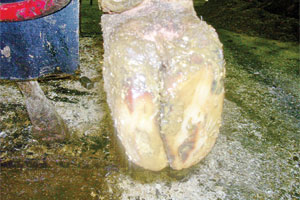 After more than 28 years working as a hoof trimmer in the dairy industry and, like many others, seeing the many changes within the dairy industry, I think a simple question has to be asked: “Why is lameness increasing as an issue?”