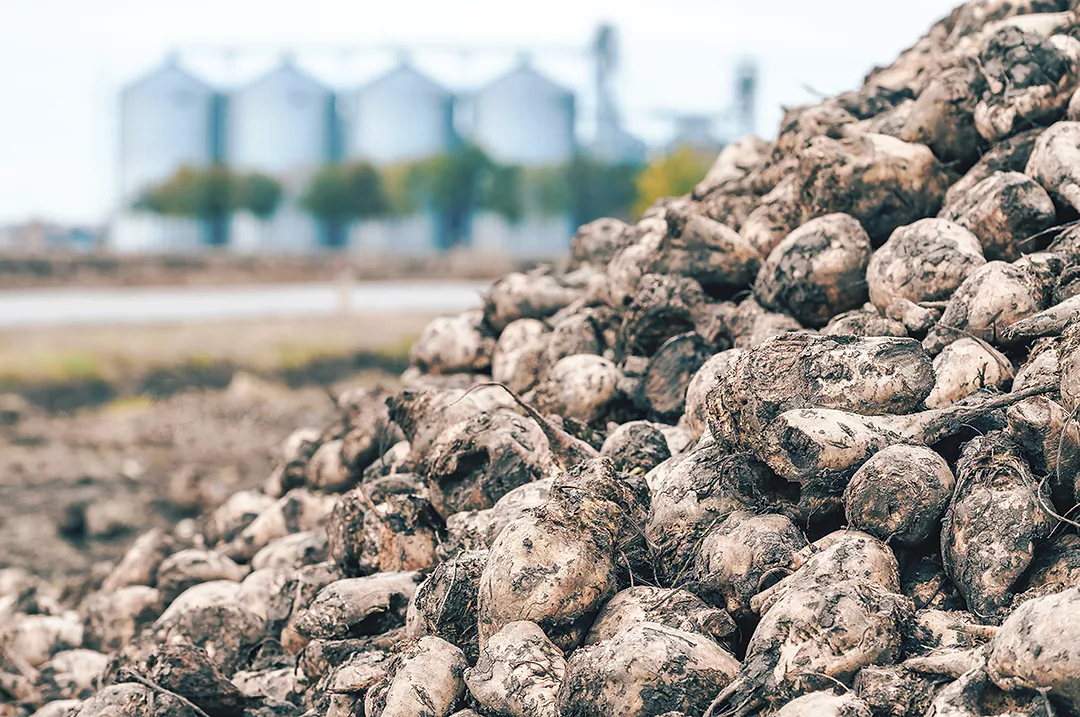
Across the Pacific Northwest, sugarbeet growers are facing one of the most challenging market environments in decades. Domestic sugar prices have fallen sharply, dropping more than 33% over the past two years. For many sugarbeet growers, the 2025 crop resulted in losses exceeding $500 per acre. If current conditions continue, the economic outlook for the sugarbeet industry is grim.

To understand why the sugar market has deteriorated so quickly, it is important to look at both sides of the equation. Demand for sugar is shifting while global supply has expanded. At the same time, gaps in U.S. trade policy are allowing large volumes of subsidized foreign sugar to enter the market and undercut domestic production.
Understanding U.S. sugar policy
The U.S. sugar market operates under a unique policy structure designed to stabilize domestic supply and defend American producers from heavily subsidized global competitors.
Normally, we produce about 75% of the sugar we need for the domestic market and import 25%. Existing trade deals allow 41 countries to export specific amounts of sugar to the U.S. while paying low or no tariffs.
Raw or refined sugar that comes in above those predetermined amounts is considered out-of-quota sugar and subject to additional tariffs intended to prevent foreign sugar from flooding the market.
In theory, this system balances supply with demand while defending American farmers from having to sell at the same price as highly subsidized foreign sugar. In practice, however, several new pressures are beginning to weaken the market.
Demand shifts are changing consumption
One challenge facing the sugar industry is a shift in consumer demand. Economic pressures have slowed purchases of discretionary food items such as candy, baked goods and other sugar-containing products. When consumers pull back on impulse purchases, it directly affects sugar demand across the food manufacturing sector.
The food industry is also continuing its push toward lower-calorie formulations. Many food and beverage companies have reformulated products to include artificial sweeteners rather than real sugar in order to meet consumer demand for reduced-calorie options. While these changes may appeal to some consumers, they increase the number of chemical additives in our food supply while reducing demand for a natural ingredient that farmers produce.
Increasing use of some medications for weight loss by many Americans is also affecting dietary habits. The consumption of many food items, including sugar-containing products (SCPs), has been shown to decline for households where a family member is using such medications. It is unclear how much or for how long those dietary habits will be affected by use of weight loss medications, but in the short term, it is clear that this is also lowering overall demand for sugar consumption in the U.S.
Surging global production
While demand pressures are emerging, global sugar production has expanded rapidly. According to the USDA, global sugar production is projected to reach roughly 189 million metric tons in the 2025-26 marketing year, driven largely by increased production in Brazil and India.
Brazil remains the world's largest sugar producer, followed by India and the European Union. Thailand, China and the U.S. also rank among the top producers globally. Brazil, India and Thailand make up approximately 70% of the world’s sugar export market.
Many foreign countries heavily subsidize their sugar industries. Government support programs often include price guarantees, export incentives and production support programs that encourage growers to produce more sugar even when global markets are already well supplied.
When global production exceeds demand, prices fall quickly. That is exactly what has happened over the past two years. With large global supplies and increased export availability from major-producing countries, world sugar prices have fallen sharply.
Another factor affecting global supply is the relationship between sugar and ethanol production. In countries such as Brazil, sugarcane can be processed into either sugar or ethanol fuel. When oil prices are high, more sugar is diverted into ethanol production. When energy prices fall, more sugar enters the global food market instead. Lower energy prices in recent years have encouraged additional sugar exports. Similarly, Brazil has been producing more ethanol from their growing corn crop. The result is a global surplus that is pushing prices downward.
The Tier 2 problem
For American growers, the most significant challenge comes from an outdated aspect of U.S. sugar trade policy known as out-of-quota tariffs.
Under the quota system, countries receive specific quotas that allow them to export sugar to the U.S. at zero or low tariff rates. Once those quotas are filled, additional imports are supposed to face a much higher duty, known as out-of-quota tariffs or Tier 2 tariffs. The Tier 2 tariffs (for raw and refined sugar) have not changed in 26 years and do not reflect any of the inflationary pressures that have affected sugarbeet and sugarcane producers and sugar processors since 2000.
Since the Tier 2 tariffs are so out of date, they no longer dissuade buyers in the U.S. from importing raw or refined sugar when the U.S. price gets close to or above the world price plus tariff plus transportation costs. When world prices fall low enough compared to U.S. prices, foreign suppliers and U.S. buyers can still profit by importing out-of-quota sugar to the U.S., paying the higher Tier 2 tariff and selling the product in the domestic market.
Because global prices have dropped so sharply, that scenario is now happening more and more often. Foreign sugar produced with government subsidies is entering the U.S. in growing quantities, even after the higher out-of-quota tariff is applied.
Unlike quota imports, Tier 2 sugar does not have strict volume limits. As long as importers are willing to pay the tariff and pay for shipping and handling, additional sugar can enter the country. That creates a situation where subsidized sugar from overseas competes directly with domestic production for sales, and it also restricts the U.S. price from rising to reflect the higher costs of production our farmers and factories are facing. In many cases, that imported sugar is displacing sugar produced by hardworking American family farmers and sugar processors who operate without the same level of government support provided in other countries and who are meeting higher labor, environmental and food quality standards.
As world sugar prices fall and Tier 2 imports increase, U.S. prices are driven downward.
What it means for the Northwest
The sugarbeet industry plays an important role in agriculture across Idaho, Oregon and Washington. Roughly 600 growers produce sugarbeets in the region, contributing more than $1 billion in economic activity.
Sugarbeets are also an essential crop within a farm rotation. For many operations, sugarbeets serve as the crop that helps pay the bills during uncertain commodity cycles.
Beyond the farm gate, sugar is also an essential ingredient in the U.S. food supply. It is used in thousands of products found in grocery stores, bakeries and food manufacturing facilities across the country. Maintaining a reliable domestic supply of sugar is important not only for farmers but also for food manufacturers and consumers. Sugar remains a key food ingredient used throughout the global food system.
As recent global supply disruptions have demonstrated, food security is closely tied to national security. A stable domestic sugar industry helps ensure that the U.S. is not overly dependent on foreign suppliers for a key ingredient in the food system.
Agriculture drives Idaho's economy, and sugar production is an important part of that success.
Looking ahead
The sugar market has always been cyclical, but the combination of shifting demand, expanding global supply and policy gaps has created a difficult environment for producers.
Ensuring that American farmers are not forced to compete against heavily subsidized foreign sugar is essential to maintaining a stable domestic supply.
For growers across the Pacific Northwest, the stakes are high. Sugarbeets remain one of the most reliable crops in the region. But if current conditions continue and the flow of Tier 2 imports remains unchecked, many growers may struggle to remain in the industry.
For an industry that has supported rural communities for generations, restoring fair market conditions will be essential to ensuring that sugarbeet farming remains viable in the years ahead.
References omitted but are available upon request by sending an email to the editor.