What’s black and powdery fine, with holes all over?

“Biochar” might not be everyone’s immediate response, but this soil additive is gaining popularity in the U.S. Now, University of Idaho (U of I) researchers hope to put numbers to the benefits of biochar application on Palouse farms. “We want to quantify how long it takes for biochar to pay for itself,” says Dr. Dev Shrestha, department chair and professor at U of I’s Department of Chemical and Biological Engineering.
Biochar is the product left behind when organic materials undergo pyrolysis, or cooking in the absence of oxygen. That marketed by Wally Bingham of Elite Environmental Products is a byproduct of electricity generation by Oregon Biochar. Elsewhere, it can be a byproduct of biofuel production.
In fact, says Dr. Daniel Strawn of U of I’s Department of Soil and Water Systems, biochar itself is typically made from waste biomass, such as “excess timber, slash piles, extra waste from milling timber in lumber mills or agricultural byproduct.” Bingham’s product is generated from a mix of hard and soft woods and pistachio shells. Shrestha’s latest work involves treatments with biochar derived from both conifer wood and wheat straw. “There are various forms, and different types behave differently,” says Strawn.
A goal of applying any of these to the soil is to increase soil pore space. Biochar’s peculiar structure means that it impacts both physical and chemical soil properties. “It can retain more moisture in the soil. It can enhance microbial activity in the soil,” says Shrestha. “Nutrients and water adsorb to the carbon compound, and it’s very stable.” Biochar can even adsorb contaminants, a feature that factors into Strawn’s research. And it has been studied as a way to improve long-term carbon storage in soil, although transportation requirements have discouraged this particular use.
“It’s really taken off in the last decade or so,” Strawn says. “Research has validated that it can have some interesting qualities.” He cautions that although it is often a beneficial soil additive, its properties may be counterproductive in some situations.

Biochar must be incorporated into the soil via tillage. Image provided by Dev Shrestha.
Why the Palouse?
Right now, biochar is not used much on the Palouse. It is too cost prohibitive to apply across entire fields. “Dev has come up with the idea to use it in precision applications,” says Strawn. “What are the areas where it can be applied for the biggest impact? It all comes down to economics.”
“On the Palouse, we have rolling hills,” says Shrestha. “Most of the moisture from the top of the hills goes down. It takes nutrients and topsoil with it.” Not only does that limit yields, it also carries nitrogen and phosphorus downstream. “If we could keep more moisture on the top, there is a potential to keep productivity and reduce pollution,” he says.
Supply, the other piece of the puzzle
But regional economic benefit could extend even further: to lumber mills. Shrestha was recently involved in an energy audit of various local industries, including mills. “They use about half of their wood chips to dry lumber,” he says. “Some are used for landscape bark, but the rest are of very little value. Sometimes they have to pay someone to haul them away.”
He proposes that the mills produce biochar from those waste chips, but the high cost of biochar – and low availability in the region – means that the local market for it is limited, despite potential benefits. That gives a mill very little incentive to refit its kiln. “We’re trying to create a market for this product and give farmers the confidence to use it,” Shrestha says.
On the farm
To find a producer already using biochar, we direct our attention to Caldwell, where McIntyre Family Farms produces beef, pork, chicken and eggs, as well as some seed crops and feed for their own animals.
To apply it to their fields, says Brad McIntyre, a fourth-generation farmer, they use compost as a vehicle. “It’s really light and fluffy, like powdered sugar,” he says of biochar. “When it’s mixed with compost it’s easier to spread.” The McIntyres began using the additive about five years ago and reapply about every two to three years. “I really like how the compost is [when mixed with biochar] – how it feels, how it spreads,” he says.
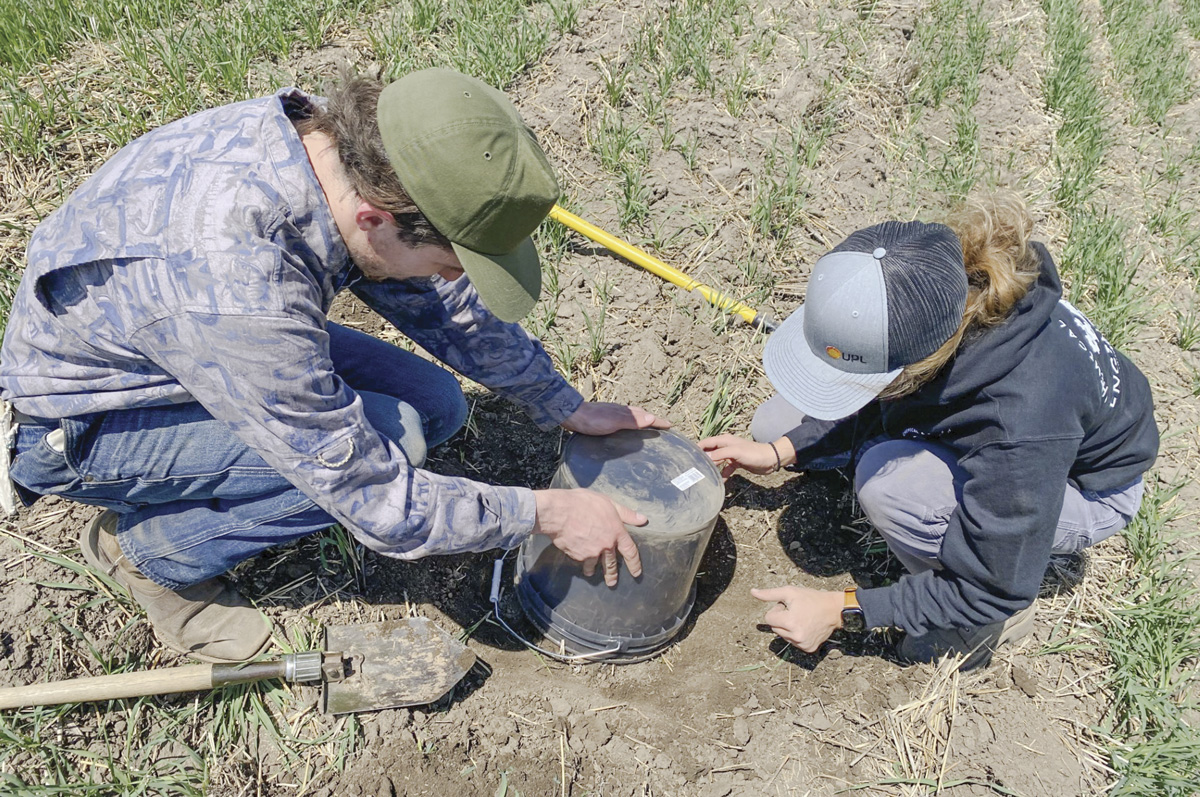
Research aide Milo Flint and graduate student Jaycee Johnson collect an undisturbed soil sample to measure soil bulk density. Image provided by Dev Shrestha.
However, there were some lessons along the way. “One of the first loads in, we had a big windstorm. We lost almost a quarter of it. … You have to figure out how to handle it, and be quick with it. It’s not like ordering nitrogen from the co-op.”
Biochar also makes its way to McIntyre’s fields by way of animal manure: They mix it into their chicken and pig feed. “It ties up bad bacteria and free ammonia in the gut,” says McIntyre. “The animals are healthier, and they’re spreading it here and there.” He has even observed better-smelling wintertime barns since they started the practice.
Other operations make similar claims. “Our two biggest consumers are dairies, for dairy lagoons, and tree farms in California,” says Bingham. He explains that the biochar facilitates converting ammonia to nitrogen, increasing compost value and reducing odor. He also cites trials (conducted both by Elite Environmental Products and by external groups) that observed increased animal gains in the feedlot and increased butterfat and milk protein when animals consume biochar.
“In the beginning, it was just hype,” says McIntyre. “I wanted to see what it could do for me – can it make my land better?” And he believes it has. “It’s no silver bullet, but it has its place,” he says. “It’s a piece of what we’re doing at this time.”
Traditional soil amendment meets precision ag tech
Though studies and anecdotal evidence sound promising, we are still learning about biochar – which brings us back to Shrestha’s study. “This is the second year,” he says. In 2025, his team put sensors in 27 plots at a U of I farm to collect baseline moisture levels. This past April, they applied treatments: 8 tons per acre of wheat or wood biochar, right before they seeded the spring crop. The next steps will be data collection, then model building and verification before they can put the model to use.
“We’re developing a website for farmers,” says Shrestha. A producer using the site will navigate to his farm on the map, and the model, using Shrestha’s findings, will factor in such variables as geography, weather and soil to estimate economic return on biochar application across the landscape. The goal is to help farmers pinpoint relatively small areas within fields where they can expect to maximize return for an investment in biochar. “It’s not economically feasible to put it uniformly across a field,” Shrestha says. “At the bottom line, it has to make sense.”