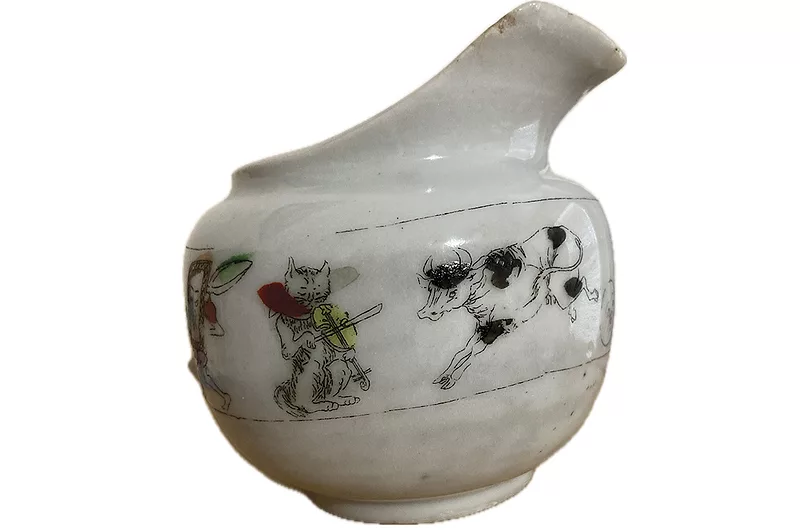
One Christmas Eve night, over 100 years ago, my great grandfather brought a calf into the family kitchen to try and warm it up. I don’t know how many of our family stories could start with those words: He brought a calf into the kitchen. John Anderson had found the newborn half-frozen in the field and was trying against the odds to save its life. It didn’t look likely. Christmas miracles are real though and the calf, warmed by the milk of the bottle and the heat from the wood stove, pulled through. It was a busy night. Despite the weather, Santa also found his cold and precarious way to the farmhouse and, among other treasures, placed a perfect little tea set under the tree. Clever elves had painted the tea pot, cream pitcher and each tiny cup and saucer with “Hey-diddle-diddle” scenes: a cat playing a fiddle, a little dog laughing and, best of all, a cow jumping over a startled moon. The whole magical set was for Ruth, my grandma. But as early as she was sure to have tumbled out of bed and run to the tree the next morning, the calf rose sooner. The family found him bucking and tangled up in the tree’s paper chains and popcorn strings, stomping and running all over the toys. The tea set didn’t stand a chance.

The point of this whole story is that my mom is downsizing. Downsizing is an unemotional word that actually means “ripping your heart out.” Downsizing is emptying your life out of closets and boxes and drawers and arranging it onto the floor in piles. Downsizing is deciding which pieces of your past should be donated, sold or thrown away. It’s fun. My mom and I were knee-deep into the process when she brought me a box. It had been carefully tucked away inside another box, then pushed to the back of a cupboard. Nestled under other treasures was a little cream pitcher, so white it was almost blue, broken still, 100 years carefully kept. Without saying a word, Mom asked “Now what do I do with it? How can I keep everything like this, but how in the world do I throw it away?”
In this, Mom and I understand one another. Frankly, in most ways we are opposite people. She is quick and decisive, and I am slow and sluggish – I mean I’m intentional and thoughtful. She is all about getting things done, while – just so we are clear – absolutely nothing in my life is ever done. But in our love of the past, we are the same. Memories are precious to us, and so are the few objects that have survived through time to carry our family’s stories. That said, the mounds of treasure piled on her floor were also real, formidable even, and we were both waking up to the fact that we could not drag most of it into the future. The most difficult questions remained: Exactly how much cargo did we need to throw overboard, and what should survive?
Mother no longer lives on a farm, but my father-in-law does. Living on a farm compounds the hoarding problem by a slight ratio of a billion to one. Suddenly, we aren’t only talking about tea sets here. For those of you in the same boat, what exactly are you doing with all your old saddles and rifles and tools and trucks and tractors? And what are you going to do with all of their precious and crumbling parts? They are basically members of the family. When farms are passed down generation to generation, it seems there’s never time to sort through all the memories. There’s always something more urgent to do than downsize. That’s how farms form their own archeological layers.
My dad’s dad saved all his old bent nails; he always planned to straighten them out at some later date. Drove my dad crazy. I have to believe, though, that every generation has its own version of a coffee can full of rusting nails. I, for one, have pictures of every 4-H and FFA calf my kids have ever shown. Every. Single. One. And I don’t just have a single shot of each animal. I have the equivalent of senior portfolios – front shots, side views, beauty pageant footage. One day I will compile it all into an encyclopedia-sized photo album. You know, when I have a free year at my disposal. Then my children can sit down together around the dinner table and laugh and tell stories and remember how much they loved and hated all those steers and heifers.
Right.
Kids may grow up, but moms have a harder time.
People tell me stuff is just stuff. But how can I hold that little cream pitcher and not remember the grandmother who kept it? To have the actual pitcher, both broken and breaking a little girl’s heart, saved year after year from that original cold morning, is to bring the windswept farm a little closer. It reminds me that in the days that kitchens were warmed by wood stoves, the life or death of a calf could spell success or failure for a family. It also tells me about the sacrifices John and Agnes Anderson had to have made to buy toys for their little boys and girls. They really loved my grandma. I think the cream pitcher is a keeper.