Canada’s federal government ended its Community Pasture Program in 2012, which had provided grazing for 220,000 cattle owned by 2,500 producers in the Prairie provinces. The program managed 85 pastures since the 1930s: 24 in Manitoba, 60 in Saskatchewan and one in Alberta, all under Agriculture and Agri-Food Canada, formerly known as the Prairie Farm Rehabilitation Administration (PFRA).

Months after the announcements, the involved governments initiated a plan to transition federal pastures to patron operation.
While Saskatchewan’s federal and provincial pastures transitioned independently, Manitoba producers adopted a different strategy.
Manitoba forms a group mentality
Barry Ross was a federally employed PFRA land manager when the 2012 announcement occurred. Today, he’s the general manager of the spinoff Association of Manitoba Community Pastures (AMCP).
“We took a different tactic in Manitoba and approached the government as a group of patrons,” Ross explains. “Our goal was to lease as an umbrella group and keep the pastures together.”
The association, made up of about 350 patrons, still oversees 24 pastures and 330,000 leased acres, providing grazing for approximately 42,000 cattle. It operates hands-on in 20 pastures, with the remaining four run by local rural municipalities. All the Crown land is leased to the AMCP, and the group employs seven full-time staff, 15 seasonal managers and approximately 25 riders.
The government remains in control of forestry, mining, minerals and treaty land entitlement interests, while the AMCP handles weeds, grazing and riparian areas. Ross handles the leases, staff and funding applications, and finds the cattle to fill the gaps.
“We considered sizes and economics when we decided to take this route, believing it would be beneficial to stay as a group since it would be harder to keep the smaller pastures running separately,” Ross says.
Having local staff report to a general manager rather than individual boards that were more susceptible to change added long-term stability.
“The first major hurdle was convincing patrons and staff that the AMCP was there to stay,” says Ross. “After we’d run it the first year, we kept most of them as they saw we could do it.”
The association preserved much of the experience and training, including forage, grass and wildlife management. They established a water maintenance position, which doubled as a safety officer, and continued range management and horseback training in a downsized capacity. The tried-and-true local patron advisory committees were retained to facilitate experienced and new operator relationships, continuing to provide 10% of space annually to newcomers. A range agronomist was hired to continue range health assessments. As a group, they were able to access funding for cross-fencing and water system projects. They even directed some funding to farmers completing range health work and initiating solar water systems and fencers worth $10,000 on 47 farms.
On the negative side, Ross notes they couldn’t replace the entire federal government’s pocketbook; subsequently, costs rose substantially to reflect market value. Additionally, the federal government-driven community jobs disappeared, hurting local businesses.
“One advantage we have is because of our umbrella approach and our promise to protect the environment as well as find other funding,” Ross says. “The Manitoba government gave us the same no-cost lease as the PFRA had. In Saskatchewan, the lease costs remained the same as those charged to other Crown land leaseholders.”
Ross believes the AMCP’s future is bright as the government wants to keep the land protected and designated for grazing. With high cattle and land prices, that support plus patron demand has remained strong since the transition.
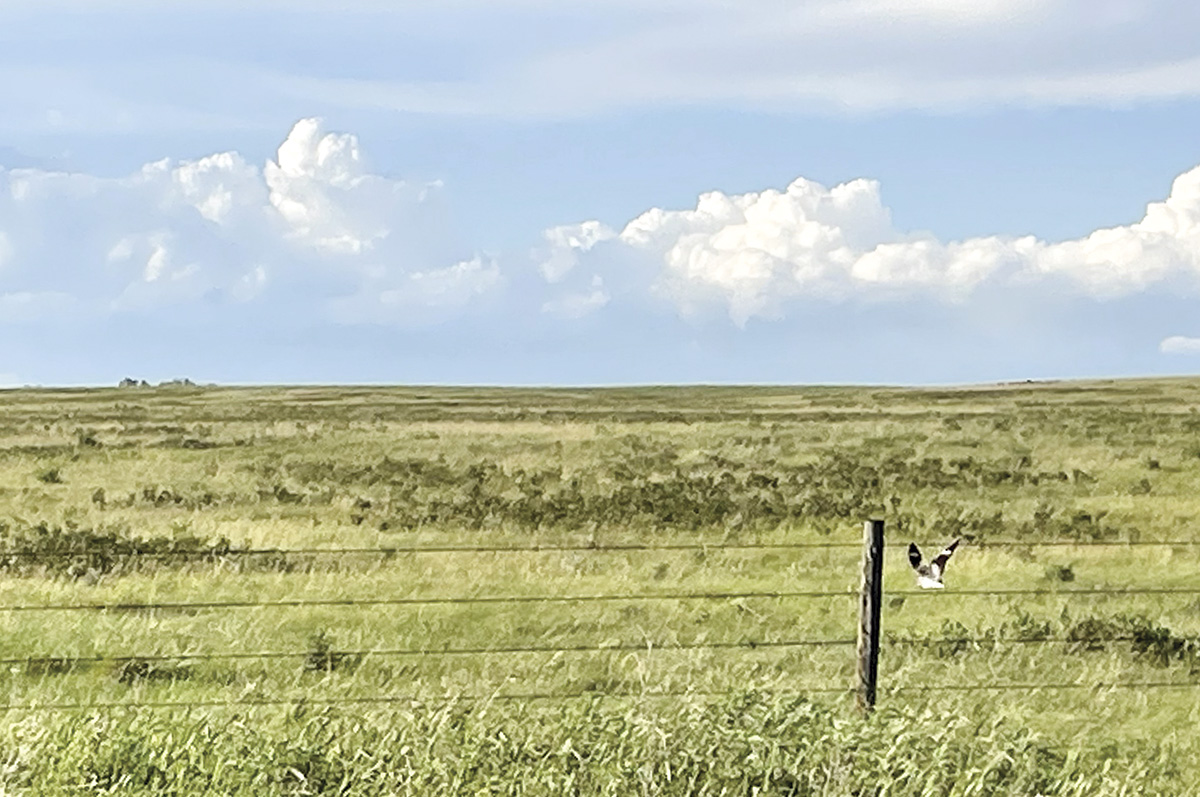
Saskatchewan grazing shareholders have been able to make changes to improve grazing land more quickly since adopting a more locally based community pasture system. Image by Ross MacDonald.
Saskatchewan chooses pasture independence
“I remember the 2012 announcement and the dysfunction within the federal government at the time,” says professional agrologist and rancher Ross MacDonald, who is also a current Lomond No. 1 Saskatchewan pasture board member. “At the time, the work was fantastic landscape-level stuff, but then cuts happened. Senior employees were sour about losing their jobs, causing a lack of cooperation. The provincial government felt pressured with no adequate resources, creating an extremely bitter atmosphere."
MacDonald had been a senior PFRA manager helping shift roughly 60 Saskatchewan pastures to patron control in 2019. Rather than follow Manitoba’s lead, Saskatchewan chose to let each unit follow its own path and operate independently.
The PFRA had a highly evolved approach to science-based grass management, addressing noxious and invasive weeds, public access, infrastructure, species at risk, awareness of balancing grass use and coordinated oil and gas development guidelines.
“It’s unfortunate, but these programs and a tremendous skill set and wealth of knowledge essentially evaporated along with the expertise that came with them,” MacDonald says. “These skills and multi-stakeholder values and expectations placed on pasturelands in concert with the grazing was really the magic of the PFRA and what they thrived on to attract good people. The organizational aspect of what we have today doesn’t lend itself to what was lost.”
As an agrologist and rancher of 25 years, MacDonald understood the concepts thrust onto shareholders, but many had no idea about basic range management, the importance of the infrastructure or the human resource dynamics within the varying operations. Most weren’t equipped to deal with these aspects, while others simply had no interest in their workings, focusing only on getting their cattle to and from pasture.
“Administering the lease was straightforward, but the functional longevity was the biggest frustration,” MacDonald says. “The previous system existed for 75 years, but during the transition, it started to break down without replacement mechanisms. Outside pressures from other land users or oil companies needed to be dealt with, no matter the consequences. And consequences came with a higher cost to the patrons.”
Today, the landscape has improved, although it’s come with a steep learning curve.
Boards and members began to discuss changes, understand animal unit months, forage balances and consumption rates, and grass management principles. Individual member strengths have united, with many embracing new challenges and driving positivity, efficiency and production.
“A bright spot is cattle operational needs are different than 50 years ago, and the PFRA wasn’t overly nimble with some of the obstacles,” MacDonald says. “Now, with more local influence, it’s opened the door to workable changes. These successes will ensure cows in and cows out will continue in Saskatchewan for the foreseeable future.”