A large-scale Global Water Futures (GWF) study funded by 23 universities and supported by 65 different projects over a 10-year period reveals significant climate change risks and challenges in the decades ahead for Canada’s western water.

Dr. John Pomeroy, director for the Global Water Futures Program, a co-chairman for the United Nations Advisory Board on glaciers presentation and professor at the University of Saskatchewan’s Centre for Hydrology, said the impacts of climate change are already manifest in western Canadian rivers, the depletion of glaciers, the northward expansion of grasslands and thawing of permafrost in forests. The trends create a pattern of risk that he predicts threatens water availability through the remainder of the 21st century.
"The future is looking warmer and with wetter winters and springs," said Pomeroy. "Ag will have to adapt to the changing climate in order to prosper, take advantages of the benefits this provides and to avoid the challenges."
The GWF assembled its water observations, data management, water predictions and knowledge of mobilization strategy over a 5 million square kilometer area, one larger than the entire European Union (EU). There were 64 GWF water observatories across seven major river basins.
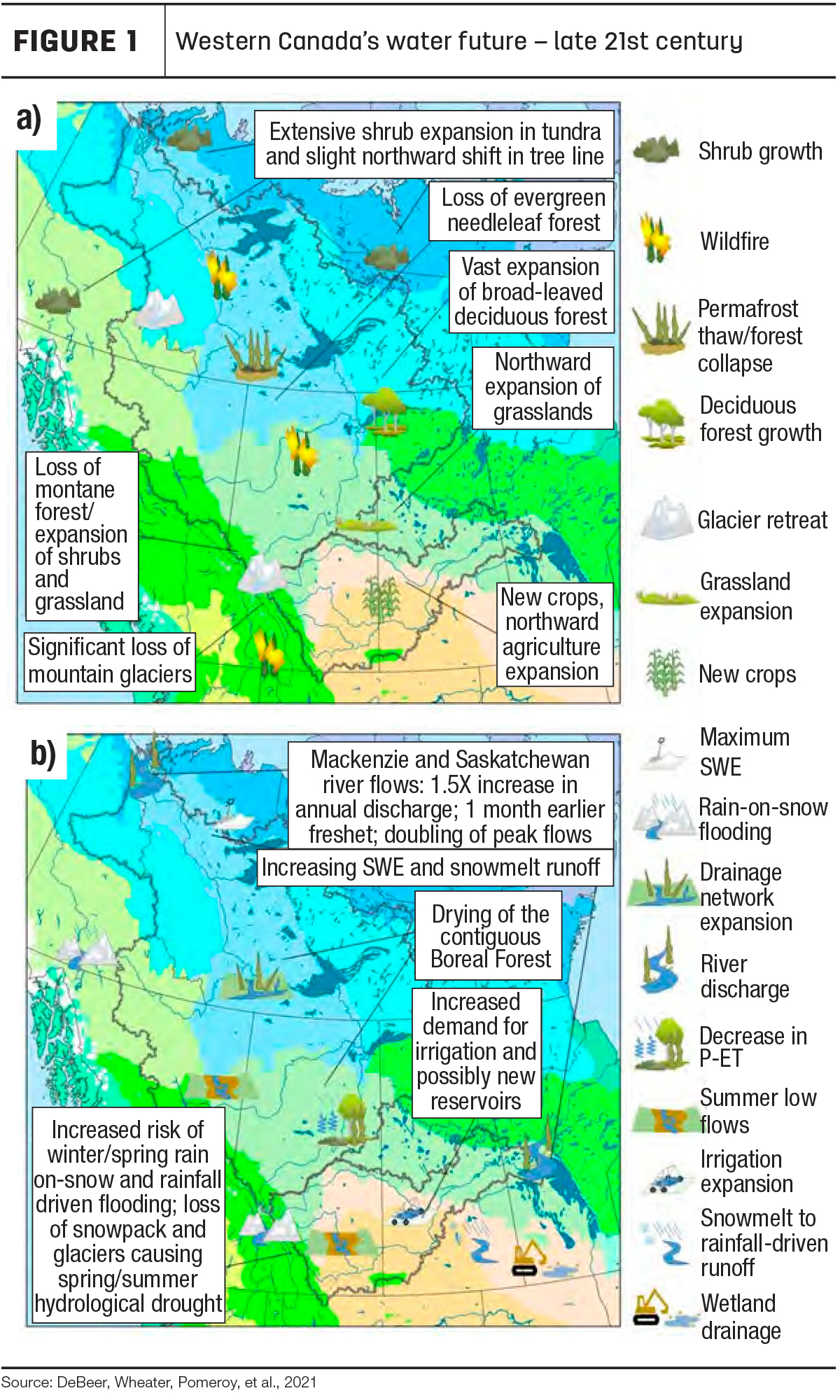
Pomeroy has closely mapped the continuing threats to western Canadian waters since 2021, and closely observed warming temperatures allowing a spread of grassland and other hydrological trends (see Figure 1). From shrub and broad-leaved deciduous forest expansion in the northern prairies, to wildfire along southern British Columbia and northern Alberta, patterns in the past 10 years are showing a vegetation growth that creates lower snowpack and earlier melt off of rivers due to warmer temps.
Glacier retreat
Those who visit Athabasca Glacier know it’s a longer walk than in previous years, Pomeroy noted. “There are new crops on the prairies in some areas, with grassland expansion in others, particularly the Palliser Triangle, where drier areas are getting wetter.”
Other factors to include as water risks are recent wildfires that burned the boreal forests, increased irrigation demand and need for new reservoirs to handle the loss of snow and ice, and the growing risk of rain on snow in the winter.
Global Water Futures observatories have primarily utilized instrument sites along the Mackenzie, Saskatchewan-Churchill-Nelson, Yukon and Great Lakes/St. Lawrence river basins to detect freshwater warning systems in a variety of geography settings. One leading indicator, however, is the Canadian Rockies Hydrological Observation sites stretching from Jasper National Park down to lower elevation spots below Banff National Park. These mountain sites are seeing accelerated declines in glaciers and ice fields.
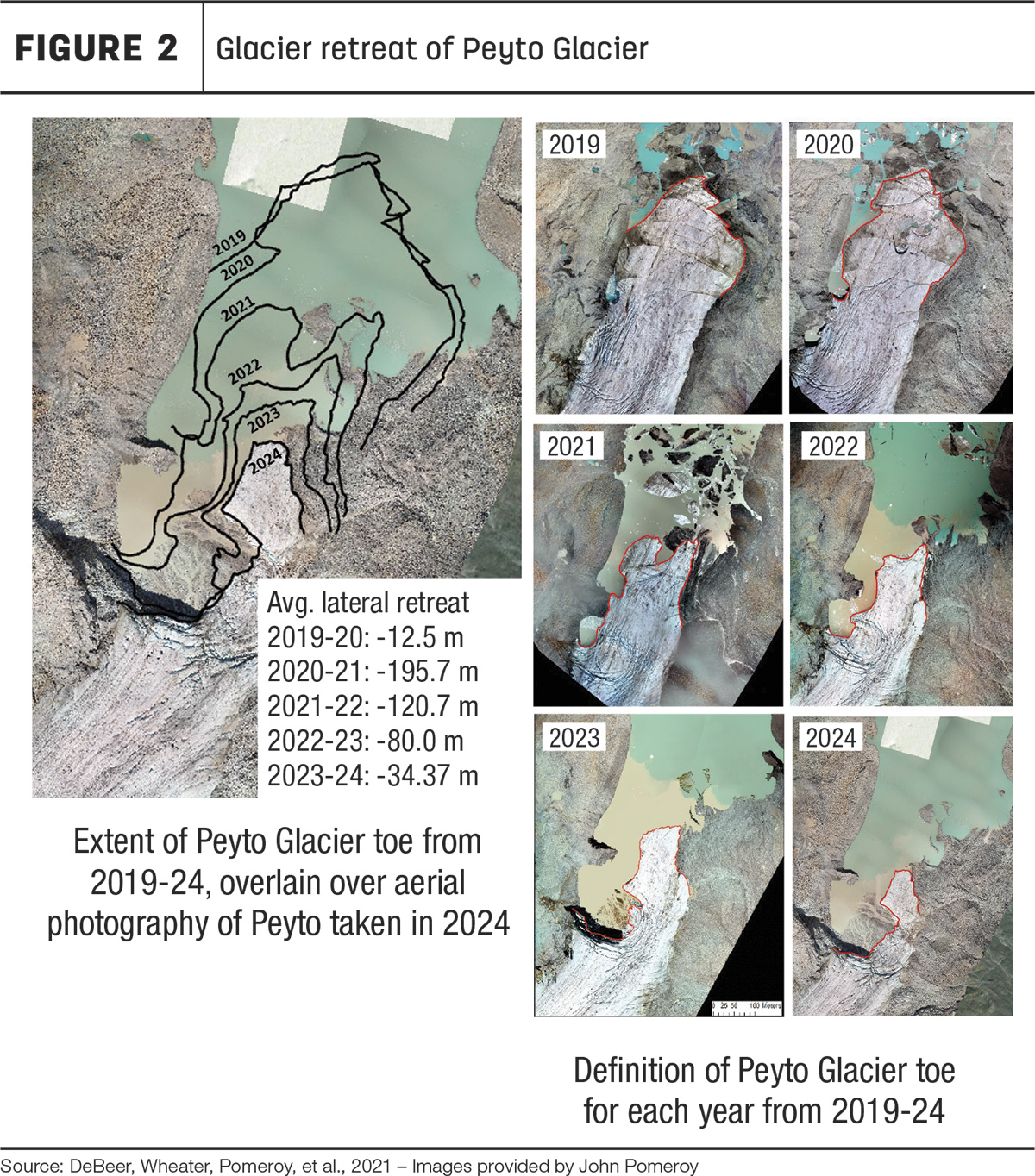
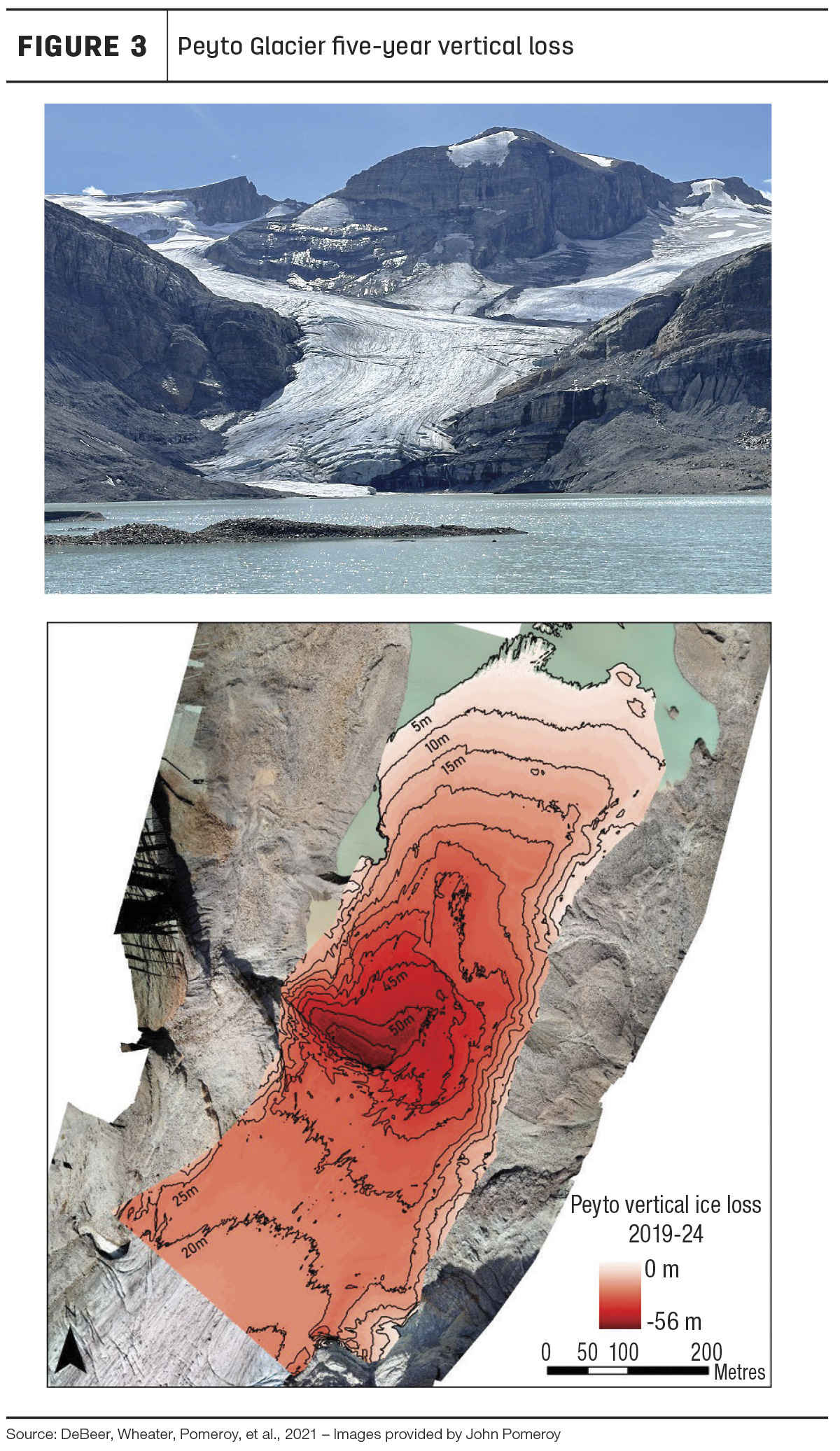
Pomeroy said melting glaciers are adding to irrigated districts in Alberta and the Mackenzie and Saskatchewan river systems at a higher pace, but that won’t last long. Peyto Glacier, which has records going to 1897, has retreated over 2 kilometres from the 1950s and retreated 450 metres in the past five years (see Figures 2 and 3). “It’s also melting downward at an incredibly fast rate,” Pomeroy said.
“It’s our canary in the coal mine and that canary is looking pretty ill. I think it’s going to be dead this decade. I don’t think Peyto Glacier will survive past 2030 in any recognizable form. It’s suffered badly.”
River runoff and precipitation
Meltoff may be sending more water to the northern Saskatchewan River, but it won’t last. Snowpack levels continue to decline, and warming in the entire Canadian west has gone up 3 degrees, twice as fast as the 1.5 degrees the rest of the world has seen since preindustrial levels. From the headwaters of the Saskatchewan and down to the Red Deer, Bow River and Oldman rivers, the water runoff drives the economy for cities such as Calgary, Edmonton, Red Deer, Medicine Hat and Saskatoon and the models suggest “we’ll see temperature change to the end of the century," he said.
Pomeroy said models predict a warming of 5 to 6 degrees to the end of the century, with much of the warmth hitting in winter and summer periods being “quite substantial.”
“It will take our climate into situations that we’ve never experienced,” he said. “Imagine 2023 as a normal year. That’s kind of what we can expect.”
While precipitation models look especially dire for the globe and the U.S. in particular, Pomeroy said data predict “it’s better for [Canada].”
Precipitation could be strong in winter months, with 15% to 20% increases in some areas. But expect fluctuating precipitation, with much of that being rainfall, not snow. “Rainfall is fickle, it’s unreliable. Snow builds up steadily over winter.” Pomeroy added that the rains will occur earlier in the year as climate change continues, with substantial increases in the trend toward the latter half of the century.
Irrigation demand will increase across the prairie and farming provinces through the rest of the century, he predicted. The senior appropriation process will require more storage and more groundwater pumping, which Pomeroy said needs improvement upon the modeling of aquifers done in the U.S.
Some positive notes
Pomeroy said that until 2010, Saskatchewan experienced a direct correlation between precipitation and wheat yield that made drought the driver of production. But in the past 15 years, the two are dividing and wheat yields are going up, even as temperature rises. He credits that to improved agricultural methods, minimum tillage when the industry moved away from summer flow rotation in Saskatchewan. More crop varieties were introduced, application of fertilizers also helped, with some lucky snowfall seasons with good snowpack management.
By leaving crop residue in place to reduce spring evaporation, crop growth was able to expand.
He also credits Canada for remaining committed to environmental policies keeping coal emissions from getting out of hand, unlike the U.S., China and India. But the trendline from a global perspective does not look good.
“What I'm showing is if the world doesn't get its act together, that's the situation we could be in. But I am still hopeful that we will get our act together, that our technologies will improve.”
By finding ways to generate energy, sequester carbon, the situation toward the mid- to latter half of the century show improvement.
Models obviously can be wrong, Pomeroy noted. Hydrological and climate models have errors, something scientists readily acknowledge and work to rectify. But the overall picture of the GWF study is showing data that doesn’t appear to waver in the outlook.
"The biggest concern I have is the decline in summer rainfall that goes along with a great increase in summer heat. This will challenge dryland farming in the Canadian Prairies and require more active trapping and retention of the winter snowpack to promote recharge of soil moisture in the spring."
To see slides of Pomeroy's presentation, click here.