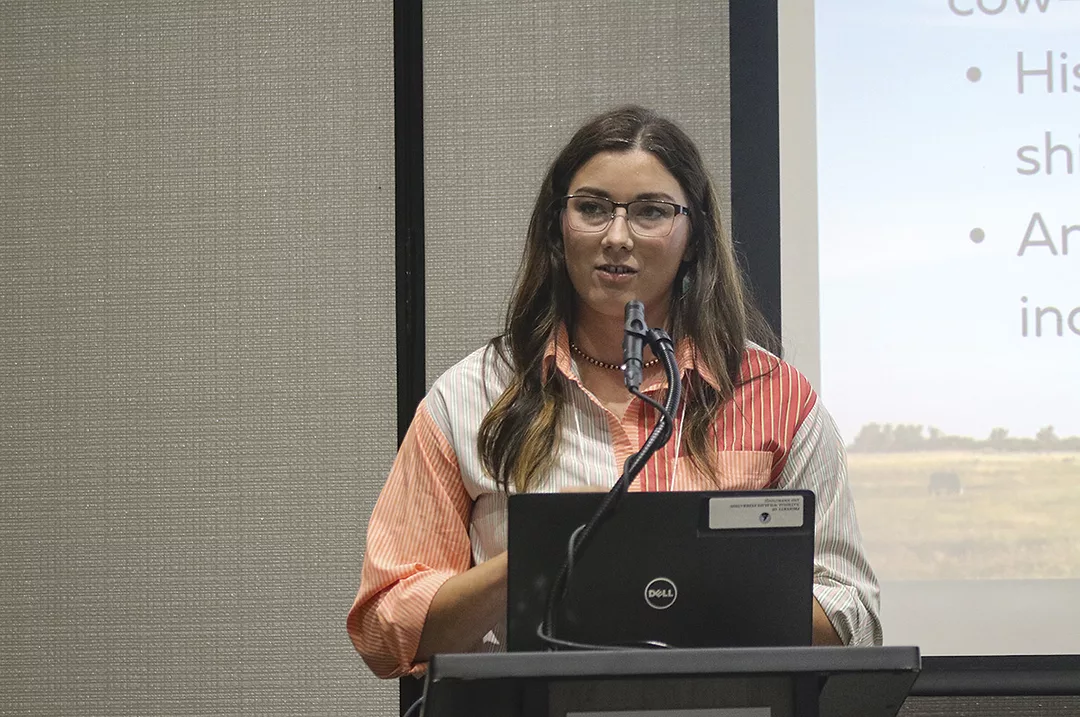
With grassland availability in the Northern Prairie region at an all-time low, producers need to turn an eye to long-term conservation practices to keep their operations safe for the next generation. Mindy Anderson from the Saskatchewan Stock Growers Foundation (SSGF) spoke to a group of U.S. producers and conservationists at the America’s Grasslands Conference in Kearney, Nebraska, about the foundation’s efforts to start up a conservation easement program in Saskatchewan.

Why conservation matters
Saskatchewan sits on the northernmost edge of the Northern Great Plains. Currently, the province has less than 20% of its native grasslands intact due to disturbances from crop cultivation, urban expansion and energy resource development. On top of that, the remaining grasslands are located in areas where the soil types or topography make conservation areas challenging. The grasslands have also been fragmented, leading to rapid declines in habitat for grassland wildlife and species.
The majority of the grasslands in Saskatchewan are under private ownership, but there isn’t much of a support system in place for them. “The ranchers that steward these grasslands have very few programs in place to enroll in and protect the livelihood around ranching and around the volatile livestock markets,” said Anderson. “Crop farmers have a national insurance program to protect them in case of low markets and disasters. There isn't a national structure for ranchers yet in Saskatchewan or Canada.” She said it’s a question of how to incentivize landowners to keep their grasslands intact without the same protections that are included for cultivated land. Historically, that is done through a conservation easement – an agreement placed on land title that limits future development to maintain the land for ag use.
Anderson said there are multiple agencies in Saskatchewan that a landowner can work with to put an easement on their land. All these easements are currently perpetual and tied to the land title. She said ranchers were still hesitant to sign the perpetual easements. Much of the mistrust around conservation easements stems from a lack of understanding about how they work, according to Anderson. Another factor is that many of these easements are funded by government agencies, so the concern over any strings being attached to the agreement is a top concern for many producers. “There's that fear of restricted land access or that maybe they will just completely open up land access to the public,” said Anderson. “And then, of course, a rancher never wants to be told what to do or how to manage their land, so there's that thought in the back of their head that someone who's never managed that land before will be dictating how and what they should be doing.”
Perpetual conservation easements are the gold standard practice in both Canada and the U.S. The SSGF has developed another option: term conservation easements. Term conservation easements are set up to cover a certain amount of time instead of in perpetuity. “They're still put into place to protect that biodiversity and ecological function of the grasslands, while providing flexibility for the landowner to make changes down the line if need be,” explained Anderson. “Like a perpetual easement, they're still tied to the land title and can transfer with ownership over the length of that term, and the landowner still retains ownership and control over access and management of their lands, so they can still sell, gift or will that properly if they like, but the future landowners are still subject to those restrictions for that term length.”
Though it varies by operation, the term conservation easements are currently set for a term of 25 years, with the opportunity to extend up to 40 years or, once the term is up, the landowner has the option to renegotiate or do away with the easement. “We're hopeful that the renegotiation process of these term easements can hopefully help to break down barriers, maybe with that junior generation coming up and taking over that landscape,” said Anderson. “It's an opportunity for that next landowner to see value or money in grassland conservation programs.”
The process
The foundation creates a baseline report that outlines the current range health at the time the easement is established. The goal is to maintain that property, ideally in that current health, or to improve it. Barring uncontrollable events such as natural disasters, the idea is to work with the landowner to practice good range management, while still allowing haying and grazing. “Communication is key with the landowners, really making sure that they understand all the implications and the process along the way.”
The easements include three restrictions: No break – no cultivation, breaking, plowing, drainage of existing waterways, etc. The only exception is to develop water sources for livestock; no building additional structures or roads; and no extraction of surface materials like oil, sand or gravel.
The landowner is paid fair market value, with payouts based on 24% to 30% of what a landowner would receive for a perpetual easement. Fair market value is roughly $1,100 per acre in Saskatchewan, so the payments can range from $75 per acre up to $220 per acre.
The SSGF is a young agency, only founded in 2020, so their funding is limited, and their five-person team is hard at work looking for solutions for producers. They recently established the first-term conservation easement in Saskatchewan and possibly in Canada. There has been a lot of interest in the term conservation easement program, which has kept the team hard at work completing assessments and reports, as well as keeping up with other SSGF programs. Anderson hopes the term conservation easements will eventually be recognized by the government's Ecological Gifts Program for a tax benefit.