Speckle Park cattle may get attention for their colourful appearance, but it is their ability to thrive in a variety of climates and feeding regimens that really make them popular.

“We are the fastest-growing breed of cattle [in Canada],” says Ciara Mattheis, the registrar and business manager of the Canadian Speckle Park Association.
Although Mattheis means that the number of Speckle Park is growing, this breed is also renowned for its ability to gain quickly and have an efficient feed conversion.
“They are smaller-framed cattle, and they have a high-quality carcass,” says Mattheis, noting that while adult Speckle Park cattle have typically had a live weight of 1,000 to 1,200 pounds, that range is probably now closer to 1,200 to 1,400 pounds.
Their appealing looks certainly don’t hurt, either.
“The joke is that most farmers get into Speckle Park because their wives think they are pretty,” says Mattheis. In fact, the association recognizes four different colour patterns as acceptable for registered Speckle Park: white with black points, resembling the White Park breed; leopard, with black spots on a mostly white coat; speckled, with more black with a white topline; and solid black.
Historically, the breed was created in Canada by crossing Shorthorn, Angus and White Park. Their popularity in Canada is well established, and now the breed is gaining traction in the U.S., with an American Speckle Park Association based in Missouri.

Producers have found that Speckle Park cattle can thrive in both harsh and mild climates. Image provided by Kevin Rioux.
Mattheis also notes that although there are some large herds of Speckle Park in the Prairie provinces, many of the people who keep the breed are smaller operations.
“In a way, they are geared towards smaller operations,” she says. “A lot of the farmers with this breed direct-market beef.”
Peter Watson of Ontario may have the largest herd of Speckle Park in that province. With roughly 100 breeding females, Watson’s operation is not large by many standards – yet he attributes the success of his ranch to the traits of Speckle Park cattle.
“They are pretty easy keepers,” he says.
Watson notes that the breed has recently been exported to such distant places as Ireland and Argentina. Their greatest numbers are still in Canada, however. He compares the attributes of Speckle Park to beef cattle in the mid-20th century. Back then, beef cattle were of moderate size, gained efficiently, and were hardy and thrifty. “They lost those qualities,” Watson says, referring to some more modern strains of beef cattle.
Speckle Park, recognized as a distinct breed in 2006, touts itself as a modern breed, carrying successful traits well into the 21st century and beyond. Watson predicts that Speckle Park will only become more popular in Canada and elsewhere. Christine Pike, an early Speckle Park breeder, compiled a book called The Cow that Jumped over the World, detailing the history and origins of the breed, which was published in 2020 to much acclaim in the Canadian beef industry.
Mark Nolin of Octave 40 Ranch in Bar Head, Alberta, emphasizes that carcass quality is a key trait of Speckle Park cattle. Octave 40 Ranch’s website states that the breed’s high-conversion carcass is made up of up to 61% to 65% meat. The website also emphasizes that the marbling and tender flavour of the meat drives demand wherever Speckle Park cattle are raised.
“They are the only fully Canadian beef breed in the world,” says Nolin, his voice full of national pride.
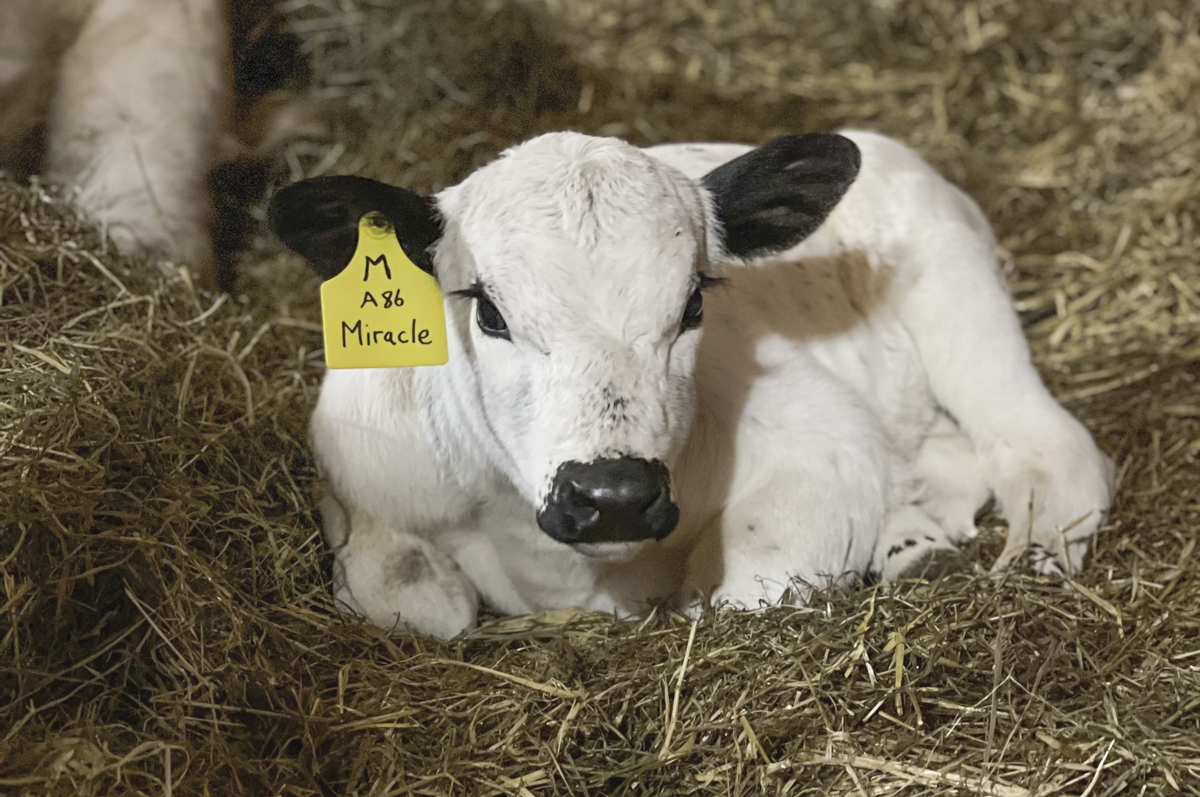
Since receiving official breed status in 2006, Speckle Parks have gained a reputation for easy calving and good maternal instincts. Image provided by Starla Hoffe.
And they fit into the landscape of his Alberta ranch quite well.
“The landscape is very varied here,” says Nolin, adding that the ranch has both good agricultural land and land best suited for pasture. “That lends itself to smaller herds.”
Octave 40 Ranch’s business model is to sell males and culls as beef and bred females as breeders to other ranchers. So far, demand is high. With beef and cattle prices at all-time highs for a variety of reasons, Octave 40 Ranch is doing well, like many beef producers across Canada.
“A lot of people thought we were crazy,” says Nolin, referring to his decision to sell some grain land in southern Alberta in order to ranch. Like any agricultural enterprise, the future is hard to predict. “[The question was], is it sustainable? … But we sold out last year.”
Kevin Rioux raises Speckle Park near Danville, Quebec. Although he has only been raising Speckle Park cattle since 2018, once he starts talking about the breed, his enthusiasm for these cattle is obvious.
“They have really good fertility, and they calve really well,” Rioux says, emphasizing that they are low-maintenance animals. “In general, they are really smart, and they’re easy to deal with.”
It’s the quality of the meat that makes Speckle Park fit into Rioux’s business plan, though. Although it may not have the same marbling that other breeds boast of, Rioux believes that the Speckle Park beef excels in quality.
“It’s just naturally tender,” he says. “They have really good steaks.”
While some other breeds may have outstanding steaks but overly fatty ground beef, Rioux says Speckle Park beef is high-quality in every cut.
Rioux aims for animals that gain 100 pounds per month and are 1,000 pounds on the hoof at 16 months. Rioux does his own A.I. and also has worked with embryos in order to build his herd, which currently is roughly half purebred Speckle Park and half commercial cattle. He says he hasn’t done too much marketing, but the demand for beef is great anyway.
“It just kind of builds itself after a while,” he says of his direct-to-consumer business.
With its interesting history and enthusiastic breeders, Speckle Park cattle are bound to play a significant role in the future of Canadian beef.