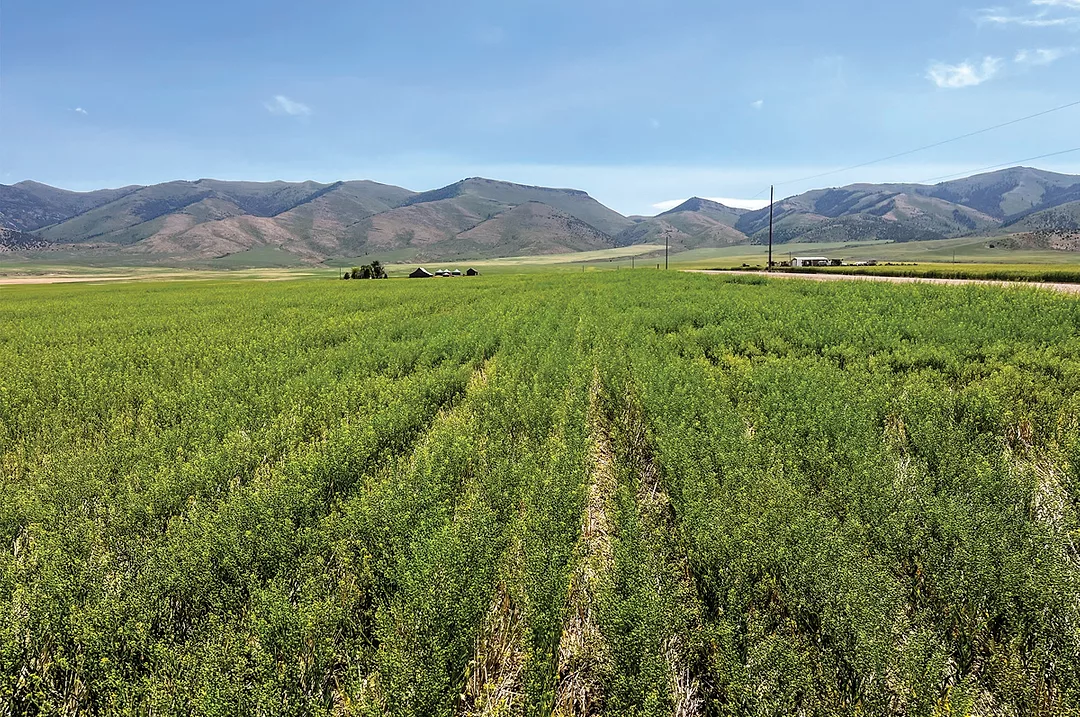
A profitable, drought-tolerant crop can be a welcome addition to a dryland rotation in the arid Intermountain West. Particularly following a push for clean fuels created by the U.S. Energy Policy Act of 2005, camelina (Camelina sativa) entrepreneurs have been making the case for expanding acres of this oilseed.

The incentive behind the push for camelina, says Oregon State University (OSU) Extension Soil Scientist Dr. Don Wysocki, is in the carbon intensity score, which describes “the amount of carbon that goes into production of that crop.” One metric included in the calculation is indirect land use, or whether it is displacing another crop. “It was identified that camelina is being grown in place of fallow,” Wysocki says. With that assumption built into the mathematical model, camelina has a very low carbon intensity score, and that makes it attractive for low-carbon programs and policies.
“It’s a low-hanging fruit for carbon intensity,” says Wysocki. When it comes to alternate fuel sources, camelina has a higher government incentive than any other crop. “The only thing with a lower carbon intensity score and higher incentive is used cooking oil,” he says.
‘Unused ground’
Growing a broadleaf crop in a fallow year is not a new idea. “We have been replacing fallow with oilseeds for the last 30 years,” says Rockland farmer Cory Kress. Safflower, mustard and canola are currently incorporated into his small-grains rotation, and he has also grown flax and – as of 2025 – camelina.
The claim that camelina uses otherwise fallow fields “is not true all the time, but it can fit into that niche,” says Wysocki. It certainly is the case in Molt, Montana, for grower John McFarland. McFarland has four years of camelina production under his belt and has scheduled it into his rotation with winter wheat and malt barley for the next several years.
“In the years that we would typically fallow, it works well to rotate into camelina,” he says. Inputs are similar to or lower than those required for winter wheat, and the producer can bring in a return that he wouldn’t see on unseeded acres. Camelina also has the advantage of opportunities for government incentives, due to that low carbon intensity score.
Although camelina requires a relatively clean field because broadleaf weed control options are limited, it does give some different grass weed control options to growers like McFarland who are concerned about preventing herbicide resistance. It also puts up a competitive stand and has the benefit of using soil nutrients different from the way grains do, improving nutrient availability for the next crop.
Then, too, McFarland says, the logistics are compatible with his operation. “It doesn’t require special equipment outside of what I use for planting and harvesting winter wheat.” He has some special combine sieves to improve cleaning of the alfalfa-sized seed, but he says, “Growers don’t have to do that – you can get away with wheat sieves.”
Furthermore, he is able to haul the camelina to the same elevator that takes his wheat. “If we have an area with enough grown – at least one railroad car full – we’ll work with growers for delivery points,” says Virginia Knerr of Sustainable Oils Inc., the company with which both McFarland and Kress have worked, and which is seeking interest in camelina production in other areas, including in Idaho. Sustainable Oils provides the seed, then contracts with the growers to buy back everything produced.
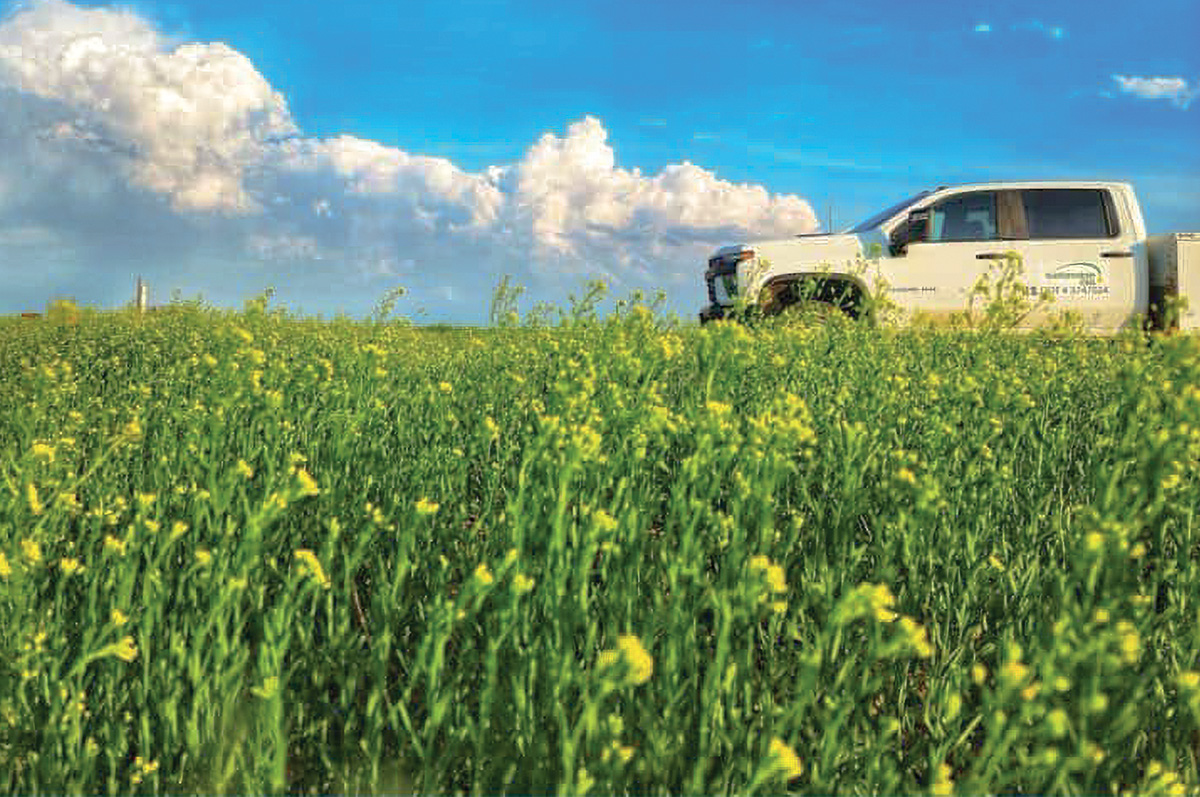
When well established, camelina can be quite competitive against weeds. Image by Virginia Knerr.
Destination: Energy
Camelina’s history as a cultivated crop goes back thousands of years, and it has been used for everything from cooking to lantern oil. Even today, says Knerr, “Markets tend to be different around the world.”
In the U.S., human consumption of camelina oil is limited. Some researchers have been exploring different uses, including natural fibers and oil, since the early 2000s, but interest waned and then resurfaced again in the last decade. Now, camelina is typically used for renewable diesel, particularly sold in California. The camelina seed contracted by Sustainable Oils Inc. is shipped there and processed in a Bakersfield refinery. The byproduct, protein meal, is used for animal feed.
Under the Climate-Smart Commodities program, Grapevine Energy Holdings (the parent company for Sustainable Oils Inc.) was awarded a $30 million grant in 2022 “for a pilot project to measure and validate the advantages of camelina as an ultra-low carbon renewable fuel feedstock,” according to the company’s press release. That grant allows Sustainable Oils Inc. to contract with camelina growers and to provide incentive payments and free seed to their growers.
“It could move into the food chain,” says Wysocki, “but if you’re growing it for fuel, you don’t really want to see that because then you move into the food vs. fuel debate.”
Camelina proponents’ success in bypassing this debate, at least for now, is one reason it is considered desirable for renewable diesel production. Another reason is the oil itself. “It’s a cleaner oil,” says Knerr, comparing it with seed oils such as canola and soy. “This stuff can go in with minimal processing.”
As far as oil yield, says Wysocki, “Camelina oil percentage is in the mid-30s, with variation based on variety.” Mustard seed has a similar oil composition. Canola yields about 45% oil, and soy, for which oil is a byproduct rather than the primary product, yields about 20% oil.
Typically, Wysocki says, a farmer can expect to harvest 50 to 75 pounds per acre per inch annual rainfall. “I’ve experienced everything from 750 to 800 pounds to 1,300 pounds,” says McFarland.
Of course, rainfall timing also matters. “It is an indeterminate plant, so if you have late-season moisture, it keeps growing,” says Knerr. In fact, growers sometimes need a desiccant before harvest.
Is Idaho next?
With a short growing season, frost and drought tolerance, indeterminate growth pattern, competitive stand and both winter and spring varieties available, there is no doubt that camelina is a versatile crop. Whether it is the best crop for any given operation may depend on the area.
As a replacement for fallow, it seems to need a relatively narrow precipitation window. “If you have very low rainfall, it might not be feasible,” says Wysocki. “If very high, you don’t need to fallow.”
It may still be a rotation option for producers who do not fallow, however. Then, too, further experimentation may demonstrate opportunities for other niches, such as double-cropping with soybeans. “It’s more frost-tolerant than most crops out there,” says Knerr.
There is still work to be done on finding the regions where different varieties grow best. In Power County, Kress was underwhelmed by his 2025 spring camelina crop. “We got about a third of our spring canola yield,” Kress said in mid-August, “and we haven’t harvested safflower yet, but I’d estimate about a quarter of our spring safflower yield.”
But with heavy incentives from the sustainable fuel sector, adventurous growers in target areas may find now to be a profitable time for camelina experimentation.