Sulfur (S) is one of the most important nutrients for plant growth, and deficiencies can potentially reduce crop yield and quality significantly. Deficiencies are being diagnosed more frequently and often attributed to intensive cropping systems causing higher S removal rates, environmental protections reducing atmospheric deposition, and more concentrated fertilizers containing less S. With the potentially high costs of fertilizer application, accurately diagnosing and addressing S deficiencies is critical for profitable crop production.


Sulfur fertilizer recommendations are typically based on soil tests measuring plant-available sulfate and a “critical value” where fertilizer application should increase yield. In the western U.S., critical S soil test values (STV) range from 8 to 15 parts per million (ppm) and recommended rates from 10 to 60 pounds of S per acre. Utah State University (USU) currently recommends 10 to 20 pounds of S per acre when soil tests indicate less than 8 ppm sulfate-sulfur (critical STV). Most fertilizer recommendations are based on decades-old research, which prompted this USU study to assess current guidelines and determine if recommendations should rely solely on soil tests or include other crop and soil factors.
On-farm sulfur trials
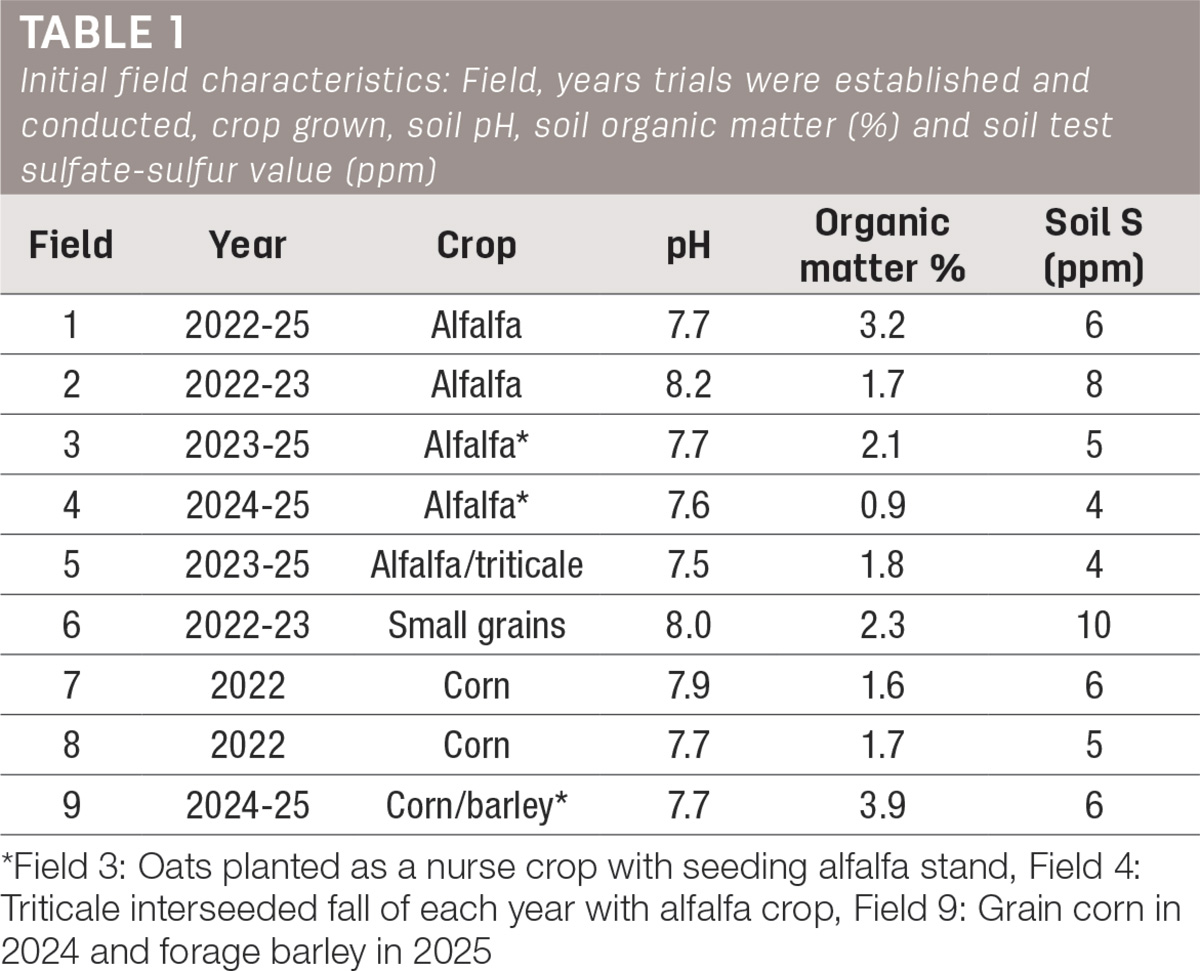
USU Extension established an experiment on nine commercial farms in Utah in corn, alfalfa and small grains from 2022 to 2025 to evaluate current USU sulfur fertilizer recommendations.
Soil samples to 12 inches were collected from each field and rates of 0, 7.5, 15 and 30 pounds of S per acre were applied using sulfate of potash (0-0-50-17.5). USU guidelines directed fertility needs for nutrients other than S to ensure none were limiting, and muriate of potash was used to balance K2O rates across treatments. Each year, sulfur treatments were reapplied, and soil samples (0-12 inches) were collected from each plot to assess changes in soil S. S treatments were evaluated based on crop impacts, soil S and fertilizer costs.
How did these treatments impact crops?
Alfalfa
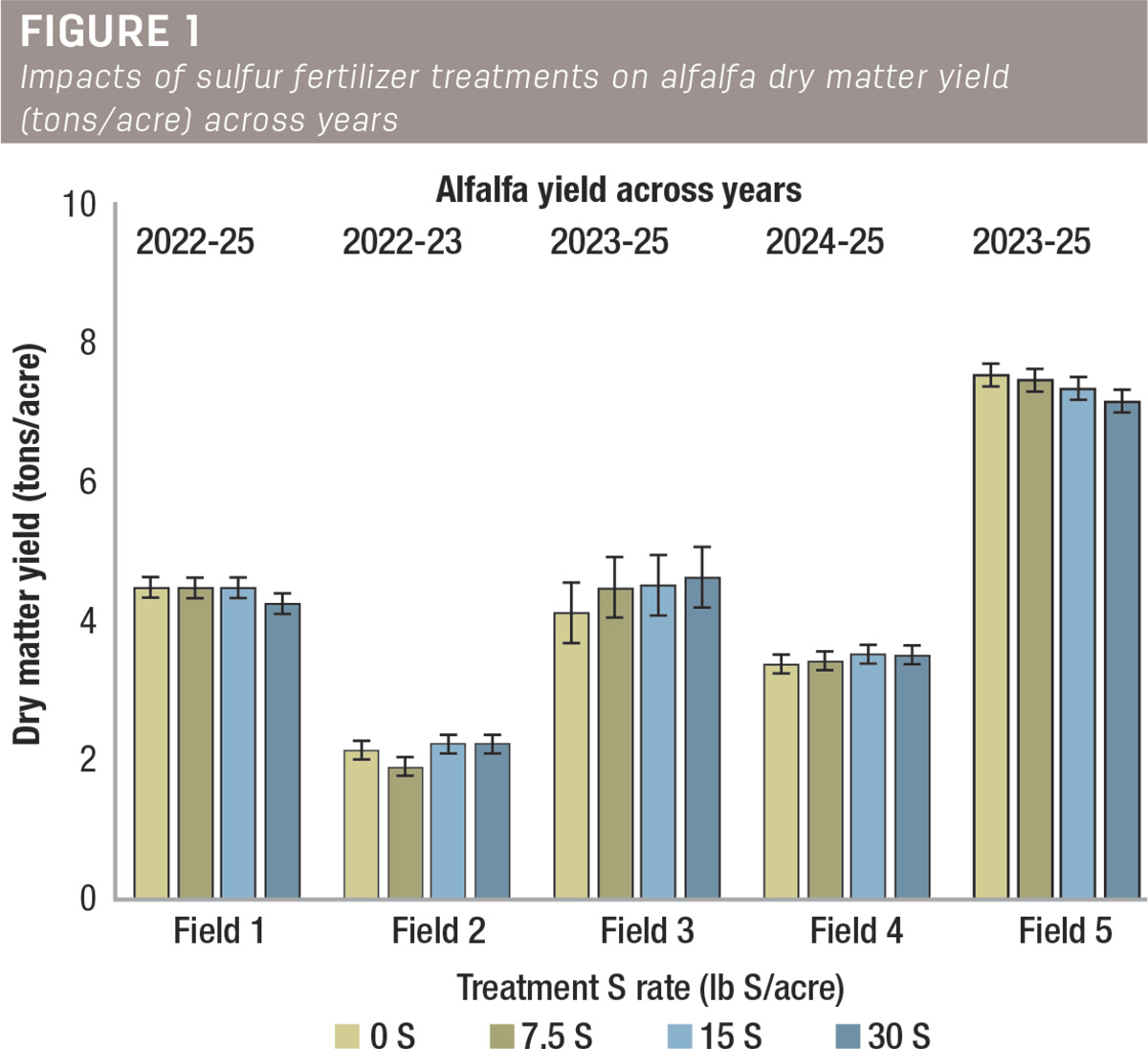
Sulfur fertilizer applications did not impact yield at any of the five alfalfa fields (Figure 1). Alfalfa market value for fields 1-4 was determined using USDA hay-quality designation guidelines, with most cuts being Supreme-grade forage. Out of 31 cuts evaluated, S fertilization improved market value at two cuts and decreased value at one, but differences in quality metrics were not statistically significant. The first cut of field 5 was predominantly triticale and had lower forage quality than following cuttings, which had greater than 21% crude protein (CP) for all treatments.
Small-grain forage
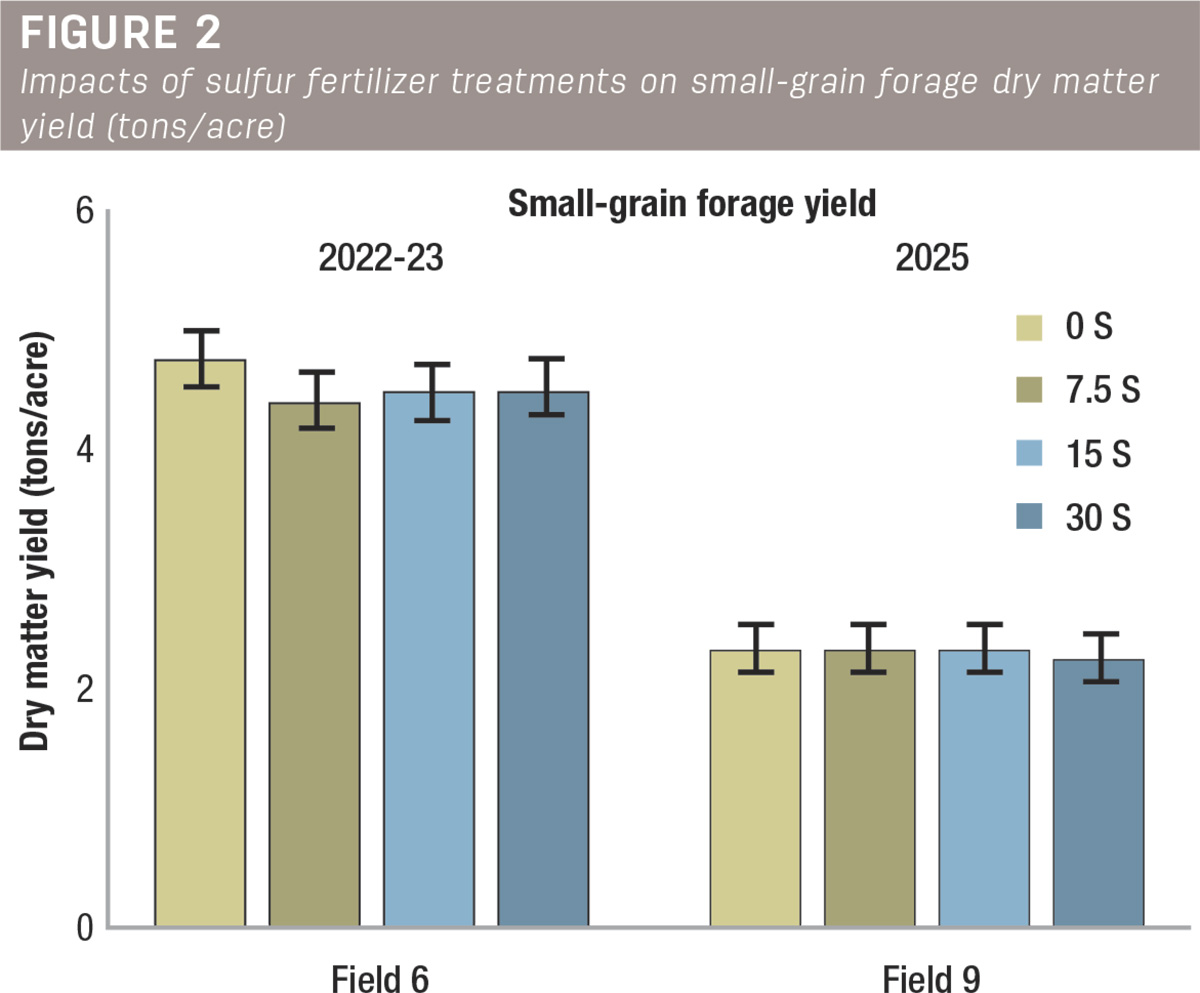
Sulfur applications did not affect yield or quality at either small-grain forage field (Figure 2). At field 6, CP ranged from 10.8% to 11.5%, and forage total digestible nutrients (TDN) and relative feed value (RFV) averaged 59% and 128%, respectively. Field 9 was similar, with CP ranging from 11.9% to 13% and TDN and RFV averaging 63% and 149%, respectively.
Corn
All treatments produced similar yield and forage quality in silage and grain corn. All treatments yielded within 1 ton per acre of the nonfertilized control at the two silage corn fields.
Impact of fertilizer treatments on soil sulfur
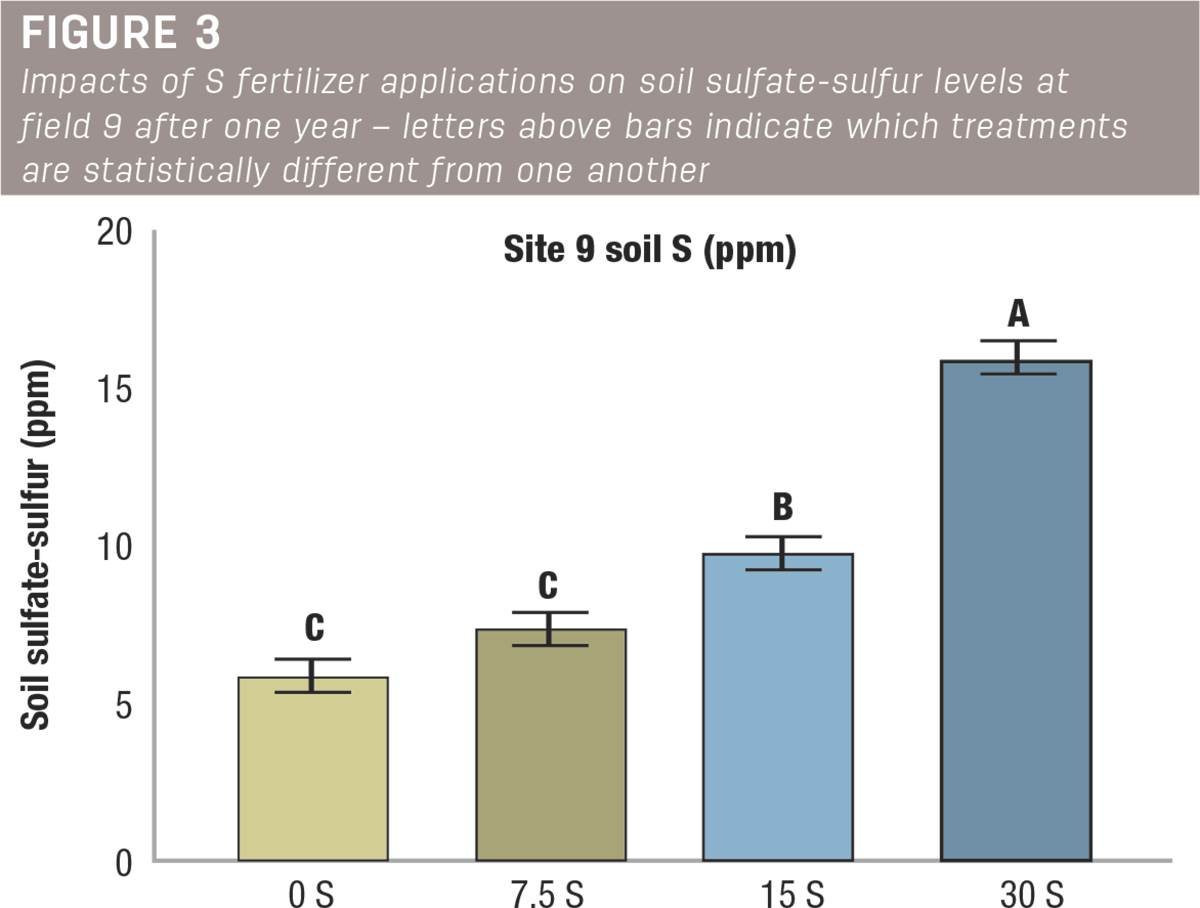
S rates increased soil S levels in two fields, but changes were not consistent with increasing S rates. At field 5, the 30 pounds of S per acre rate had higher soil S than the control and 15-pound rates but did not differ from the 7.5-pound rate. The 15- and 30-pound rates increased soil S after one year compared to no fertilizer at field 9 (Figure 3). At the other five fields sampled after one to three years of fertilization, soil changes were similar for the control and S treatments.
Fertilizer costs vary depending on the source and rate, but these results indicate that S application is not always profitable. Using sulfate of potash as the source, treatments in this study ranged from $24 to $94 per acre, but fertilizer costs were not justified by increased yield or quality.
Why did crops not respond to S fertilization?
Soil testing cannot always diagnose sulfur deficiencies accurately, making it difficult to know if fertilization will be beneficial. A USU Extension survey of paired soil and tissue samples from commercial alfalfa fields deemed 67% of fields as S-deficient from soil tests but none using tissue results. Soil test S variability from analysis methods can also be significant, with an average variation of 62% observed from 21 soil samples sent to three soil testing laboratories in another USU study, which is consistent with similar studies nationally and globally. Variability in soil analysis methods coupled with inaccuracies when estimating plant-available S for predicting yield response to fertilizer indicates that fertilizer guidelines should consider other factors besides soil S. Deeper soil samples (to 2 feet) were evaluated at several fields in Utah and in an ongoing study in Montana. The relationships between soil S and crop response to fertilization have sometimes improved with this approach, but more assessment is needed.
There are also external sources of S that can satisfy crop nutrient needs. Irrigation samples collected in this study ranged from 6 to 168 ppm sulfate, which is roughly 17 to 456 pounds of sulfate per acre-foot of water applied. Many crops receive 2 to 4 acre-feet of irrigation in a growing season and can receive enormous amounts of S each year. Phosphorus fertilizers (e.g., MAP, DAP and TSP) can contain 0.5%-5% sulfate and supply adequate S if high rates are applied.
Where do we go from here?
Sulfur fertilizer applications of 7.5 to 30 pounds of S per acre did not impact the yield or crop quality of alfalfa, small-grain forage or corn at any of the 48 cuttings/harvests from nine fields in this study. Soil testing is not always accurate for diagnosing sulfur deficiencies or predicting yield response with S application, but using visual symptoms is risky because yield and/or quality loss has already occurred by the time they are visible. Fertilizers increased soil S levels at two of seven fields, but the rate of increase was often not consistent with increasing S application rates. Fertilizer guidelines may need adjustments to critical S levels and factors other than soil S, such as soil texture, soil organic matter or crop yield/removal rates incorporated. Growers should monitor fields with a higher risk of deficiencies closely to ensure that crop fertility needs are being met, and if deficiencies are suspected, use tissue testing for confirmation. Sulfur is a very important nutrient for crop growth, but applying S or adding S to fertilizer blends as “insurance” is often not worth the cost.