Protein is one of the most expensive nutrients in a dairy ration on a per-unit basis, and it is also one of the easiest places to lose money when diets are not balanced precisely. Feeding too little protein can limit milk production and reduce revenue, while feeding too much protein increases feed costs without necessarily improving performance. In both cases, the result is the same: dollars left on the table. As feed and milk markets are volatile, understanding the economic consequences of protein underfeeding and overfeeding becomes increasingly important for protecting margins on dairies.



One way producers and nutritionists evaluate feeding decisions is through income over feed cost (IOFC), which relates daily milk revenue to daily feed cost on a per-cow or per-pen basis. IOFC captures the combined effect of production response, milk price and ration cost, making it a practical economic metric for evaluating whether changes in feeding strategy actually improve profitability.
Protein feeding decisions are often made conservatively, sometimes with the assumption that slightly overfeeding protein provides insurance against lost milk. To evaluate whether this approach pays off economically, a controlled research study was conducted as part of a USDA-funded project. The study examined how feeding protein below, at and above current national recommendations affected milk production, intake, milk income and IOFC. The “meeting requirements” protein level aligned with current national guidelines (National Academies of Sciences, Engineering and Medicine, 2021), which estimate how much metabolizable protein (MP) cows need to support milk production without waste. While prices reflect conditions at the time of the study, the biological and economic relationships observed remain relevant across price cycles and provide useful insight into the real cost of missing the protein target.
When protein was fed below requirements, milk income declined, reflecting a limitation on production potential. As protein supply moved closer to requirements, milk income increased from an average of about $22.04 per cow per day when protein was fed below requirements to $22.70 per cow per day when requirements were met. Although feed costs also increased over this range, the gain in milk revenue outweighed the additional feed investment, resulting in a higher IOFC.
The economic risk of underfeeding protein becomes clear when looking beyond averages. Feeding protein below the requirement reduced daily IOFC by about 20 cents per cow compared with feeding at the requirement. While this difference may appear small, it represents an important loss when multiplied across hundreds or thousands of cows and across an entire lactation.
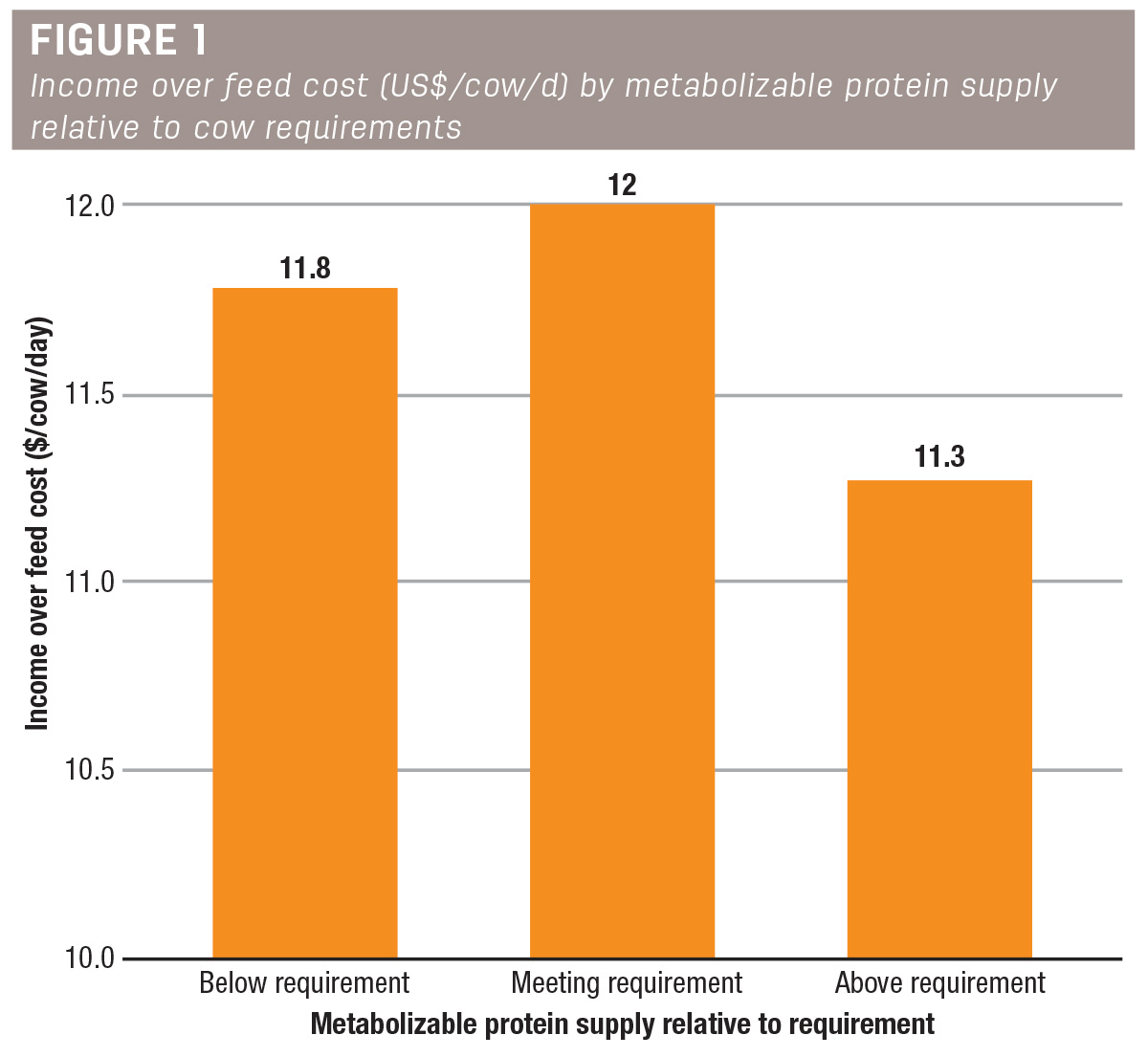
When protein was fed above requirements, feed costs continued to rise, increasing from about $10.70 to $11.25 per cow per day. However, milk income did not increase proportionally and, on average, declined. As a result, IOFC dropped, declining by approximately 70 cents to 75 cents per cow per day compared with the protein level aligned with requirements.
These results highlight a key economic risk of overfeeding protein. Excess protein did not provide a buffer against lost milk production; instead, it increased ration cost without improving returns. Under the conditions of this study, feeding protein above requirements reduced IOFC more severely than feeding below requirements, emphasizing that overfeeding protein can be a costly form of insurance.
The highest IOFC was achieved when protein supply closely matched requirements as estimated by current national guidelines. This balance point maximized the return on feed investment by supporting milk production without incurring unnecessary feed costs.
Results from this study reinforce a simple but important message: Precision in protein feeding matters. Both underfeeding and overfeeding protein reduced IOFC, but for different reasons. Underfeeding limited milk revenue, while overfeeding increased feed costs without delivering additional milk income.
From a management perspective, the economic penalties associated with missing the protein target can add up quickly. A difference of 20 cents to 75 cents per cow per day may not stand out on paper, but across a 1,000-cow herd, that represents $200 to $750 per day in lost margin. Over time, these losses can overshadow gains made elsewhere in the operation.
These findings do not suggest that producers or nutritionists should cut protein indiscriminately. Instead, they highlight the value of feeding protein as accurately as possible relative to cow requirements. Aligning protein supply with current recommendations offers the best opportunity to balance milk production and feed cost, particularly during periods of tight margins and market uncertainty.
Ultimately, protein should be viewed not as a safety margin but as an investment. Like any investment, its return depends on how precisely it is managed.
This work is supported by the Agriculture and Food Research Initiative – Inter-Disciplinary Engagement in Animal Systems, project award no. 2024-68016-42391, from the U.S. Department of Agriculture's National Institute of Food and Agriculture.