As water resources become increasingly scarce in southern Idaho, producers are looking for forage options that make the most of limited irrigation. One strategy gaining traction is planting fall-seeded annual cereals for forage. These crops – wheat, barley, triticale and, more recently, hybrid rye – offer several advantages over traditional spring-seeded cereals. Fall planting allows these cereals to establish before winter, providing soil cover that reduces erosion and traps snow, which can boost spring soil moisture. They also tend to use less irrigation water, mature earlier and often produce more biomass than spring-planted cereals. Additionally, depending on how early they are seeded, how mild the fall is and water availability, annual cereals may be lightly to moderately grazed during the tillering phase with little to no reduction in grain yield. For operations considering double-cropping with corn or dry beans, or for those facing drought conditions, fall-seeded cereals can be a practical solution.

While winter barley, wheat, triticale and hybrid rye offer important opportunities for farms in the Intermountain West, each crop comes with its own strengths and limitations. Winter wheat and triticale are generally the most dependable in terms of winter survival. Hybrid rye also handles the cold well under midwest U.S. growing conditions and produces high forage yields. Winter barley can provide excellent fall growth and is more palatable to grazing cattle than wheat, but it is typically more sensitive to harsh winter conditions, making variety choice especially important.
Soil moisture going into winter plays a major role in stand establishment and spring vigor. Fields seeded into dry conditions are more prone to winter injury and reduced yields the following year. In addition, crop insurance rules for winter cereals can influence planting and grazing decisions, since coverage varies by crop and may affect how growers manage risk in years with poor emergence or winterkill. Together, these factors make variety selection and management decisions critical, and they underscore the value of local trials that measure winter survival, yield potential and forage quality under Idaho’s conditions.
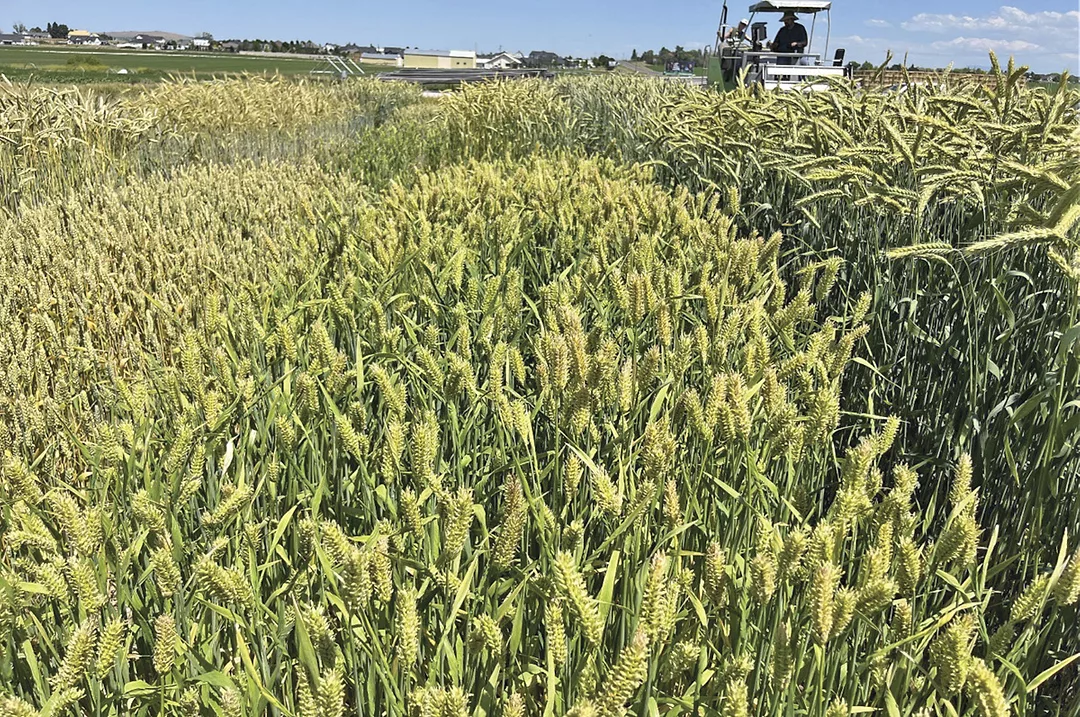
The University of Idaho Barley Agronomy program conducted a series of field trials in Rexburg, Aberdeen and Kimberly from 2021 through 2023. We set out to evaluate how different fall-seeded cereals performed in terms of forage yield, quality and winter survival under southern Idaho conditions. We evaluated multiple varieties of hooded barley (Hoody, Verdant), awnless wheat (Evina, WestBred 1621), triticale (Forerunner, Gunner, Surge) and hybrid rye (Aviator, Progas, SH-05, SH-06). We targeted seeding rates of 800,000 seeds per acre for hybrid rye (58 to 88 pounds of seed per acre) and 1,000,000 seeds per acre for barley (70 to 99 pounds per acre), wheat (82 to 107 pounds per acre) and triticale (58 to 108 pounds per acre). Planting dates ranged from late September (Rexburg) to early October (Kimberly), and each variety was harvested at the boot stages in late May to early June and soft dough stages in mid-July.
Timing of harvest is critical because forage quality declines as plants mature. Younger plants harvested at boot typically have lower fiber and lignin concentrations and higher crude protein (CP) content and relative feed quality. Despite lower forage quality, soft dough harvest maximizes tonnage while still maintaining “good” forage-quality hay.
Winter survival and stand establishment
Winter survival can be quite variable depending on the winter and soil conditions. Stand emergence and winter survival was excellent across all species and locations during the winter of 2021-22, but the winter of 2022-23 told a different story. Barley proved the least winter-hardy, while hybrid rye and triticale generally fared better. Varieties such as Aviator (hybrid rye), Forerunner (triticale) and WB1621 (wheat) maintained over 90% survival at most sites.
This difference in winter hardiness is a key consideration for producers. If your area is prone to harsh winters, hybrid rye or triticale may be safer bets than barley.
Yield performance
Hybrid rye consistently matured to the boot stage five to seven days earlier than triticale and about two weeks ahead of barley and wheat. Faster maturity can mean less water use and quicker turnaround for double-cropping.
At the boot stage in 2022, hybrid rye and triticale produced the highest biomass, averaging 1.5 to 1.7 tons per acre at Aberdeen and Kimberly, compared to 0.7 to 0.8 ton for barley and wheat. By soft dough in 2023, hybrid rye again led the pack, with Aviator yielding over 7 tons per acre, while wheat and triticale ranged from 5 to 6 tons. Barley lagged behind at 3 to 4 tons. Winter forage biomass production potential was greatest in Kimberly and least in Rexburg, likely due to Kimberly’s milder winters.
Forage quality
Quality is where barley and wheat shine. At the boot stage, they delivered the highest CP and relative feed quality. For example, in 2022, barley varieties at Aberdeen tested at 10% to 16% CP at boot stage, compared to 6% to 11% for hybrid rye and triticale. Relative feed quality followed a similar pattern, with barley topping 200, while hybrid rye hovered near 100.
However, these advantages diminish as plants mature. By soft dough, protein levels dropped sharply across all species, and differences narrowed.
Grazing potential
Although our study focused on harvested forage, we observed good regrowth in hybrid rye and triticale after boot-stage cutting. While a second harvest may not pencil out economically, this regrowth could support grazing – provided it occurs before heads emerge. The hybrid rye and triticale varieties we tested are awned, which can irritate cattle’s eyes and mouths, so timing and processing of biomass is critical.
Key takeaways for producers
- Match species to your goals: For maximum tonnage and early maturity, hybrid rye is hard to beat. For top-end forage quality, barley and wheat excel – especially at boot stage.
- Consider winter survival: Hybrid rye and triticale offer better winter hardiness than barley.
- Plan harvest timing carefully: Boot stage delivers the best quality; soft dough maximizes yield.
- Think about water and rotation: Faster-maturing cereals such as hybrid rye can reduce irrigation needs and open the door for double-cropping.
For additional information related to annual forage cereal production, please reach out to Dr. Jared Spackman, Dr. Pramod Archarya or your local county extension educator.
Disclaimer: Artificial intelligence tools were utilized to help edit the article for improved organization and clarity. The final content presented in this article has been reviewed and verified, and is the author’s original work.