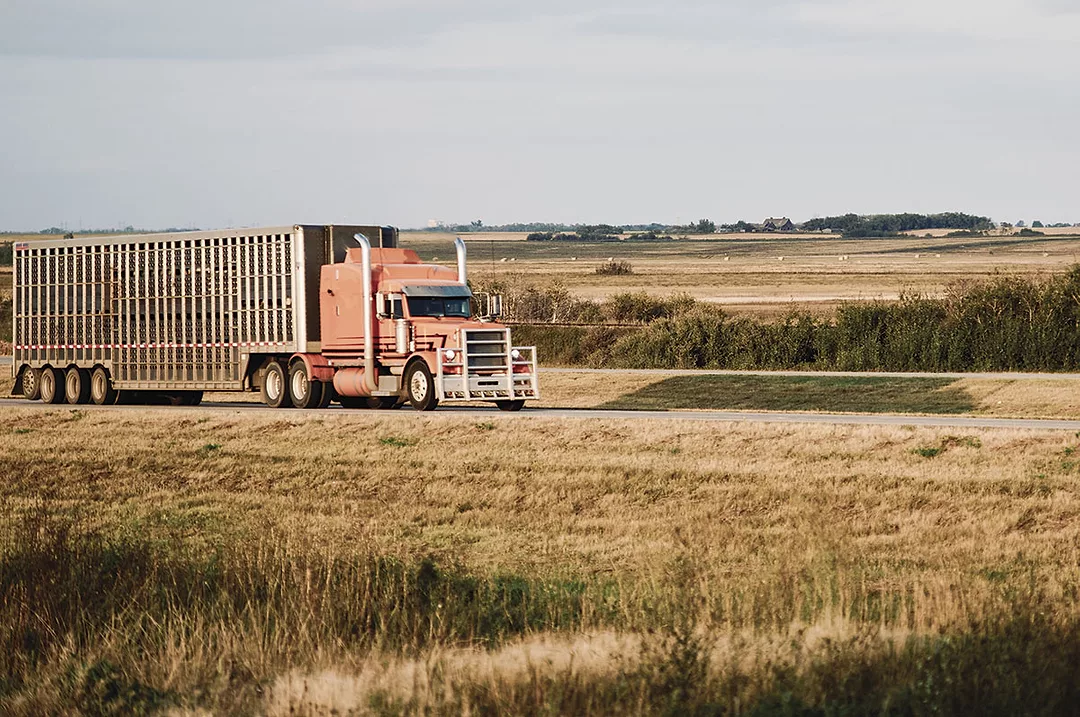
The Canadian Food Inspection Agency (CFIA) began enforcing its revised livestock transport regulations in 2022, which reduced the maximum travel time for weaned calves from 48 to 36 hours before a mandated break and increased rest periods from five to eight hours. Rest periods also needed to include the opportunity for calves to eat and drink. The changes were meant to improve animal welfare during transport.

A CFIA spokesperson explains the decision to set a 36-hour maximum limit for weaned cattle was driven by three primary considerations:
- Animal welfare concerns: Prolonged transport increases welfare risks; hunger can appear after 12 hours, fatigue by 16 to 20 hours and trips over 30 hours sharply raise the risk of injury and death. Limiting time without feed, water and rest (FWR) is essential to reduce suffering and mortality.
- Regulatory modernization and alignment: Canada’s former 48-hour limit was among the longest globally. Regulatory amendments modernized standards, aligned with science and international expectations, and reflected Canada’s geography and industry realities.
- Stakeholder consultations: Following extensive consultations, a 36-hour limit was adopted as a balanced solution to improve animal welfare, while allowing flexibility to accommodate the industry’s operational realities.
“The CFIA is a science-based organization using evidence to inform policy and regulatory decision-making,” the spokesperson says. “We welcome and continue to review all research on humane transport.”
Regarding the benefits of rest stops in comparison to the risk of added stresses and potential loading and unloading injuries, the CFIA states:
- Shorter transport times straight to the destination are best from an animal welfare perspective. Mandatory FWR stops are a way to reduce stress, fatigue, dehydration or injuries compared to allowing a single 36-hour journey.
- The CFIA recognizes that transport journeys are complex, with factors to consider for both drivers and livestock. Overall, the agency sees FWR stops as a compromise to protect animal welfare, while giving the industry flexibility to meet requirements.
- Loading and unloading cattle can be stressful with the risk of injury. These risks can also increase with the overall duration of confinement due to fatigue, nutritional deficits and dehydration. The CFIA includes rules for safe loading, unloading and break conditions.
What the research shows
Before the CFIA regulations were enacted, Karen Schwartzkopf-Genswein, principal research scientist with Agriculture and Agri-Food Canada’s Lethbridge Research and Development Centre in Lethbridge, Alberta, and her research team, including Daniela Meléndez Suárez, conducted a series of trials in 2018, 2019 and 2020 to examine the effects of transport on calf behaviour, health and overall well-being. Their studies involved 320 weaned Angus-cross calves ages 7 to 8 months that were subjected to varying travel durations (12 or 36 hours) and rest periods (zero, four, eight or 12 hours). Importantly, these calves underwent an introductory phase, receiving vaccinations and an 18- to 26-day acclimation to new feed and pens before the trials began.
The results were unexpected: The length of rest stops had minimal effect on the calves’ performance, health or recovery.
“We realized the absence of differences in our initial study was due to the conditioning we provided,” Schwartzkopf-Genswein explains. “Although the 18- to 26-day period didn’t strictly qualify as formal preconditioning, we felt weaning, vaccinating and getting the calves used to their new pens and feed helped ensure they were in good shape. As a result, additional stops didn’t have a noticeable impact on their health, performance or overall well-being up to 28 days after arriving at the feedlot.”
Schwartzkopf-Genswein says preliminary conditioning reduced the calves’ stress, making additional stops largely inconsequential. Further studies comparing conditioned and nonconditioned calves, including those purchased at auction markets versus directly from ranches, reinforced the finding that conditioning, not rest duration, was the decisive factor in calf welfare.
Even when researchers tweaked travel times following rest stops, the outcome remained the same. Rest periods and travel length after a break played a minor role. The most significant differences in welfare indicators were consistently found between conditioned and unconditioned calves.
A companion project led by bovine respiratory disease (BRD) expert Trevor Alexander used deep nasopharyngeal swabs collected multiple times from 12 rested and 12 unrested steers to measure the prevalence of different respiratory bacteria. The project found calves stopping at rest facilities showed a higher presence of pathogens linked to bovine respiratory disease, although no clinical BRD was observed. This likely relates to increased exposure in less-controlled environments. These findings, which combined results from two trials, suggest stopping for breaks may raise biosecurity concerns.
“A caveat on this entire situation is our trials were completed on receiving-age and weight calves,” Schwartzkopf-Genswein says. “The outcome could be very different if looking at cull cows or younger dairy animals. In more vulnerable livestock, I’d admit we’d probably see greater variations.”
Preventing a perfect storm
“Our studies showed the outcomes of the rest stops depend largely on the type of animal,” Schwartzkopf-Genswein continues. “With receiving-age calves, we found preconditioning had a greater impact than rest. It was somewhat surprising, but it confirmed pretransport condition dictated the outcome.”
Additionally, the CFIA outlined several findings of their own about methods of optimizing animal health before, during and after transport, including:
- Extended transport or marketing through auction systems increases the abundance of pathogens associated with BRD. Acclimated calves may be more resistant to microbiome changes than unacclimated calves. However, the direct link between respiratory microbiota changes and disease development has not yet been established.
- Preconditioned calves may be more resistant to microbiota changes than nonpreconditioned calves and, in general, do better when transported.
Schwartzkopf-Genswein explains that many producers still wean right onto a truck, so procedures such as weaning, castrating, dehorning and administering vaccinations close to travel times become key factors in supporting calf health.
“These procedures can create a perfect storm of stress,” she says. “How can we minimize this? And which parts of the storm count more than others? I’m not sure we know the answers to some of these questions, but it appears regulating rest periods shouldn’t be a one-size-fits-all rule.”
Much more work needs to be done in this area. Changes may come, but patience will be required.