Despite poor winter weather, 53 hardy individuals gathered in Kelliher, Saskatchewan, on Jan. 15, 2026, for a virtual fence field day. Roughly half of the attendees traveled an hour or more to attend, highlighting the strong interest in the emerging technology across the Prairies.

Jodie Horvath, forage and extension specialist with Canadian Forage and Grassland Association (CFGA) and Ducks Unlimited Canada (DUC), presented results from the virtual fence technology trial, now six months in.
“DUC and CFGA both wanted to demonstrate this new technology and knew it was important to show it working in a real-world scenario,” said Horvath.
The project set out to answer key questions: Is virtual fencing a viable option for Prairie livestock producers? Do collars affect cattle behaviour? And, is virtual fencing effective throughout the entire ranching year?
The technology works as cattle wear GPS-enabled neckbands that track their location in real time, while producers create digital fence boundaries using a simple map interface on a phone or computer. These virtual fences can be adjusted at any time and layered with existing infrastructure such as physical fences, water sources, landmarks and hazards.
When cattle approach a virtual boundary, the collar emits a series of high-pitched audio cues as a warning. If the animal continues forward and crosses the boundary, it receives a pulse similar to an electric fence. Horvath noted that cattle quickly learn to respond to the audio cue alone and stay within the designated area, avoiding the pulse altogether.
The benefits of the system go beyond replacing cross fences. Producers can schedule moves into new paddocks, monitor grazing pressure through heat maps and receive alerts if an animal breaches a fence, stops moving or if a collar requires attention.
For the demonstration project, Horvath and her family implemented virtual fencing with their own herd. They began by collaring 23 replacement heifers, and with the help of an extra length of chain to extend the neckband, successfully collared a bull.
“Training the animals took about four days,” Horvath explained. “They were young animals in a new-to-them paddock, so we started in a 35-acre field with good permanent fence, then gradually brought the virtual fence in. We tested their response using odd-shaped polygon paddocks, and lo and behold, it worked.”
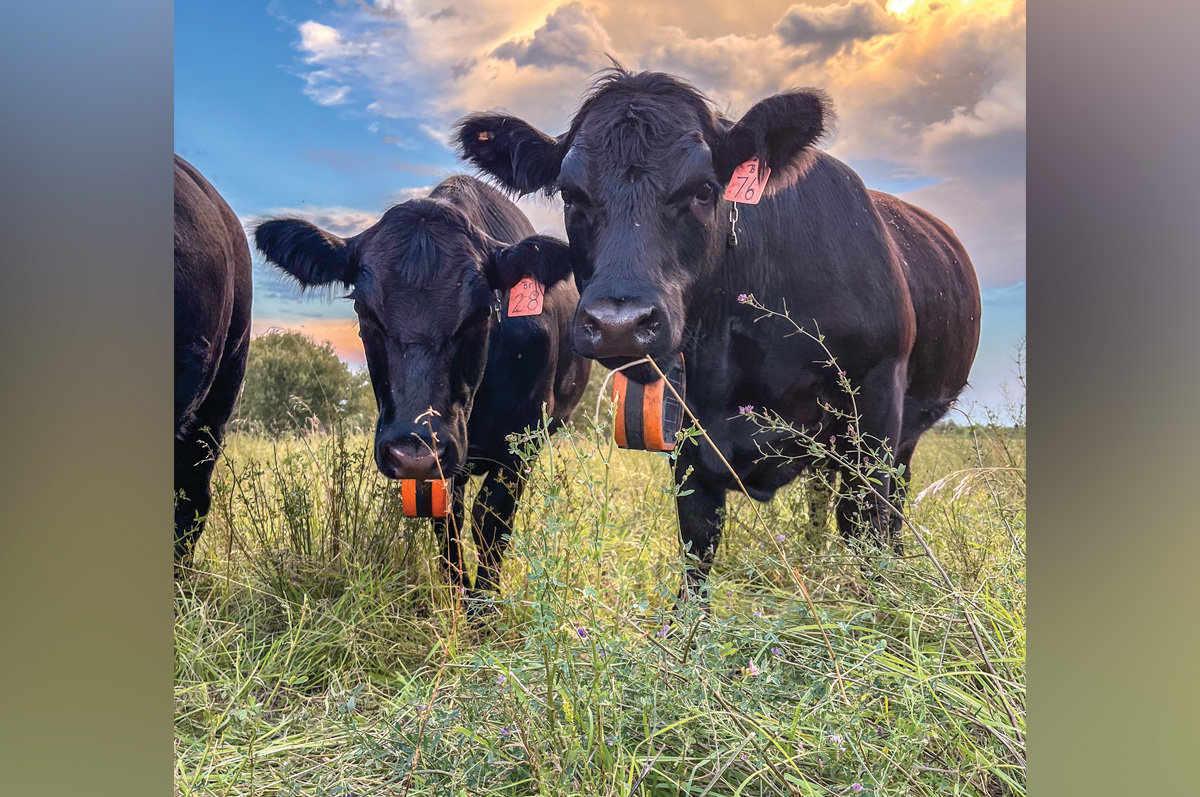
In trials and many real-world applications, cattle quickly learn to stay within virtual paddocks made possible with virtual fencing technology. Image courtesy of Ducks Unlimited Canada.
A few months later, the herd was brought together for pregnancy checking, and the Horvaths were able to confirm that collars had no effect on conception. They also took the opportunity to check collar fit on existing animals and to fit an additional 41 heifers and young cows with collars, bringing the total number in the trial to 64.
As with any new technology, Horvath acknowledged there have been challenges. Battery life during a Saskatchewan winter was a concern for producers, though she reported that only a small number of collars experienced low battery levels, and all recovered – even during periods of limited sunlight, a result that pleasantly surprised her.
Another common question was how the system performs in areas with poor cell service. While virtual fencing typically relies on cellular networks, Horvath explained that base stations can be installed in mobile “black spots.” These stations use long-range, line-of-sight wireless technology (LoRa) and can cover large areas, making them well suited for rugged or remote rangeland.
Cost was another key topic of discussion. Each collar costs approximately $350, with an additional data fee of $2.50 per head per month. Funding is available through the On-Farm Climate Action Fund (OFCAF), which can cover up to 70% of costs when virtual fencing is adopted as part of a rotational grazing system.
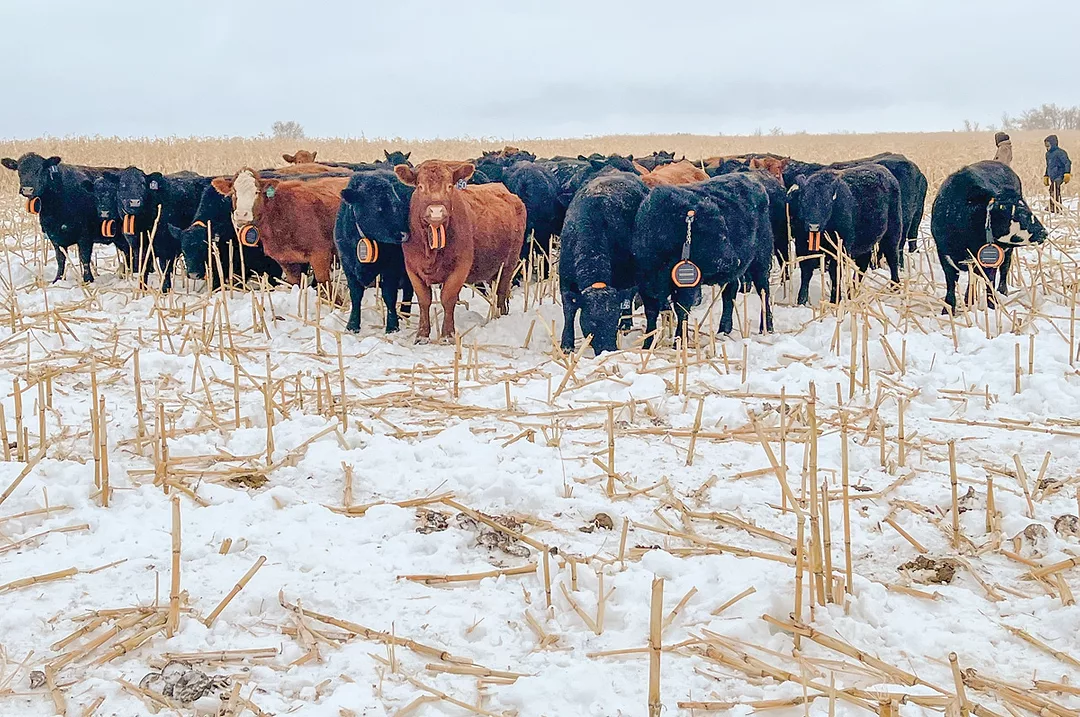
The Horvaths have implemented virtual fencing for winter corn grazing on their ranch, a practice that can ease pressure on pastures while redistributing nutrients. Horvath explained that controlling timing and access to the forage is key.
“Cross fencing is essential to allocation, and a virtual fence offers a really convenient way to do that,” she said. “But limiting access is about more than a balanced ration. Shorter allocations mean better cleanup and less feed waste, too.”
Following this winter-day gathering on a Saskatchewan cornfield, Horvath said the most striking takeaway was the producers’ mindset.
“Farmers are problem solvers,” she said. “They don’t expect perfection. They always have a plan B, C, D or E. Virtual fencing is seen as another tool. It may need troubleshooting, but if the upsides outweigh the down, it can be worth implementing.
“What’s more,” she continued, “farmers think of better ways of doing things. Every time we meet in a group like this, somebody mentions another way the technology could be used. It’s never a one-way flow of information at these events.”
Advancements such as virtual fencing point to better outcomes not only for farmers, ranchers and livestock, but for wildlife, too. When used in rotational grazing systems or to manage access to alternative feed sources such as corn, virtual fencing helps control animal distribution and make better use of available forage.
“We know that when it comes to perennial forage stands, rest periods after grazing are critical for plant recovery. Better root systems mean more resilience to drought, weed pressure and enhanced ability for regrowth,” Horvath said. “Can virtual fencing help make our pastures healthier and more resilient? So far, the signs are encouraging.”