Bovine respiratory disease (BRD), also called shipping fever, remains a leading health concern in Canadian feedlots. Triggered by environmental stress, animal susceptibility and pathogens, BRD is characterized by fever, respiratory distress, decreased appetite and many other symptoms. With morbidity rates between 35% and 50% and fatality rates up to 10%, early detection is critical, especially since most deaths occur within 45 days of arrival.

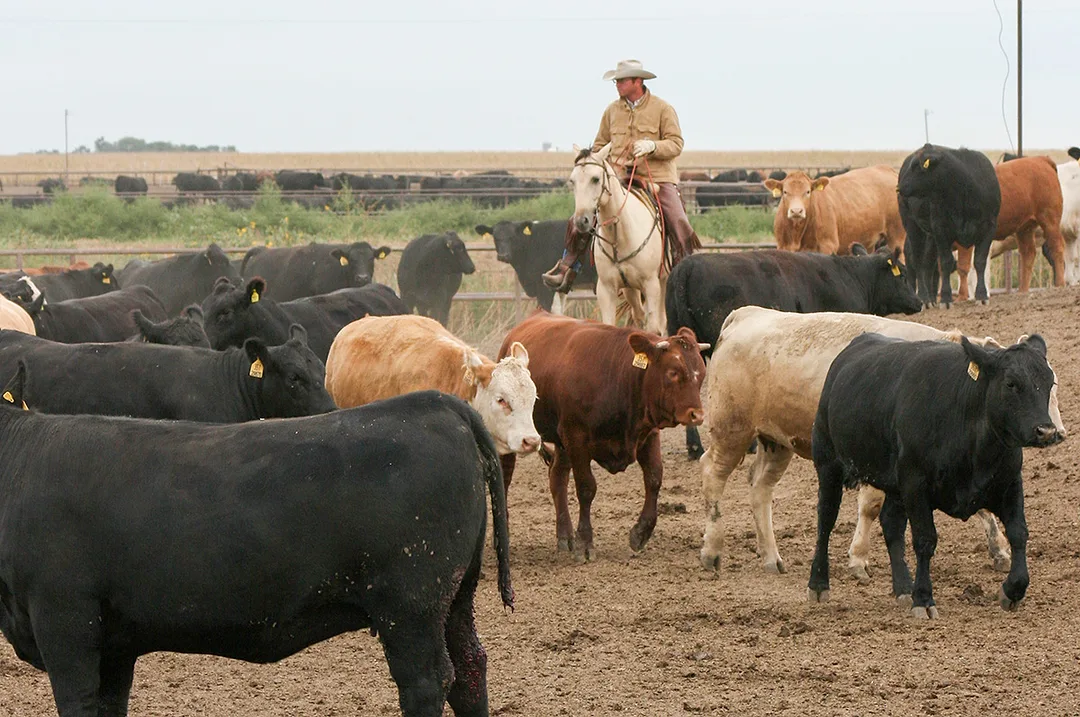
Currently, pen riders quietly surveying thousands of cattle daily are a feedlot’s main defence against this challenging disease.
Fine-tuning BRD diagnosis accuracy
Katrina Garneau, a University of Saskatchewan (USask) researcher, took on the task of deciphering how to fine-tune the typical pen rider’s visual diagnosis accuracy of BRD. With assistance from fellow USask researchers John Campbell, Emily Snyder, Diego Moya and Mike Jelinski, Garneau set out to observe pen riders in their natural element and gain hands-on access to hundreds of BRD-affected feedlot calves.
The study began in fall 2021 and ran for two seasons. Twelve pen riders from southern Alberta and northern Saskatchewan feedlots participated, each equipped with a GoPro camera and two-way radio. All conversations were recorded, and clinical signs were scored using a standardized sheet.
“Each pen rider had to wear the GoPro camera, which they hated me for, and that’s fair,” Garneau laughs. “It was so important they did, because then I could see what they were seeing and hear what they were talking about.”
During the pen rider’s routine, Garneau set up remotely, so the cattle behaved normally.
“I got the riders’ thoughts and opinions in real time, which was extremely valuable,” she says. “They could anonymously say whatever they wanted.”
Clinical signs of interest were mouth and nose secretions, altered respiration, loss of appetite, empty or shallow flanks, slow movements, isolation and more.
When riders pulled a calf, Garneau would ask follow-up questions to pinpoint clinical signs and understand what was observed. Using a clinical scoring sheet, she recorded unique terms like “glassy eyes” or “looks rough because of …” Animals would be identified by tag number and visible sign descriptions, such as droopy ears, runny noses or poor posture.
At the hospital, the treatment process began with a rectal temperature. Those testing 40ºC (104°F) or higher were classified as ill with BRD symptoms. Garneau also used an early Whisper model to listen to the lungs. Lung sounds were read and analyzed, generating an image displaying the different volumes and noise frequencies. A severity score from 1 (normal) to 5 (chronic) was produced. Blood was also drawn from the tail vein, and a handheld lactate meter measured blood lactate. A level of greater than or equal to 4 millimoles per litre (mmol/L) was used to help identify cattle affected with BRD.
“We evaluated 163 sick calves and achieved health records on 146,” Garneau says. “In typical years, there would have been more – even up to 500 sick calves – but these months and years turned out to be healthier than usual. Of course, fewer sicknesses were great for the feedlots, but it limited our data. What we did achieve helped us move into the next step of the research, namely a video survey for pen riders.”
Survey data to help boost confidence
In this phase, Garneau distributed a video-based survey to varied demographics and experience levels of pen riders across western Canada. The survey inquired about work environments, checking routines and the clinical signs considered most and least important for BRD detection. Participants also watched 30-second clips of sick animals whose health outcomes were already known.
“I wanted to see if they could visually assess the calves and say ‘yes’ or ‘no’ based only on what they saw without any diagnostic tools,” Garneau says.
Results showed worker experience level didn’t strongly affect accuracy; both seasoned and new riders showed high variability in their assessments. Overall, 225 responses revealed strong agreement that laboured breathing, slow movement and abnormal posture or head carriage were key indicators of the disease.
Garneau’s main objective was to develop a clinical scoring chart outlining key BRD clinical signs and their severity and importance. The idea was to create a visual, user-friendly guide, similar to California’s dairy BRD scale, to boost confidence in assessments and support training for new workers, who currently learn mainly by shadowing experienced colleagues.
“Such a tool could provide consistent reference material, critical in an industry with high turnover and no formal pen riding schools,” Garneau says. “We hoped to base the chart on extensive data, but a lower-than-expected number of sick animals limited our ability to create a fully validated tool. Despite this, we gathered valuable insights and believe that with further research and more cases, a comprehensive clinical scoring sheet will be possible and greatly benefit the industry by standardizing disease detection and improving training outcomes.”
Building for the future
Post-survey, Garneau is assisting Alberta veterinarians and stays in contact with many pen riders.
“They can take the results we did achieve with a grain of salt, but it’s still a form of education,” she says. “The data isn’t excessively strong with the limited numbers, but I believe it still puts thoughts in people’s heads about BRD identification.”
Regarding the technology used, Garneau favoured the Whisper device over ultrasound for its on-the-spot lung scoring without the need for a laboratory. The handheld lactate meter also provided immediate results. With previous positive outcomes, she hoped to test whether these tools could streamline research and be a benefit, making BRD detection quicker and simpler.
Currently, with her master’s degree completed, Garneau is working as a research assistant with USask Professor Bart Lardner. Eventually, she would like to pursue her Ph.D. and continue her studies in the BRD field.
“I think advancing our knowledge of this disease is so valuable,” she says. “The response from producers, public and the industry has been amazing. Pen riders will remain an essential part of cattle production, whether it’s in addition to technology or not. If it helps, they can adopt and make use of what we’ve achieved. It’s just a small piece of getting people’s minds working as they deal with BRD.”