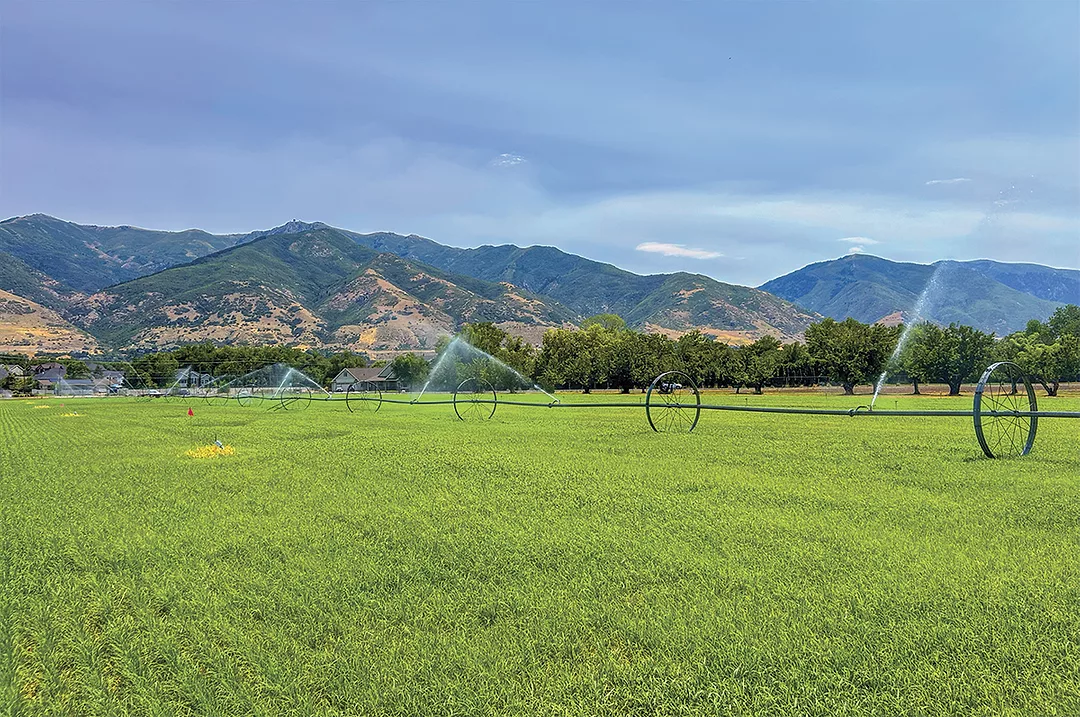
In the Intermountain West, water is becoming scarcer, and irrigation efficiency is increasingly important in crop production. Wheel-line irrigation systems are commonly used by small- to medium-scale farmers in this region. According to the most recent USDA Census of Agriculture irrigation survey, over 15,000 farms spanning 1.6 million acres are irrigated with wheel lines across the U.S.

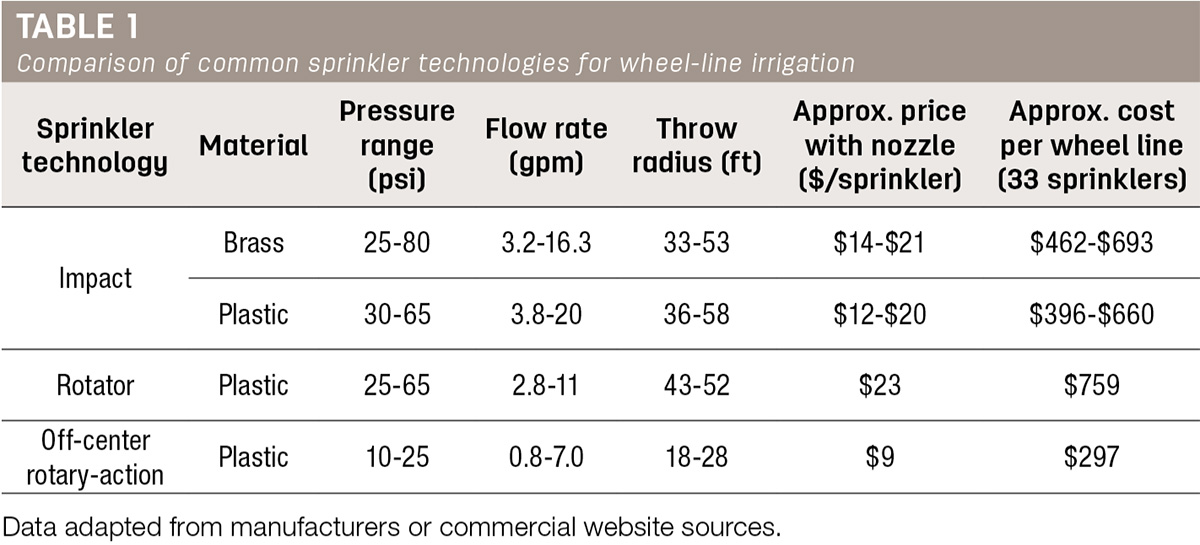
Several different sprinkler options can be used on wheel‑line systems, and they vary in how evenly they apply water, how much pressure they need, how far they throw water and how much they cost (Figure 1). Newer, more efficient sprinkler designs may help improve water use efficiency, boost crop yields and reduce irrigation costs. When water is not applied evenly, some areas of the field may become too dry and stressed, while other areas receive too much water, leading to runoff, nutrient leaching and wasted water. Even small improvements in how water is applied and managed can make a noticeable difference in irrigation efficiency and crop performance. Utah State University (USU) is currently studying four types of wheel‑line sprinklers (traditional impact sprinklers and newer rotator styles) to see how they affect irrigation efficiency and yields in common forage crops.
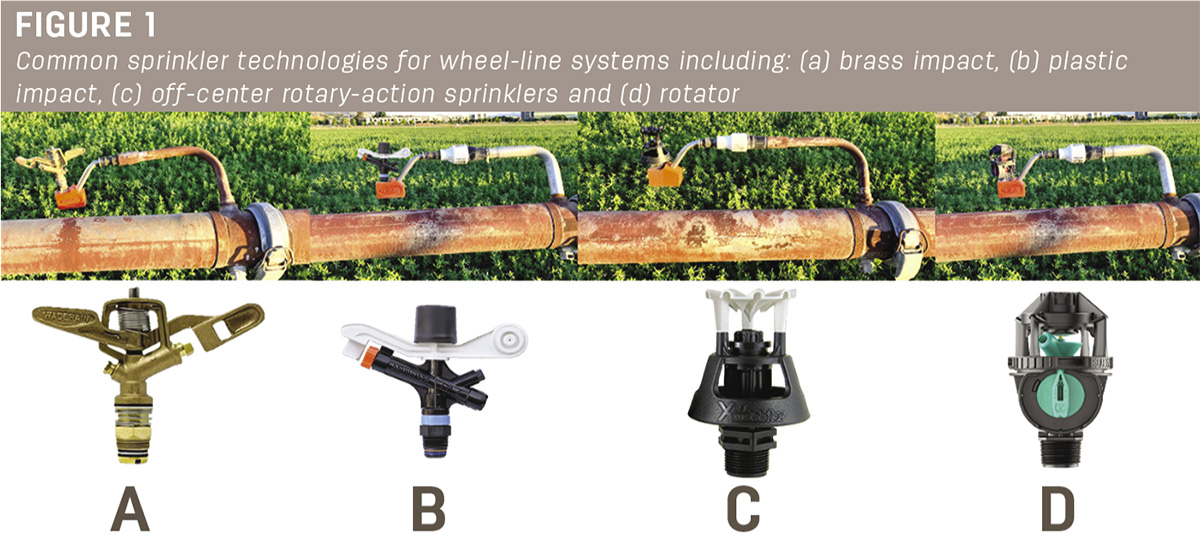
Impact sprinklers work by using the force of the water stream to move an impact arm, which rotates the sprinkler and breaks the stream into droplets. This design provides a long throw, making impact sprinklers a common and reliable choice for wheel lines. Their widespread use is also due to their durability and long history in irrigation, having been around even before wheel lines became common.
Rotator sprinklers also turn using water pressure, but instead of an impact arm, the water drives a rotor plate that spreads the flow in a more controlled pattern. This helps improve water distribution uniformity over a wide wetted area.
Off‑center rotary sprinklers operate at much lower pressure by slowly releasing water as the sprinkler rotates off‑center. They are the most affordable option but have a shorter throw, which limits their use to smaller fields or tighter sprinkler spacing. Because of this shorter reach, they are less practical for larger wheel‑line setups that require wider spacing between sprinklers.
Brass and plastic impact sprinklers and rotators cost more per unit, but their longer throw makes them better suited for typical wheel‑line systems. Sprinkler costs in this study are shown on a per‑sprinkler basis. Most wheel lines are about 1,320 feet long and use roughly 33 sprinklers, and this standard setup was used to estimate total system costs.
On-farm trials
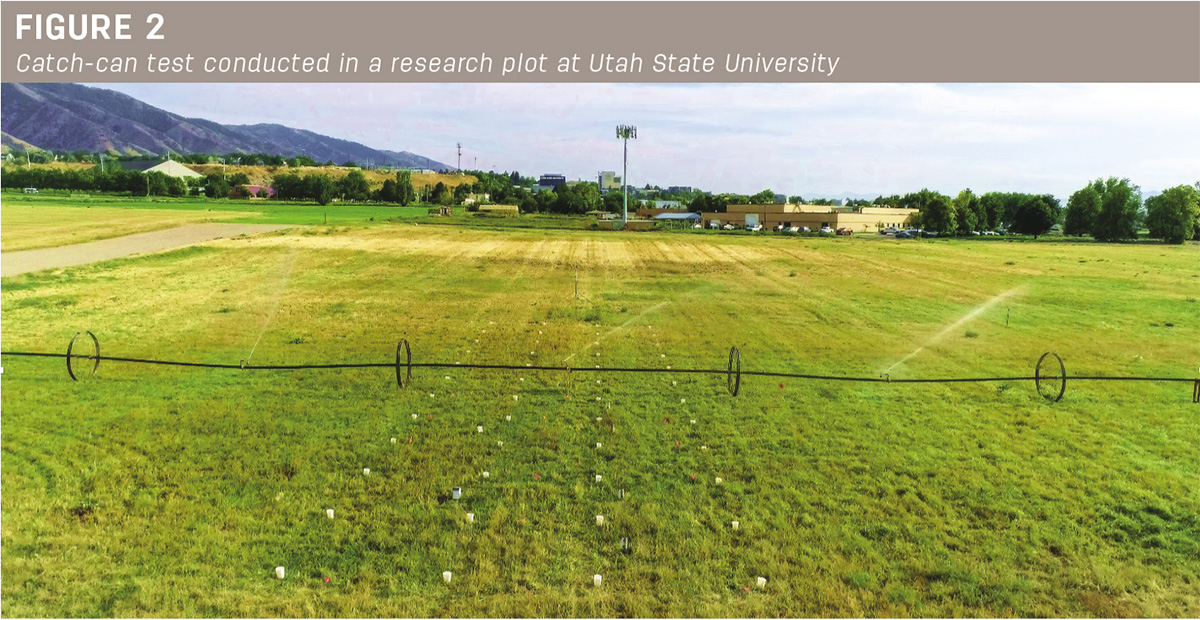
On-farm wheel-line irrigation trials were established in the summer of 2024 to test wheel-line sprinkler technologies in nine farm fields in Cache (4), Iron (2), Uintah (1) and Wayne (2) counties in Utah. Two to three impact and rotator sprinkler treatment combinations (brass impact, plastic impact, rotating and off-center-rotating sprinklers) were tested in each field. Each sprinkler technology was tested using three adjacent sprinklers to capture the normal overlap that occurs in wheel‑line irrigation systems, and each treatment was replicated three times in every field. Catch-can tests for all sprinkler technologies were conducted during selected irrigation events to quantify sprinkler irrigation uniformity (Figure 2). Alfalfa, teff and three-way small grains (wheat, oat and barley) were grown in the trials.
What did the catch-can test show?
Preliminary catch-can tests indicated no difference in irrigation uniformity between the impact-type and rotating-plate sprinkler designs. The off-center rotary sprinkler had lower distribution uniformity when operated at the same interval, for which this type of sprinkler was not specifically designed. However, if the wheel-line position is offset by one roll every other irrigation (a strategy long promoted by USU Extension), distribution uniformity is projected to increase across all sprinkler technologies, resulting in uniformity comparable to that of a well-performing center pivot irrigation system.
Did the treatments impact dry matter yield?
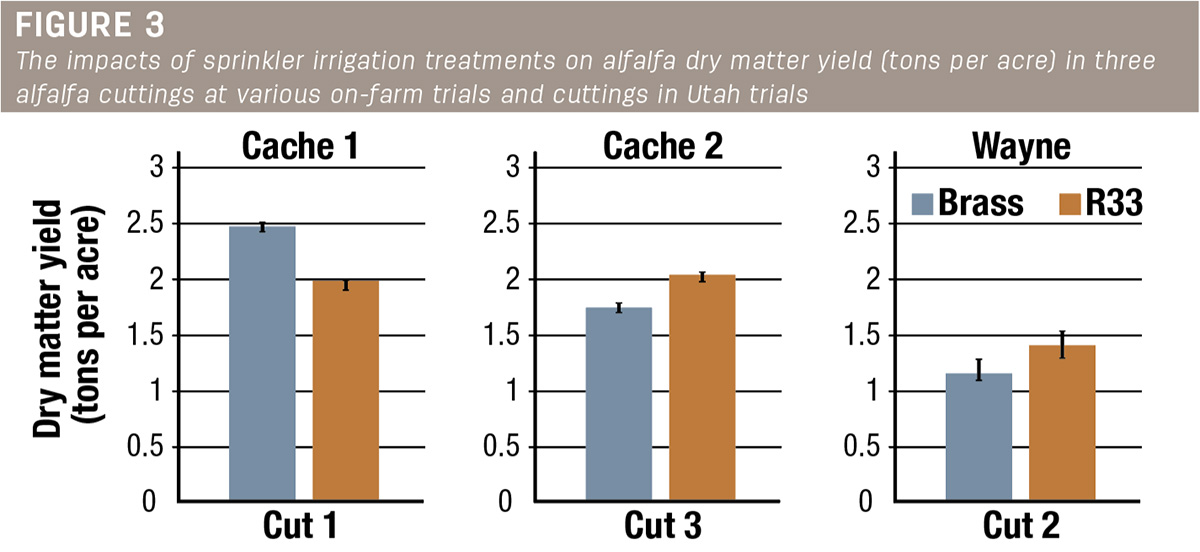
Alfalfa yield was measured at the end of 2024 and throughout 2025 on seven fields for a total of 19 cuttings across fields. Teff and three-way small grains were evaluated in one and two fields, respectively. Though the study is ongoing, the initial data are evidence that the brass impact sprinkler produced the same alfalfa yield as plastic impact or rotator-type sprinklers in 16 of 19 cuttings. For three cuttings, the rotating sprinkler increased yield by roughly 20% in two cuttings but reduced yield by 20% in the remaining cutting (Figure 3). Teff and three-way small-grain forage dry matter yields did not differ across fields or cuttings.
What are the takeaways so far?
Early results suggest that farmers can upgrade wheel‑line sprinkler packages without sacrificing yield. That naturally raises the question: If yields stay about the same, why make the change? The potential advantage of replacing traditional brass impact sprinklers with rotating sprinklers is improved irrigation efficiency or applying water more evenly while maintaining crop performance. This added efficiency could help reduce water losses and improve overall water management, an area we are continuing to study. Ongoing research will focus on the longer‑term sustainability and profitability of these upgrades in Utah, with the goal of providing practical, field‑ready recommendations for wheel‑line irrigation decisions.
Graduate students Maziyar Roudbari and Benedict Okorie and Dr. Burdette Barker contributed to this article.


.webp?t=1687979285&width=640)