We use cookies to provide you with a better experience. By continuing to browse the site you are agreeing to our use of cookies in accordance with our Cookie Policy.
  • Sign In
  • Create Account
  • Sign Out
  • My Account
subscribe / renew
  • Topics
    • All recent articles
    • Forage Analysis
      • Testing Forages
    • Forage Equipment
      • Baling Equipment
      • Forage Technology
      • Groundwork Equipment
      • Silage Equipment
      • Storage Equipment
    • Forage Harvest
      • Harvest Considerations
      • Harvest Issues
    • Forage Marketing
      • Pricing Forages
      • Selling Forages
    • Forage Planting
      • Crop Rotation
      • Seeds
    • Forage Production
      • Common Issues
      • Growing Issues
      • Irrigation
      • Pests & Weeds
      • Plant Health
      • Soil Health
      • Soil Sampling
      • Weather
    • Forage Selection
      • Alternative Forages
      • Commodity Crops
      • Ensiled Forages
      • Grasses & Legumes
      • Hay
      • Small Grains
    • Forage Storage
      • Baling
      • Ensiling
      • Transportation
      • Wrapping
    • Forage Business Management
    • Forage Farm Features
  • News
    • Forage Industry Issues
  • Blogs
    • From the Editor
    • Guest Blogs
    • Irons in the Fire
    • Outside Eden
    • Tales of a Hay Hauler
  • Buyers Guide
  • Current Issue
  • Past Issues
  • Advertise
  • Ask AgProud

Progressive Dairy

Progressive Dairy Canada

PD Canada en Francais

Progressive Cattle

Progressive Cattle Canada

Progressive Forage

Agproud Idaho

Home

Home » Topics » Progressive Forage

Progressive Forage
Progressive Forage RSS Feed RSS

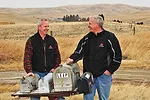
Leep Hay & Grain

Growing into business

May 15, 2013
Richard Banks
Standing on this domed stretch of Leep family land, you can see mountains in every direction – tall peaks, some reaching two miles above sea level.
Read More
Forage harvester

Harvesting forage safely

May 15, 2013
Dawna L. Cyr and Steven B. Johnson
Farmers often grow hay and forage crops on ground too rough, steep or unsuitable for row crops. This means it’s especially important to prepare fields and machines for safe use.
Read More

Preventing hay fires

May 15, 2013
Glenn Shewmaker
In the last 25 years, there may have been more hay fires than in the past because high moisture is retained longer in the more dense and massive types of bales.
Read More

Alfalfa quality, yield, productivity: Do you have to choose?

May 15, 2013
Tim Meister
When it comes to alfalfa, many growers believe they have to choose quality, yield or productivity and that increasing one element will automatically reduce the others. Fortunately, you don’t have to trade one for the other, if you keep a few fundamentals in mind:
Read More
0513fg nowaczyk 1 full

Getting maximum nutrition from mixing alfalfa, grass stands

May 15, 2013
Gary Nowaczyk
Mixing grass with alfalfa stands has long been a popular choice for farmers who produce dairy feed.
Read More
0513fg newman 1 full

When the storm hits: Pasture recovery from tough weather

May 15, 2013
Yoana Newman
Many producers throughout the country keep enduring tough weather conditions. In the last five years, the region has experienced five different records or near-records for the last 40 years.
Read More

Author Q & A to Rocky Lemus about forage inoculants

May 15, 2013

The following came in response to the article 'Inoculating forage legumes' which appeared in the March first edition. Click here to read the original article.

Read More
Electrified high-tensile wire

Power fencing for improved grazing efficiency

May 15, 2013
Jeremy McGill
We are all familiar with the old saying that “Good fences make good neighbors.” Although this is true in most cases, other benefits must not be overlooked.
Read More

Targeted multi-species grazing: Should you try it?

May 15, 2013
Rocky Lemus
Pasture systems support their own unique plant and animal species. The need to control weeds in pastures and reduce herbicide and mowing cost to control undesirable species has increased due to higher fuel and chemical prices.
Read More
0513fg marsalis 2 full

Winter annual small grains: Filling the silage gap

May 15, 2013
Mark Marsalis
Small-grain crops are used extensively in some areas for various types of forage production and animal feeding operations. Small grains used to the greatest extent are wheat and triticale; however, rye, barley and oats are utilized also.

Read More
Previous 1 2 … 391 392 393 394 395 396 397 398 399 … 526 527 Next
  • RECENT ARTICLES
  • mechanics-corner.jpg

    Equipment Hub: What’s the condition of your mower-conditioner?

    June 18, 2026
  • Forage Market Insights: Markets hold steady as supply signals shift

    June 18, 2026
    • Klondike Farms: Built with grit, guided by stewardship, growing for the next generation

      June 17, 2026

FREE NEWSLETTERS

Award-winning coverage of in-depth news and analysis to make your business more profitable.

SIGNUP TODAY
Advertisement
THE GUIDE

How do I get my company listed in your Buyers Guide? 
Submit a request to be listed for FREE in the Buyers Guide here.

Why can I only see so many articles before I have to register for the site?
Find out why here.

SUBSCRIBE to Leading Industry Magazines

Award-winning coverage of in-depth news and analysis to make your business more profitable.

Subscribe/Renew
Advertisement

I'm looking for ________

Find the right products and services for your farm, ranch or operation.

CHECK OUT OUR BUYERS GUIDE
Advertisement
  • FEATURED PODCASTS
  • [Podcast] Matthew Evangelo talks mastitis management at Bar E Dairy

    Progressive Dairy
    Mastitis
  • [Podcast] Changing the Rules of Pre-Fresh Dairy Cows

    Progressive Dairy
    Podcasts
    SPONSORED BY Applied Biotechnologies Inc.
PERSONALIZED CONTENT
Create an account and see website content tailored to your operation.  It only takes a few seconds!
SEE RECOMMENDATIONS NOW!
Copyright © 2026 Progressive Publishing

MORE INFORMATION
  • About Us
  • Terms & Conditions
  • Privacy Policy
  • FAQs
  • Advertise
  • Shop
  • Stats Posters

OUR MAGAZINES
  • Progressive Dairy
    • Facebook
    • Twitter
    • Linkedin
  • Progressive Dairy — Canada
    • Facebook
    • Twitter
    • Linkedin
  • Progressive Dairy — en français
    • Facebook
  • Progressive Cattle
    • Facebook
    • Twitter
    • Linkedin
  • Progressive Cattle — Canada
    • Facebook
    • Linkedin
  • Progressive Forage
    • Facebook
    • Twitter
  • AgProud — Idaho
    • Facebook
    • Linkedin

CONTACT INFORMATION

Progressive Publishing
238 West Nez Perce (physical)
PO Box 585 (mailing)
Jerome, ID 83338


info@progressivepublish.com
(800) 320-1424
(208) 324-7513 (Main)
(208) 324-1133 (Fax)