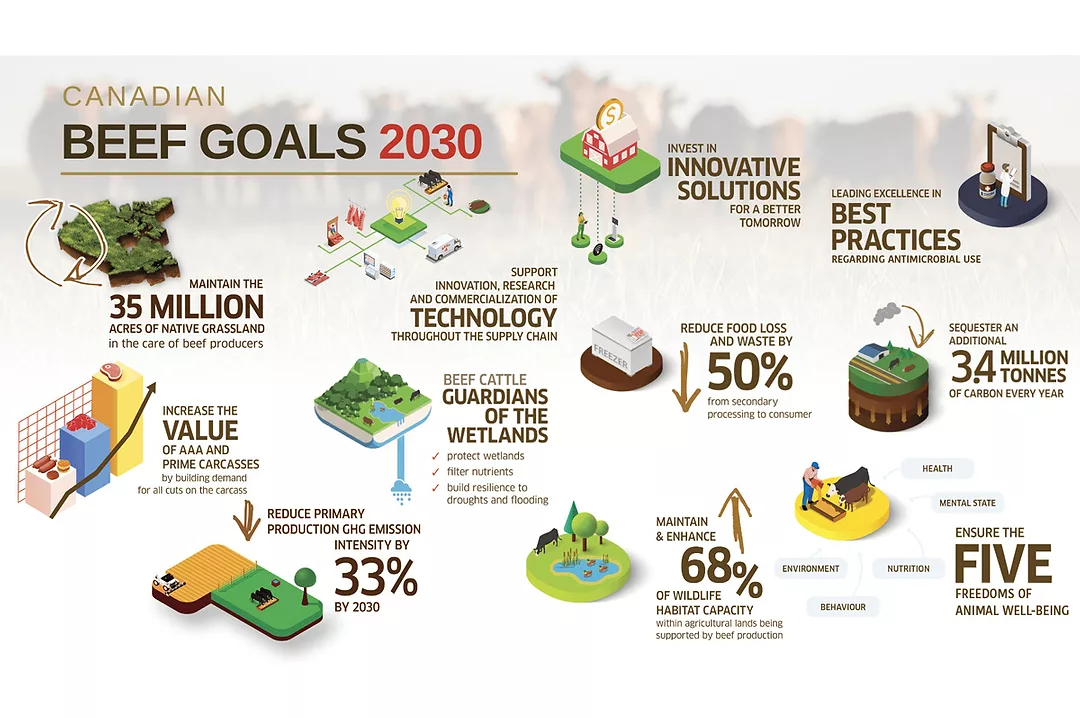
The North American beef industry is not only a major contributor to the global food system, but it is also considered one of the most efficient protein production systems. Even though the industry has made significant advances in reducing its environmental footprint, it still faces increasing pressure to reduce greenhouse gas (GHG) emissions, with both the U.S. and Canadian cattle industries setting aggressive goals to improve their overall environmental footprint. According to the U.S. EPA's GHG emissions inventory, only 2% of U.S. emissions come directly from cattle, with the cow-calf phase being considered responsible for most of these emissions within the beef value chain.

While the conversation often centers around emissions, there is more to sustainability and a cattle operation’s environmental footprint.
Sustainability can be defined as meeting the growing global beef demand by balancing environmental responsibility, economic opportunity and social diligence throughout the supply chain. It comprises three very different, yet intersecting pillars: social responsibility, economic viability and environmental stewardship.
Cattle have many positive environmental attributes. They often utilize byproducts unfit for human consumption, graze pasture or rangeland unfit for crop production and can have a positive impact on carbon sequestration.
The challenge for many beef producers is balancing profitability with sustainability. Rising costs, environmental concerns and the need for efficient production make it critical for beef producers to adopt strategies that maximize resources while maintaining performance. Improving production efficiency and producing the same amount of beef with the same or fewer resources boosts producer profitability and supports economic viability, and it can protect the environment in significant ways.
For example, since most cow-calf producers are typically paid for the number of pounds weaned, the goal is typically to get as many cows bred or maximize the amount of pounds weaned per exposed female. By focusing on reproductive efficiency, producers can thus have a significant impact on their bottom line.
Reproductive efficiency
Reproductive efficiency can be defined as the proportion of cows eligible to be bred that become pregnant during an estrous cycle. It determines the calving-to-conception interval and has the potential not only to improve farm profitability but also to lessen the environmental impact, since fewer cows need less land, feed and water, and fewer animals yield lower emissions.
Proper nutrition, specifically trace minerals, plays a critical role in reproduction. Maintaining protein and energy balance and trace minerals, including copper, zinc, manganese and selenium, can help the cow achieve proper body condition scores (BCS), which can lead to higher conception rates, healthier calves and shorter calving intervals. Supplementation with organic trace minerals has been shown to reduce days to first service and lead to fewer days open, improved ovarian activity and decreased embryonic mortality.
Supplementing with organic trace minerals has also been shown to have a profound impact on reproductive efficiency as measured by:
- Higher calving and weaning percentages
- Earlier puberty in heifer calves
- Improved health and immunity in calves
- Increase in weaning weights
All of these directly impact the number of pounds weaned per exposed female, a producer’s profitability and an operation’s environmental footprint.
Environmental impact
In a recent university study, the benefits of an organic trace mineral program compared to an inorganic program were evaluated. Supplementation with organic trace minerals resulted in an improvement in reproductive efficiency of 2.7%, as well as a 4.3% improvement in weaning weight. Using these results as an example to calculate and model the potential impact of improvement in reproductive efficiency in a 100-head cow-calf baseline, the 2.7% improvement in reproductive efficiency resulted in a 2.1% reduction in emission intensity. And when modeling the 4.3% improvement in weaning weight, it accounted for a 1.7% reduction in emission intensity.
This clearly demonstrates that small, incremental changes in something as simple as nutritional strategies can positively influence production efficiency, profitability and environmental sustainability.
Thus, it is no surprise that the Canadian Cattle Association's Canadian Beef Industry Goals consider reproductive efficiency as one of the key drivers to help reach the industry’s sustainability goals. Producers are encouraged to look at technologies and/or solutions that can help drive performance through adoption of mineral programs, precision nutrition, feed additives and other best management practices, including grazing management, animal health care and better genetics.
Productivity is a powerful tool for improving the sustainability of food production, including beef, in the face of a growing population and increasing food demands. Improvements in performance are key to the rancher’s bottom line and can have a positive impact on their environmental footprint.
Nutritional strategies, including the utilization of organic trace minerals, can help to optimize health and performance, getting animals to perform as close to their genetic potential as possible. Economic, social and environmental sustainability do not have to be mutually exclusive to one another. The industry can support all three by continuing to evaluate and implement practical solutions to improve on-farm efficiency, productivity and profitability for beef producers and the integrated beef supply chain.