Recently, I was working in our sample preparation department, covering for our supervisor who was at the NIRS Forage and Feed Testing Consortium Hub Training, and our other sample preparation technician was out signing a new lease and moving into a new apartment. I was so happy to help. Before they joined the sample preparation department, I spent many hours fixing mistakes and solving problems that come from technicians trying to take shortcuts in their work at the expense of our customers. I also spent a lot of time preparing the samples myself during our busiest seasons. Now, I check in with them and do some quality assurance measures, and overall things go smoothly and I rarely step foot in that room, let alone do the actual work.

While working on splitting some manure samples, a temporary worker stopped in the room and asked how I drew the short straw. I explained that I truly didn’t mind and did not see it as a short straw. I explained that every number that comes out on our reports is potentially a data point a producer will use to make a decision. Those decisions have a real economic impact on that operation. If the sample is not properly prepared to represent what has been submitted to the laboratory, then our data is worthless and can even have detrimental effects. In the case of manure, over- or underapplication on a field could impact yield or fertilization cost.
‘Grunt work’
In years past, sample preparation was considered "grunt work," and typically the lowest-skilled workers washed in and out of that department. Meanwhile, we would hold trainings, which would temporarily improve the quality of work, but inevitably, the sample preparation technicians would fall back into taking shortcuts, compromising sample integrity. Grunt work is defined as “dull, repetitive or physically demanding work that's necessary but not glamorous. It's often delegated to less experienced workers.”
In a laboratory setting, sample preparation certainly seems to fit this definition relative to running high-tech instrumentation or performing complex chemical digestions. However, as the first step in the process, if the sample is not prepared properly, then it doesn’t matter how well anyone downstream in the process does their job; the numbers will simply be wrong.
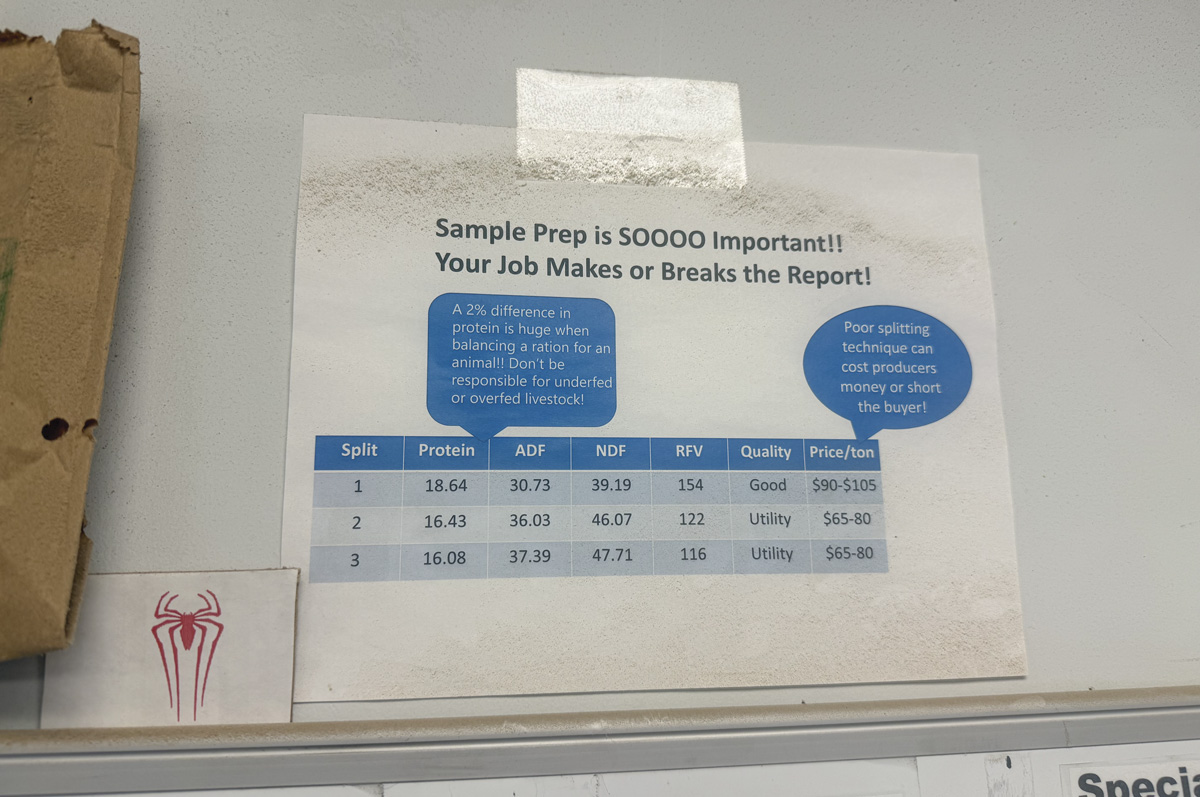
This sign is a daily reminder about the importance of sample preparation and its impact on forage value. Image by Rebecca Kern-Lunbery.
Shifting mindset
So in our laboratory, we have a mindset shift. Sample preparation is certainly not glamorous work, but it requires a level of competency, attention to detail and efficiency that goes beyond grunt work. It is unpleasant work to prepare manure samples, but other sample types such as hay, plants and other feeds aren’t so bad. Furthermore, the work is very important to the customer outcome and producing reliable numbers for data-driven decisions.
So the sample preparation technicians must have higher organization, cleanliness and problem-solving skills, but above all, they must take pride in their work and understand the impact and importance of their work. Here are some ways we have developed our sample preparation technicians.
1. Understanding economic impact
Making sure technicians see the bigger impact of their work. Specifically, when it comes to hay testing, a mistake in the preparation process can result in higher fiber values (acid detergent fiber [ADF]/neutral detergent fiber [NDF]) and therefore a lower relative feed value (RFV) or relative feed quality (RFQ). The lower quality index can cost that producer by undervaluing their hay. Of course, it can happen the other way as well, resulting in someone overpaying. More importantly, though, this can have a real impact on animal nutrition over- or undersupplementing based on a hay analysis.
2. Meaningful work
It was about three years ago now; we had one of our busiest hay seasons I can remember. I was pregnant at the time, but I worked side by side with our current sample preparation supervisor, splitting hay, feeds and manure (although sometimes I ducked out on this one since it made me sick). He knows I would never ask him to do a task that I would not be willing to do myself.
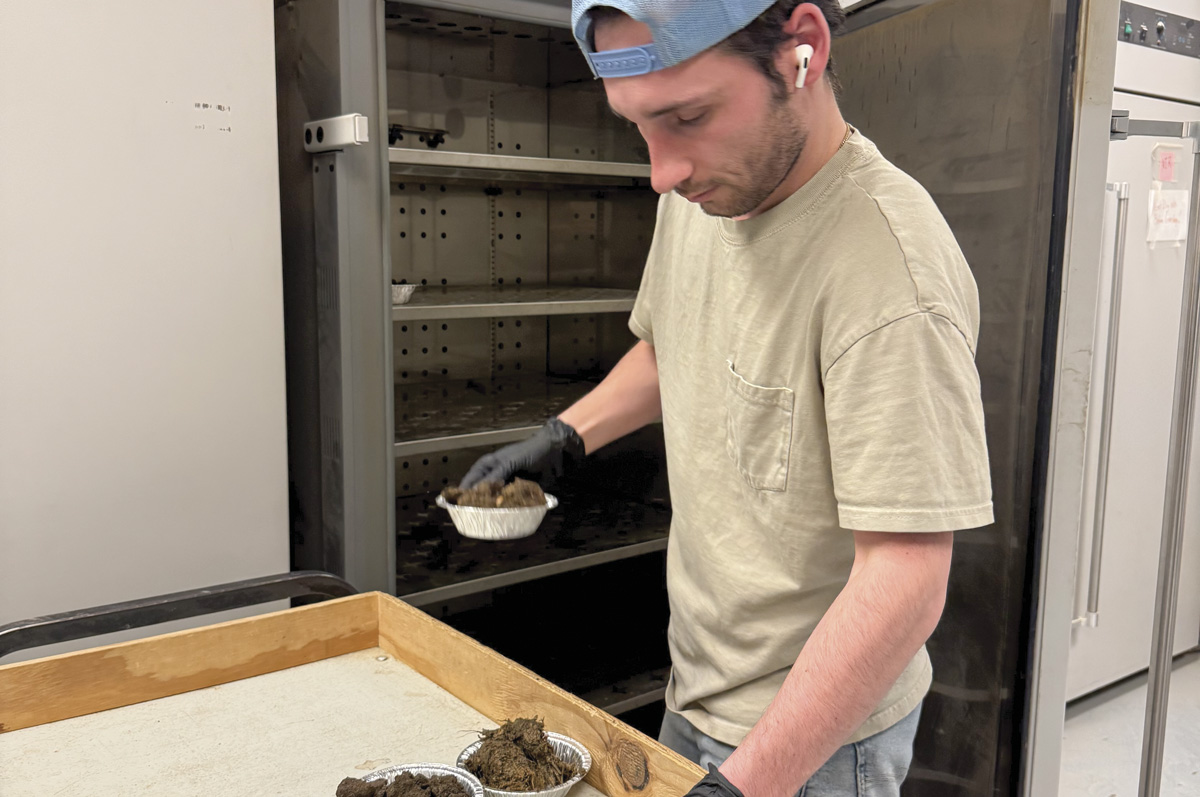
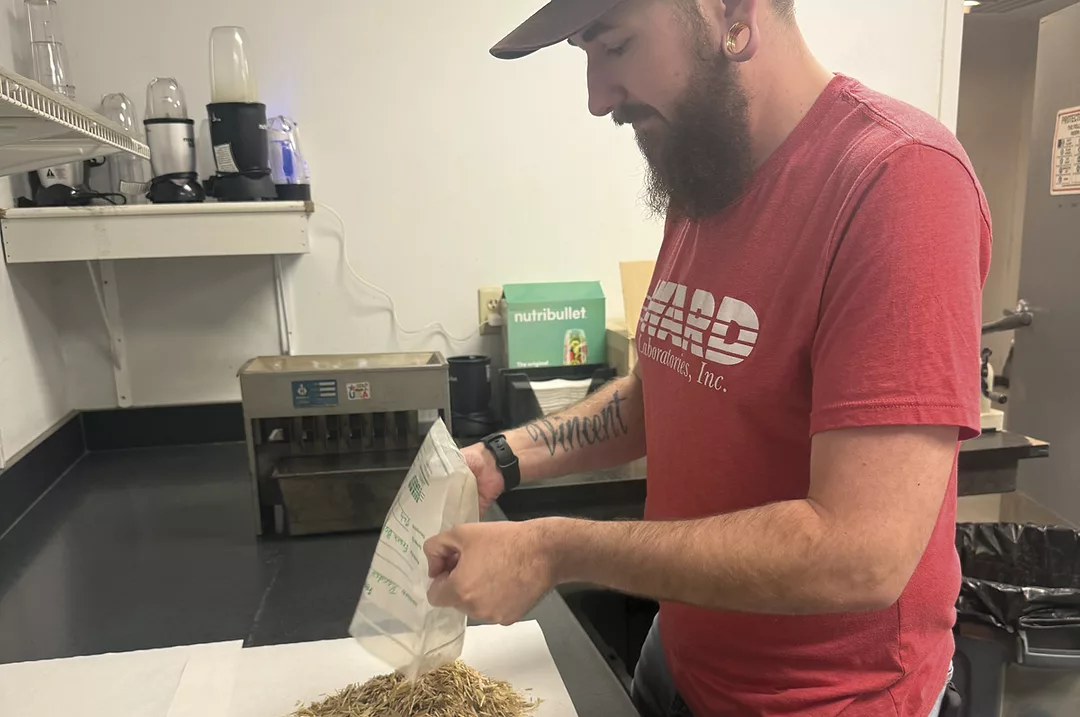
Royce Austen loads fresh manure samples into a drying oven after taking proper subsamples. Image by Rebecca Kern-Lunbery.
3. Encouraging and embracing change for efficiency
Listening to process improvement suggestions and implementing them where they make sense has been a game-changer. A lot of the time when we come from a scientific background, our viewpoint is to follow the SOP and do not deviate. Especially when "shortcuts" taken in the past have resulted in lost sample integrity. But when a good idea is brought forward in the right way, it is key that you try it; sometimes these work out great and we see process improvements – other times, they don’t. But involving the team and letting them try their ideas helps build trust and confidence.
4. Autonomy
Speaking of trust, our two-man sample preparation team does a great job executing their tasks and providing representative laboratory portions daily. We can trust them to get the job done and we give them the freedom to manage their own workload and daily schedule.
5. Communication and support
I check in with them periodically, and they know they can always come to me with any issue and they won’t be berated or belittled for any mistakes. More importantly, they know they can ask for help when they need it.
Overall, I am so blessed to have a motivated, competent, detail-oriented, organized, efficient and experienced sample preparation team. My challenge to you would be: The next time you find your team grumbling over the "grunt work," pause and ask: Is it really low-skill or just undervalued?
Sometimes, the most unpleasant tasks are the foundation for everything else. And when you treat them that way, you will build a stronger team and a better outcome for your customers.