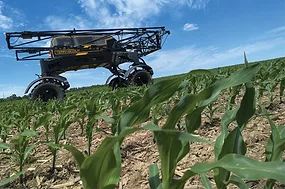
I don’t often think like others when it comes to conventional farming. I really like to understand the “why” and dive a little deeper into what nature has to offer and how our practices affect natural processes. We often like to use the easy button on so many things. In some instances, this works for a time, but what can the long-term results be, and do we attempt to understand how nature interacts and responds to the practices we do in farming? Controlling weeds is one of those easy buttons that I feel we need to take a deeper look at and understand what the weeds are trying to tell us.

One of the best indicators of soil dysfunction is weeds. Weeds have been referred to as nature’s paramedics and are, in all cases, trying to fix a problem with the soil. If we can learn to understand their purpose and what they are trying to remediate, we can utilize this knowledge to our benefit and work to correct the issue, so the weeds don’t have a need to be present.
For one to better understand weeds, we need to recognize they are in plant families, and within plant families, the plants are all trying to accomplish similar things. For example, if we look at Canada thistle, it belongs to the asteraceae family (daisy family). The responsibility of the daisy family is to remove heavy metals, build soil aggregation and structure and bring nutrients like calcium back to the surface. The spiny leaves on Canada thistle also indicate that the nutrients don’t need recycled by herbivores and it needs to be able to complete its life cycle to remediate the soil.
To continue with this example, we must look at what practices we have been doing that would require the remediation of a member of the daisy family. Tillage breaks down soil aggregation; overgrazing breaks down soil structure and aggregation. Most of the soil in Idaho has a lot of calcium, but it is in an unavailable form. To remediate and remove the need for Canada thistle to be present, we need to first apply some calcium to increase the available calcium and to help open up the soil so there is more oxygen deeper in the soil profile. This improves soil structure, allowing for biology to move deeper into the soil profile. Second, find ways to reduce tillage and limit the amount of time we have bare soil with the use of cover crops.
We can use this example to review any of the weeds we are dealing with in a field/crop. Once we understand what the weed is trying to remediate, we can utilize nutrients and cover crops or intercrops within that same family to remove the need for the “weed” to be present. We can also change the practices causing the dysfunction to be there.
I have been told many times that weeds will grow no matter what, but I believe nature is very intentional. There are thousands of weed seeds in any given soil, so we must ask the question: Why are we only seeing these weeds in this crop? Why do the types of weeds change based on soil type, cropping rotation, tillage practices, etc.? If weeds are nature’s paramedics, they only arrive to repair damage that has been done and to restore life to the soil. When a particular issue is present like heavy metals, compaction, low oxygen, bare soil, etc., the seeds within that soil will germinate because the need for them to get to work is present. If conditions are optimal, the weed seeds will not germinate and remain dormant in the soil profile. I have also seen where the weeds germinated but an application of biology and nutrients when they were small created an environment where the weeds remained small and didn’t pose a problem to the crop without any need for chemicals.
One additional thing to know and understand with regard to weeds would be that the soil microbiome also plays a big role in soil function. Many of the purposes of weeds as paramedics are to restore the soil to a system where biology can function and thrive. A soil without a healthy, diverse population of microbiology will always have significantly more weeds.
The final question to ask: Why spend the time understanding weeds and natural ways to reduce their need to be present when we have so many tools currently? The answer goes back to the first statement – we like to use the easy button – but what are the deeper consequences of continually applying chemicals to the soil and to a crop? Herbicides typically shut down photosynthesis on the crop for a given time. This reduces nutrient uptake and sugar production for energy and root exudates to feed biology. This weakens the plant for a period of time, and it becomes more vulnerable to disease and insects. The herbicides also tie up micronutrients in the soil. I have seen this in sap analysis data over the years. The available micronutrients and Brix levels drop after an herbicide application.
The final reason and one of the most important: The herbicide seals the ground. It breaks down soil structure in the top few inches and creates a seal. If the top layer is sealed, that means there is limited oxygen. The beneficial biology can’t live in that type of an environment, but it is a perfect environment for bad biology to move in and cause disease. It is also a reason many of the low-oxygen types of weeds show up.
I am definitely not an expert and no scientist when it comes to understanding all that goes on in a field, but I have seen and observed how nature works. If we allow nature to function and understand what she is trying to tell us with the types of weeds growing in our crops, we can use that knowledge to our advantage. So next time you are in a field and see a weed, take a minute to ask the question: Why is that weed here and what is it trying to tell me about the condition of my soil? The answer will improve your understanding and allow you to better manage crops without the use of so many pesticides.


.webp?t=1687979285&width=640)


.webp?height=auto&t=1783636475&width=285 "63802-Thomas-GPS-equipment--Automated-Magnum-Tractor--Matt-Skinner-photo(1).jpg")