.webp?t=1783636475&width=1080)
GPS equipment on many types of farm machinery has revolutionized most aspects of farming.

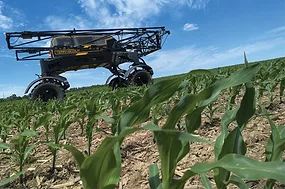
Jared Wiersma, equipment manager at Campbell Tractor in Nampa – a John Deere dealer with locations in Idaho and Oregon – says a lot of the tech research has been put into time and input savings on sprayers, fertilizer application, planting, etc. “Much of our current focus from John Deere is to control all aspects of inputs, right down to the individual weed,” he says. You can spot spray individual weeds in a field while traveling 20 miles per hour.
“Some of the pioneer technology has been around for 10 years already, but we’re now seeing it hit the main markets on Deere machines with good success. For example, we put a see-and-spray unit with a 120-foot boom John Deere 412 R sprayer where it can spot spray weeds in a field and turn on and off. Cameras see different weed types, down to a quarter-size weed or smaller. We’re seeing 75 percent chemical savings,” says Wiersma.
Filling the labor gap
“Coming soon is more autonomy and automation. We are trying things out with some of our main customers, like full autonomy on a tractor where you just monitor from a computer in an office. The tractor doesn’t need an operator; it’s like a kid with a joystick controlling it.”
With that comes labor savings. “We know labor is hard to find, but the downside is you don’t develop that labor and those jobs go away.” Agriculture is losing a number of skilled people.
“Everyone gets excited about technology and what it can do, but it can and will eliminate jobs, including some skilled labor and some manual labor. But it may create work in other places like analytics, computer software, engineering, etc.,” says Wiersma.
Matt Skinner, a precision farming specialist for Titan Machinery, oversees five locations in Idaho, and says that when GPS was introduced about 25 years ago, it was nothing more than enabling the machinery to drive in a straight line. “Many of the older farmers said they didn’t need GPS to drive a straight line. That is true, but GPS did a lot more. When it gets dark or windy, you couldn’t see where you’d been; you couldn’t see your previous rows or lines.” Today, those machines can keep going 24 hours; visibility is not an issue.
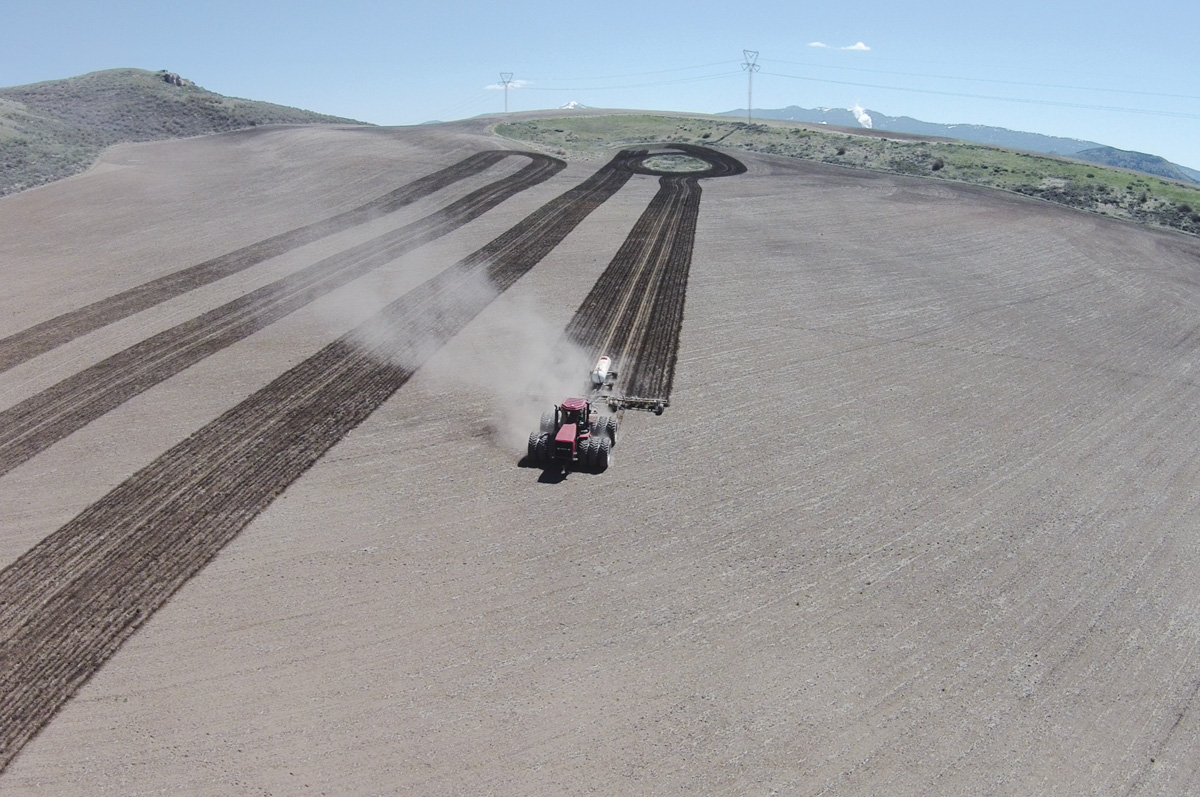
Automated equipment runs perfect lines in a field. Courtesy image.
“Without GPS, it took longer to farm a few hundred acres than it takes today. As technology advanced, driving a straight line is the most minimal thing GPS and precision farming does. Automation can completely control the machines now,” he says.
“With automation, via the cloud, we can know how many acres we’ve been through. We can see moisture levels and areas where we need more water or less water. Information coming through satellites to and from the machine goes to a website where you can access it through your phone or computer at home.”
Perhaps you have five tractors working in the same place. “Instead of sharing that data via thumb drive like we used to, now I can go into my field ops account and tell it to send that field boundary to all five tractors and when they get there, you simply tell it which line they are going to follow. This is very useful with combines if you have multiple combines going into that field,” he says.
This saves a lot of man hours, fuel, and wear and tear on the machine. “This reduces operator fatigue. You don’t have to strain your brain to figure it all out. You don’t have to watch the header to make sure you are not missing anything or hitting anything, or watch the grain tank as it gets full. There was always a lot to focus on, and mental fatigue, to do everything at the same time. Now you just push a button and everything is automated.”
The machine goes to the line and stays on it. “The combine is automated; if you take in a big slug at once, it automatically slows everything down and makes sure it all gets separated, to have grain going into the tank instead of out on the ground,” he says. It saves a lot of time and money.
It’s also easier to find people to operate the new machines. “It’s so simple, anyone can do it. I talked to a guy recently whose 10-year-old son is operating a combine now.”
Greater accuracy, better efficiency
Brian Rigby has worked in precision farming for 23 years. He now works at Case IH doing precision farming and was sales director for the Pacific Northwest. “When farming first started using precision technology and GPS in southeast Idaho and northern Utah – that’s where I started and I’m now all over North America – it was mainly assisted steering and light bars. Then we got into autopilot, which changed the game for crop farmers. We used a technology called RTK, a radio-based network. Repeatability was phenomenal in corn, potatoes, onions or any other vegetables.” If a farmer was in the field often, he would not run over any of the crop.
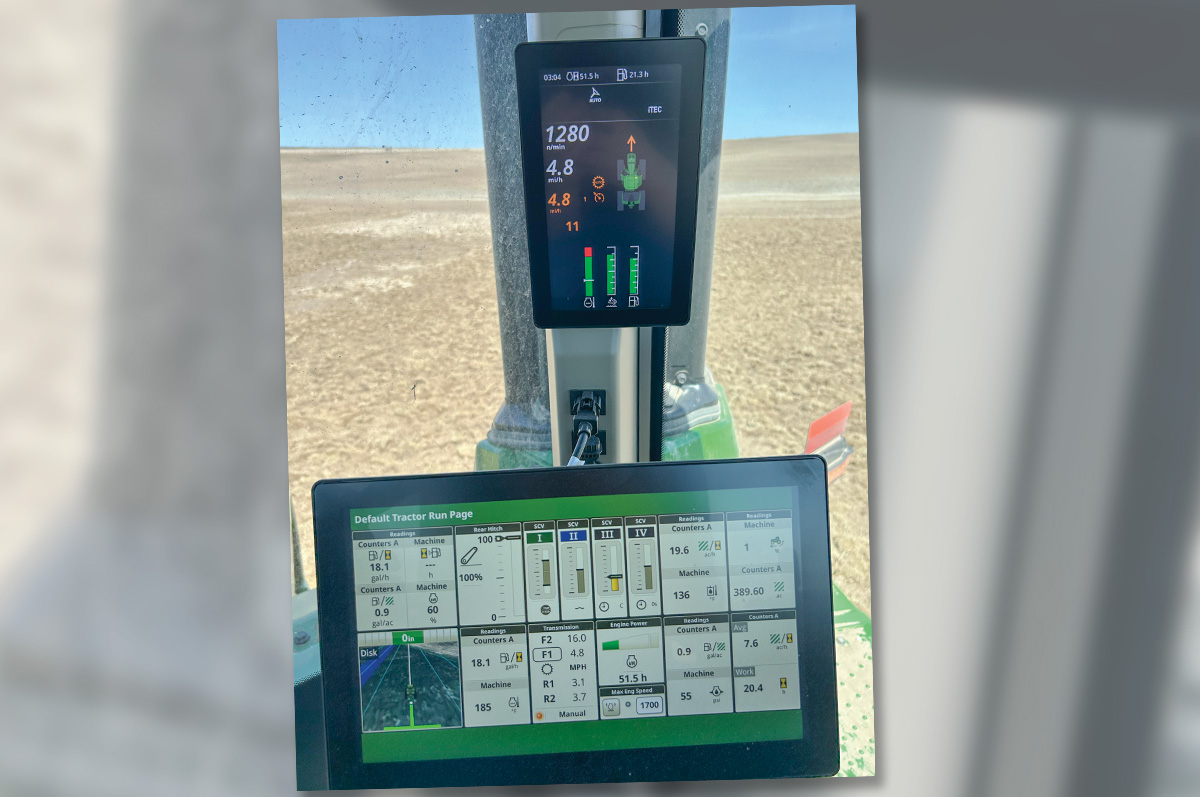
A typical screen shows the many things the automation is keeping track of for you all at once. Courtesy image.
“There are still some radio-based stations, but we also have deliverable sub-1-inch accuracy from satellites. John Deere runs an SFRT. Case and New Holland run an RTK-plus base station that goes off cellular. We now can have 50 miles between base stations and before it was only 8 miles,” says Rigby.
“There is a lot of accuracy delivered via satellites. If you buy a GPS system now, you can run WAAS (wide area augmentation system) – a government-mandated correction given to everyone. If I go down one way and come back again, I can be 6 to 8 inches from where my tool was the last time,” he says.
Other systems can get down to 2 to 4 inches pass to pass, and even more accuracy. “At first, just huge corporate farms could afford this, and now, most farmers have at least one or two tractors they can use with this technology because the cost has come down,” Rigby says.
“When I started in the business, I told customers what I had. Now, I ask them what they want to do, and there is usually a solution to make that happen," Rigby says.
Kellen Nebeker, Titan Machinery, grew up on a potato farm in Murtaugh, Idaho. He witnessed firsthand the dramatic technological advancements that have reshaped farming. “My father would have enjoyed the incredible technology we now have at our fingertips in tractors, combines and swathers,” says Nebeker. “He’s been gone for 22 years, but I think of him often when I climb into a combine, tractor or even a corn chopper and see how far the equipment has evolved.”
Nebeker became an early expert on Trimble GPS systems, with a national reputation for technical support. “I helped Trimble develop several vehicle profiles, one of which is still being used in Claas corn choppers. I also helped develop implement steering systems on the hills near Glenns Ferry, Idaho, and those are still in use as well.”
He entered the GPS industry in 2006 and transitioned away from day-to-day GPS work in 2015. During that time, he watched precision agriculture advance from simply steering tractors and swathers in straight lines to creating systems to automatically follow circular pivot tracks. “Then we moved into application controls for liquid and granular products, all managed through GPS.”
One of the biggest breakthroughs came with infrared scanners. “As the crop moves through the chute into the truck, the system continuously measures the material passing through, providing valuable information instantly.”
He credits software engineers for developing the sophisticated algorithms behind the technology but remains fascinated by the practical applications. Information can be collected on the go. “That data can be used to build maps for the following season. Farmers can identify strong and weak areas within each field and make better decisions about irrigation, fertilizer applications and overall crop management.”


.webp?height=auto&t=1783636475&width=285 "63802-Thomas-GPS-equipment--Automated-Magnum-Tractor--Matt-Skinner-photo(1).jpg")