Farming is a risky business – and a solid risk management plan is essential for the long-term success of any farm. While a complete risk management plan should address all major risk areas (production, price, financial, legal and human), price (or market) risk deserves extra attention. Crop prices are volatile, and for many producers, the market price at harvest in 2025 was below their cost of production. While no one has a crystal ball, a producer with a basic marketing plan can take steps to mitigate their price risk and increase their chances of long-term profitability.

Start with an objective
First and foremost, a good grain marketing plan begins with an objective to outline your high-level marketing goal. For example:
- “Buy crop insurance to protect my production risk and have 50% of my expected crop (based on actual production history) priced by May 1st."
Set marketing targets
The next consideration is deciding what will trigger a marketing decision: time alone? A price target? Some examples are:
- "I will price 10% of my anticipated yield on the first of January, February, March, April and May.”
- “I will price 25% of my anticipated yield once the wheat price reaches 110% of my expected breakeven price and price another 25% if the wheat price reaches 140% of my expected breakeven.”
There are drawbacks to both of those examples. What if the first five months of the year represent the lows? What if the price never reaches my price target? It’s valuable to “backtest” your plan by comparing what you plan to do with how it would have performed in the past.
Determine the how
Farmers today have countless options to manage price risk. Many of those options can be done individually through a broker, but the most common options involve working with a local elevator. A few of those options are:
- Forward contract: Under this agreement, the producer agrees to sell a specific quantity of grain at a specific price during a specific delivery window to a specified location. This is the only option that removes both price risk and basis risk.
- Hedge-to-arrive (HTA): A producer enters into an agreement to lock in the futures price today but leaves the basis to be set on a future date for a specific quantity of grain to be delivered in the future. When executing an HTA contract, a merchandiser places a hedge on a producer’s behalf by selling deferred futures contracts. An HTA contract eliminates the futures price risk, but the producer is still exposed to basis changes.
- Basis contract: With a basis contract, the producer agrees to deliver a specified amount of grain on a future date at a fixed basis but leaves the futures price open to be set later (but before the delivery window).
- Minimum price (MP): The producer agrees to deliver a specified quantity of grain at a minimum guaranteed price in a future delivery window. An MP contract allows the producer to create a price floor while taking advantage of potentially higher prices before the delivery window.
- Delayed pricing (DP): A price later or DP contract allows a producer to establish the price of grain at a later date. After delivering grain to the elevator, the producer prices the grain at a later date within a specified window. During this time, the producer is fully subject to both price and basis risks.
- Average price: The term average price encompasses a range of products that operate on the same principle. Generally, an average price contract is a variation of the standard HTA, but with a key difference: Rather than entering into the entire position at once, the pricing spreads out over a period of time. The producer determines the number of bushels to sell each week during a given window, creating an average crop price. They can set the basis at any time during the given window. Alternatively, they may opt for a series of cash forward sales instead of HTA-type sales. In such a scenario, the producer does not need to set the basis.
Each of these options has pros and cons, and each has a year where they have performed better than the others. More can be read about these tools in the University of Idaho’s Extension Bulletin Managing Price Risks Using Grain Contracts.
Additional considerations
- There’s plenty of tools to go around. You don’t need to choose one pricing tool – a prudent farm manager should explore a combination of the options available.
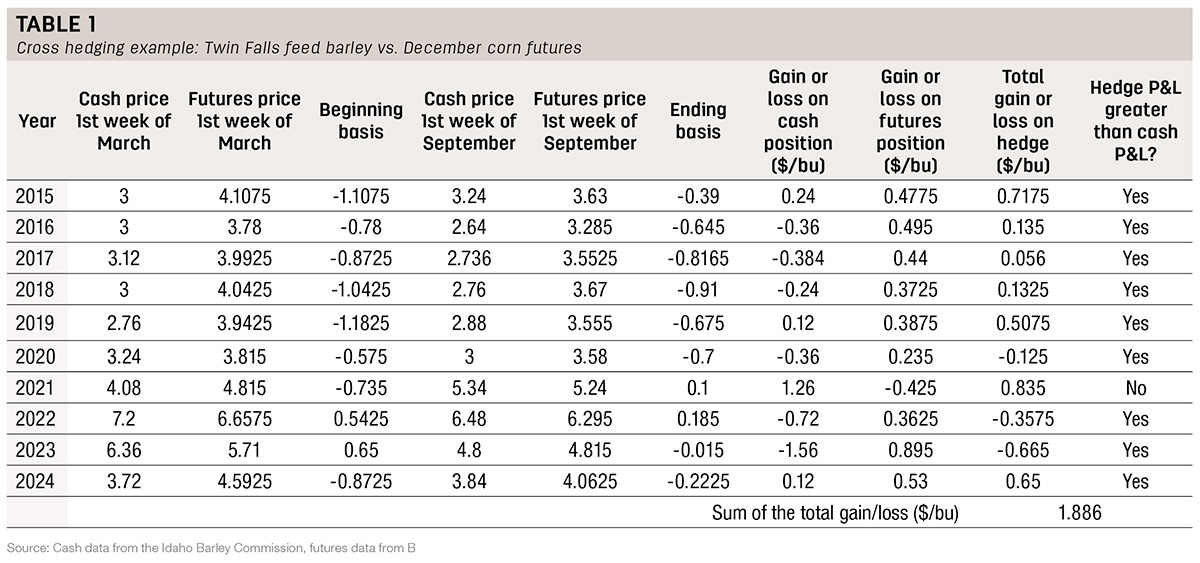
- What if I grow a crop that doesn’t have its own futures contract? A producer or elevator may be able to manage price risk using a futures contract for a commodity with similar attributes and fundamentals – this is called cross hedging. An example would be hedging feed barley with corn futures. If a producer in Twin Falls had priced 100% of their feed barley crop in the first week of March and lifted the hedge in the first week of September over the ten-year period of 2015-24, that producer would have been better off for doing so.
Basic terminology
Cash price: the price quoted by a local grain elevator or merchandiser for a given delivery window (today or a future date).
Futures price: the price of an exchange-traded futures contract, which is the obligation to deliver a specified amount of grain on a future delivery date; futures price typically reflects global demand and supply conditions.
Basis: the difference between cash and futures prices, which reflects the cost of carry, insurance, freight, merchandiser margins, and local supply and demand conditions; basis can be either positive or negative and varies by location and time.
Price risk: the risk posed to a producer that the selling price will decline before delivery.
Basis risk: the risk that basis will move in unfavorable directions; basis risk is in general significantly lower than price risk.
Cash price = futures price + basis: final price received by producers can be decomposed into futures price and basis; most grain contracts deal with at least one of the three quantities.