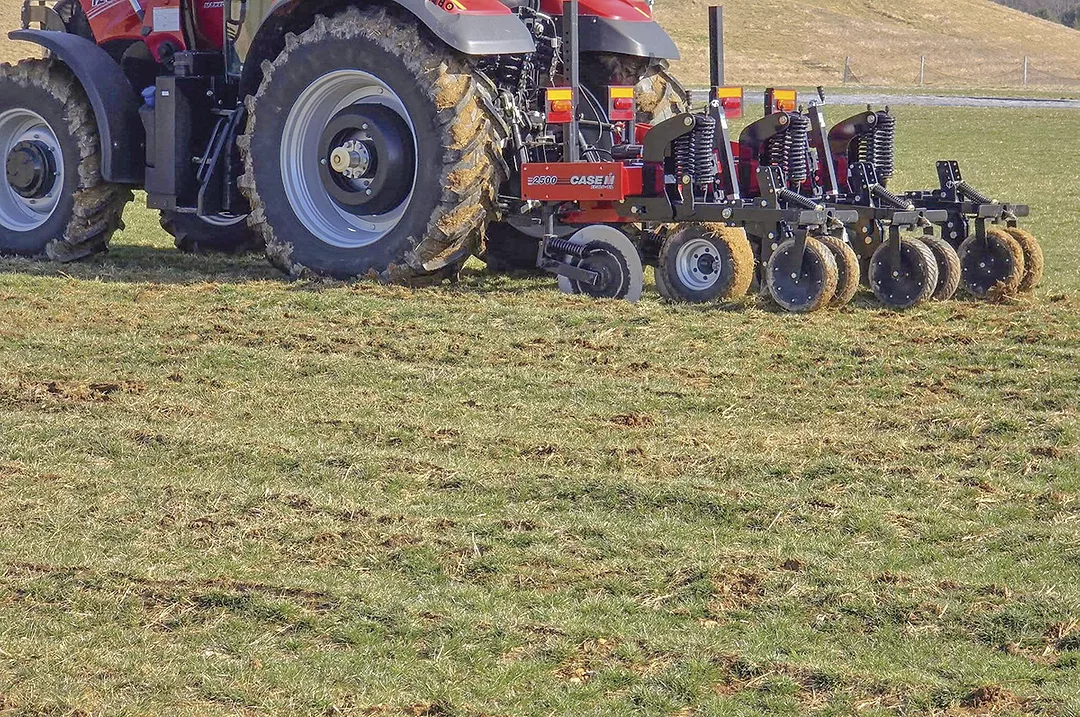
As much time as farming can gobble up, seeking ways to cut corners can be enticing. Cutting corners can also be detrimental. On many livestock farms, one corner that often gets cut is management of our pasture.

It is easy to understand that when the clock is ticking to get our corn in the ground and our crops cut at the proper stage, pasture gets pushed to the back burner.
Corn and hay are important crops. They are expensive crops to produce, and we invest a great deal in their establishment, growth and harvest. Perhaps we need to begin looking at pastures as an important crop, too – because it is.
When speaking to beef cow/calf producers, I often ask them how many of them are in the dairy business. Rarely will a hand get raised, but the reality is they are all selling milk.
They don’t have a parlor, but they do have a gang of highly motivated milkers.
They may not know what their cows gave last month on test, but when the weaned calves are weighed, they get plenty of information on which cows milked the best. At today’s prices, a good mama cow is queen of the pasture.
Without fail, one characteristic of a profitable livestock operation is the production of high-quality forage. The nutritional value of our pastures is key to that profitability.
Grazing animals do not tax the soil as much as hay production. Generally speaking, a single cutting of hay removes about 50 units of nitrogen (N), phosphorus (P) and potassium (K); a cow will remove about a tenth of that amount.
Still, it pays to monitor soil fertility, and I recommend that my clients pull a soil sample every three years to see if any amendments are needed.
One area to monitor closely is soil pH. On a scale of 1 to 14, a pH of 7 is neutral. Lower than 7 is acidic and higher than 7 is more caustic.
The reason why we want the pH in the 6.5 to 7.0 range is because this is the “sweet spot” where nearly all of our soil nutrients are most available to plants.
Acidic soils generally need an application of agricultural lime to raise the pH, and soils that are alkaline are amended by applications of elemental sulfur (S) or aluminum sulfate. In either situation, you should use caution to not overdo it.
For example, most of our soils in Virginia tend to be acidic. Gardeners apply lime and see good results, and because lime is relatively inexpensive, and they are dealing with a small area anyway, liming their garden becomes a yearly ritual.
The problem is lime can take up to three years to fully incorporate into the soil, so adding it annually can turn acidic soil into caustic soil in just a few years. When I see a soil sample with a pH over 8, it is a garden sample 99% of the time.
One last thought on soil pH. In our area, sage grass or broom sage was considered a sign of acidic soil. While that still might be the case, I'm seeing more and more that sage grass is a sign of poor fertility, especially P.
Controlling weeds is another important piece in pasture improvement. Weeds are thieves; they steal water, air and sunlight away from plants, especially grasses. If you think back to your high school days and photosynthesis, sunlight, carbon dioxide and water is all a plant needs to flourish.
If with the other two being equal, what can more efficiently catch sunlight, a blade of grass or a burdock leaf? The weed of course, which brings us to another need for pasture renovation – overseeding.
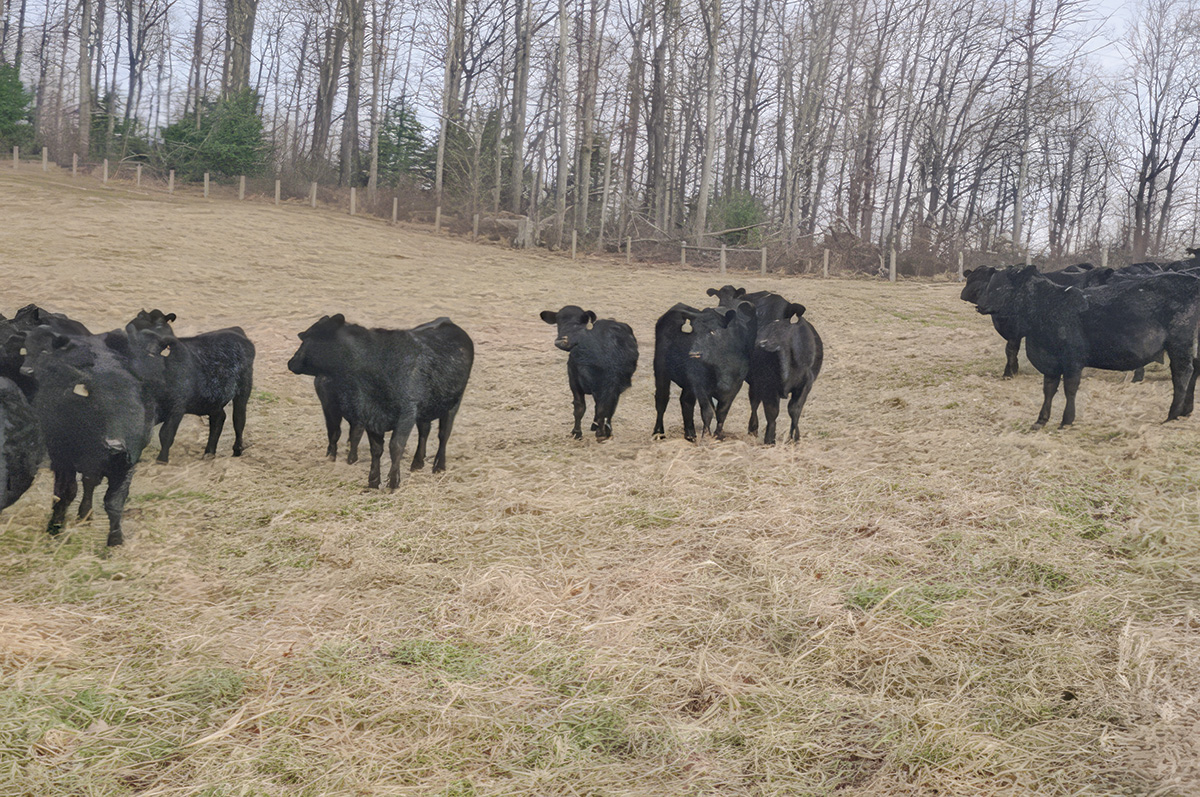
Feeder calves graze on managed pasture, exhibiting a healthy condition and uniformity prior to winter feeding protocols. Image by Andy Overbay.
As we treat weeds and they die, in their absence, ground is left bare. Bare ground draws more sunlight, and sunlight is more available to broadleaf weeds. So simply spraying weeds may not be the best thing to do, especially if our pasture’s growth is unable to shade the space vacated by the broadleaf.
If our weed pressure is a grass, then our control methods must change. If the invasive weed grows fast, like johnsongrass, you may have success treating the weed with a wiper system that slowly brushes the leaves of the johnsongrass with low doses that do not drift as easily onto non-target plants.
We can also help control some unwanted grassweeds or at least control their effects on the herd by maintaining a certain amount of residual grass in the wake of the animals grazing. Cool-season grasses do best when we leave 4 or more inches of grass standing after the animals move on. In comparison, warm-season grasses do best when they are clipped at about an inch.
Too often, the most damage we do to pastures is self-inflicted. We overstock and overgraze the pasture into oblivion. This is one way we already treat pastures and hayground alike. We often have our mowers set far too low for the hay crop in question.
Introducing legumes is a good way to improve pastures and can be one of the easiest. Frost-seeding clovers is a great way to combat issues like fescue toxicity. Delusion is the solution to pollution. Be advised that once again, we can overdo it. I generally recommend 4 pounds of red clover and a pound of white clover to help prevent bloat issues while still getting palatable protein into the pasture sward.
Finally, check your ground for soil compaction with a penetrometer. A penetrometer is simply a sharpened rod that measures how difficult it is to push the rod into the soil. They usually run about $200 to $250, but if you have soil compaction, the cost of the tool is the least of your issues. Aerators or vertical tillage tools are about the only way to combat compaction.
In closing, treat pasture the same as a perennial hay crop. Every year, try to renovate 20% of your pasture. Yes, you’ll lose some carrying capacity as you establish this rotation; however, if the end result is a more nutrient-dense grassland, your carrying capacity in the end will likely increase. You may also find that many of your animal health issues go away as well.