
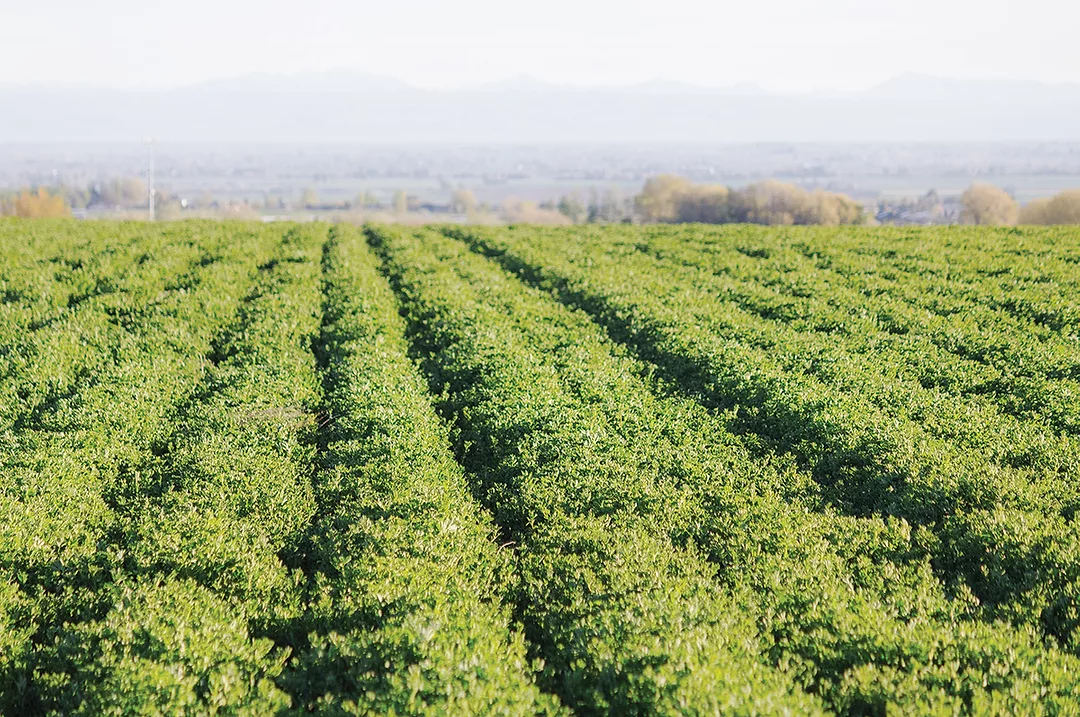
Alfalfa producers are always striving to make a profit in both good and bad years. To achieve this goal, producers often utilize improved genetics and/or optimize the use of inputs to improve quality and yield. However, there is one production factor that trumps all the others – an adequate supply of irrigation water for forage production.

The detrimental effect of climate change, combined with the increasing demand for limited water supplies, is starting to limit the production and profitability of alfalfa in some regions.
A new production strategy is currently being proposed by researchers to minimize the loss of revenue when irrigation water is limited. This strategy is capitalizing on alfalfa’s relatively unique genetic ability to survive extended periods without water.
Compared to other crops, alfalfa is better suited to withstand extended periods of drought stress. Alfalfa has a deep root system, allowing it to survive by accessing water deep in the soil profile, often reaching a depth of up to 20 to 25 feet. This advantage allows alfalfa to survive where other crops may not.
The second and probably most important attribute of alfalfa during a drought is its ability to go dormant during extended periods when adequate water is not available. During this dormant period, alfalfa ceases all aboveground growth until adequate water is restored. This reaction to drought is called drought-induced dormancy. This ability is similar to alfalfa's fall dormancy trait in which alfalfa goes into a dormant period as winter approaches to conserve resources to survive winter conditions. In this case, alfalfa’s dormancy is a response to the lack of adequate water for plant growth.
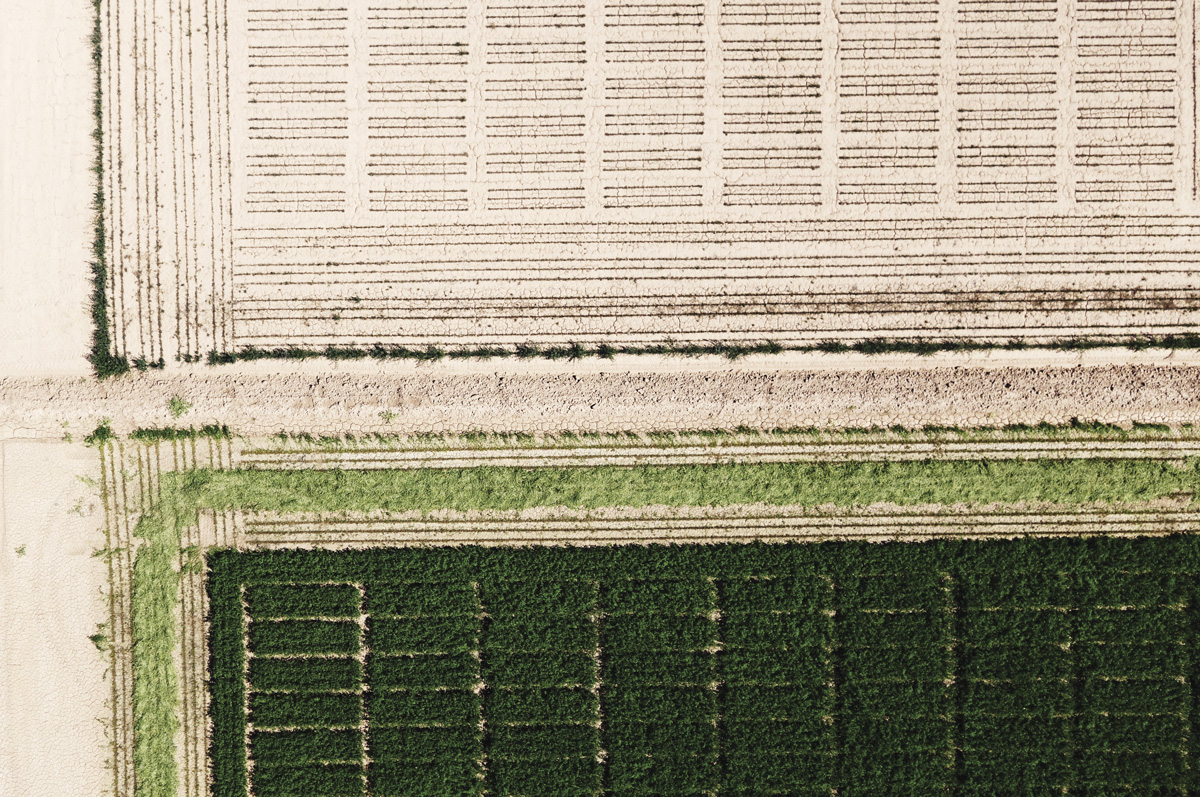
PHOTO 1: The top field depicts a drought trial with summer irrigation termination for three months. The bottom field depicts a normal irrigation trial. Image provided by Dr. Ian Ray, NMSU.
Utilizing alfalfa's drought-induced dormancy trait
For years, the profitability of alfalfa production has been centered around maximizing the number of cuts per season and applying optimal water and inputs needed to obtain high yields. Historically, producers harvested every cut during the season, even though the midsummer cuts are low in yield and forage quality, making them the least profitable cuts while using the most water per ton of forage produced. Taking these factors into consideration, researchers are suggesting that alfalfa producers should reconsider harvesting every cut during low water years and consider harvesting and irrigating only those cuts that are the most profitable. Withholding water during the hottest part of the summer will cause the alfalfa to go into a drought-induced dormancy (Photo 1). During this period, top growth will cease but the alfalfa will still be alive, lying dormant until the soil moisture is restored. This practice of introducing drought-induced dormancy into a harvest strategy has been tried by researchers at several western universities (New Mexico, Colorado and California) and it appears to be feasible in most situations and stand losses have been reported to be minimal. Research has shown that once water is restored, following a drought-induced dormancy period of three to four months, yields have returned to normal or near-normal levels with minimal stand losses (Photo 2). The exception has been in regions where summer temperatures are consistently above 100ºF and in soils with low water-holding capacities.
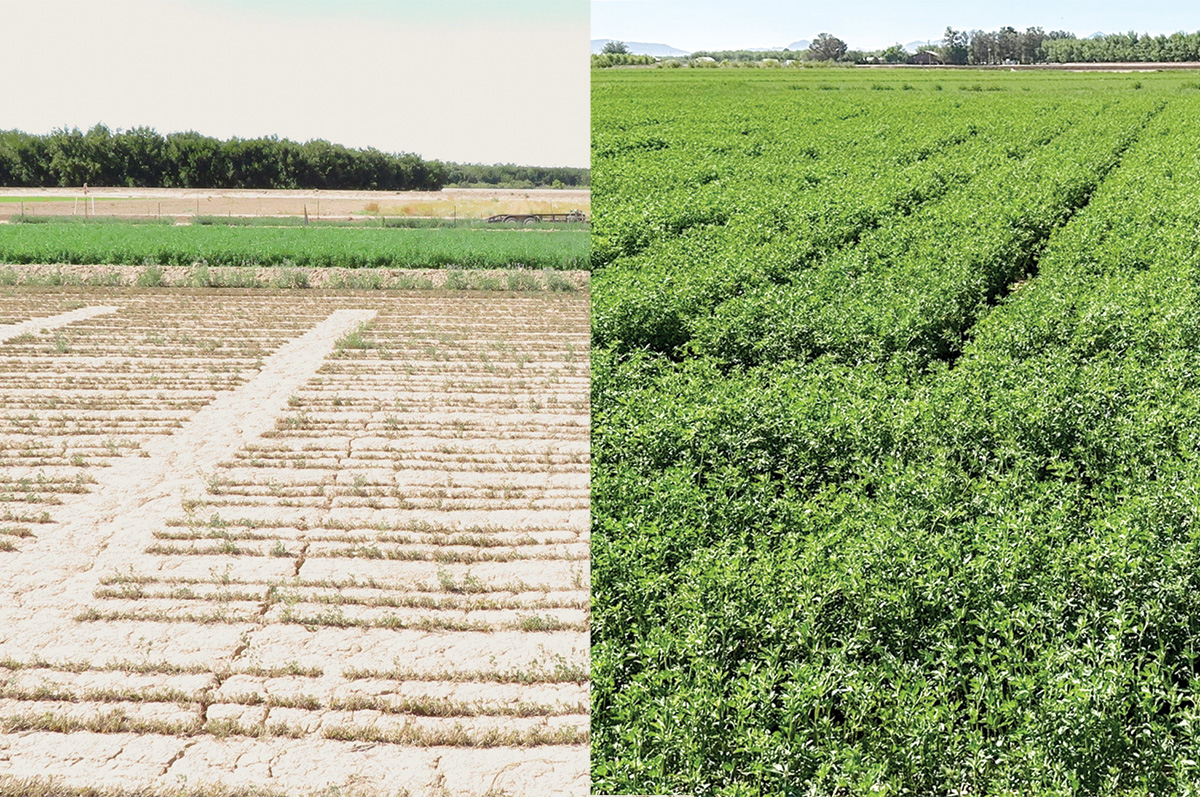
PHOTO 2: These photos depict alfalfa's ability to return to normal or near-normal production after drought-induced dormancy. On the left is an alfalfa field in a three-month midsummer drought-induced dormancy. On the right is a photo of an alfalfa field during first cutting the following spring after normal irrigation is restored. Images provided by Dr. Ian Ray, NMSU.
Harvesting less cuts can still be profitable
Recent research has shown that alfalfa production can still be profitable during low water years if harvest and water management strategies are modified. The new strategy is to harvest only the most profitable early-season cuts and eliminate the expense of harvesting the less profitable summer cuts. The rationale of this strategy is that early-season cuts are the highest yielding and highest in forage quality. During this time, the water use efficiency (WUE) is at its highest, providing the most forage production for each inch of water applied. Data also indicates that most of the season’s yield is captured by harvesting the first two cuts. By not harvesting the summer cuts, there is significant water savings, and yield revenue losses are offset by the reduction in harvest-related costs by eliminating two to three low-yielding summer cuts.
New genetics: ‘Drought-resilient’ alfalfa
Most university trials utilize the drought-induced dormancy management strategy using regular alfalfa varieties and achieved favorable results. However, there have been several new alfalfa variety releases from New Mexico State University that are taking this concept to a next level. These varieties were developed by selecting plants that were more “drought-resilient” under the above deficit irrigation conditions. These varieties “NuMex 501,” “NuMex 801” and “NuMex 802” are bred to survive without irrigation during the summer months and have the genetic resilience to return to normal or near-normal forage production once adequate moisture is available. General attributes of these varieties are:
- Less sensitivity to drought stress
- Remain productive under reduced water allotments
- Have more extensive root systems
- Display mature plant vigor under deficit irrigation
- Able to more thoroughly extract soil moisture
- Salinity tolerant
The following is the current thinking on how to utilize drought-induced dormancy to best manage alfalfa when irrigation water becomes limited:
- Plant the best adapted drought-tolerant alfalfa variety available for your region.
- Crop and water management of fall-planted stands can commence the following spring.
- Depending on the available water supply, apply full irrigation treatments to the first two to three cuts in the spring and early summer.
- After the last full irrigation treatment, withhold water for the next two to three months to initiate a “drought-induced dormancy” during the less productive hot summer months.
- If there is some residual growth during that drought-induced dormancy, avoid taking any harvests if the crop height is 6 inches or less. If the top growth is greater than 10 inches, it can be harvested if it is economic to do so, and there is at least 10% flowering.
- If water is available, irrigate the last fall cut to replenish root reserves going into winter.
To learn more on this subject, check out this previous article featured in Ag Proud – Idaho.




.webp?height=auto&t=1783636475&width=285 "63802-Thomas-GPS-equipment--Automated-Magnum-Tractor--Matt-Skinner-photo(1).jpg")
