Fuel prices have fallen from their 2022 peaks, but – like many other farm inputs – they remain well above pre-pandemic levels in 2025. This decline reflects a wider slowdown in global energy markets. On the supply side, crude oil production continues to rise in the U.S. and abroad, with OPEC+ countries pumping more oil than they did in 2024. Meanwhile, slower-than-expected global economic growth has eased pressure on oil demand.


Yet even though global crude oil prices dropped by 15% in 2025 compared to 2024, retail fuel prices have not fallen nearly as much. This is because beyond crude oil, prices at the pump also reflect refining, distribution and marketing costs, as well as taxes. Refining capacity in the U.S. remains a key constraint, as total capacity has not returned to pre-pandemic levels and utilization often exceeds 95% in certain months. When refineries operate near their limits, even a small disruption can cause price spikes. These structural challenges keep gasoline and diesel prices elevated even as crude oil prices fall.
Idaho is particularly sensitive to these pressures. The state has no in-state refineries and depends entirely on fuel from Washington, Montana and Utah. This reliance heightens vulnerability to regional refinery outages, seasonal maintenance cycles and transportation constraints along major pipeline and trucking routes. Refining capacity in the Rocky Mountain and West Coast regions currently stands at about 95% and 88% of pre-pandemic levels. As a result, fuel prices in Idaho often exceed the national average and can experience sharper short-term swings, especially during peak agricultural seasons when demand increases and freight networks are already stretched.
Gasoline
Figure 1 shows retail gasoline prices in the Rocky Mountain region (PADD 4, which includes Idaho), using data from the U.S. Energy Information Administration (EIA). Prices in the region peaked above $5 per gallon in mid-2022, then fell to $3 to $3.50 by late 2022 and early 2023. Throughout 2024, prices fluctuated between $2.80 and $3.50. In 2025, gasoline prices remained within a relatively narrow range of about $2.90 to $3.30 per gallon.
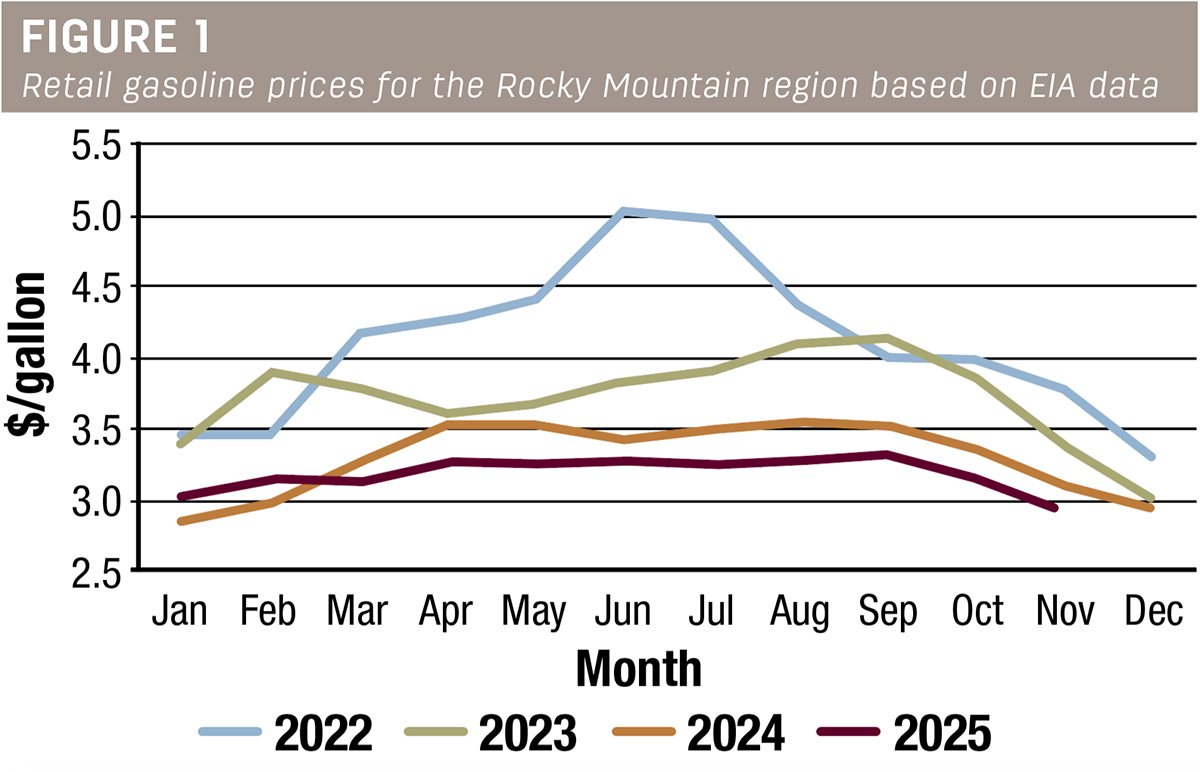
Looking ahead, the EIA forecasts the national average retail gasoline price to decline from $3.10 per gallon in 2025 to $2.98 per gallon in 2026, the lowest level since 2020. Idaho and the broader PADD 4 region are expected to follow a similar pattern. However, regional transportation constraints and supply limitations may result in slightly higher prices or more pronounced seasonal fluctuations than the national average.
Diesel
Nationally, the EIA projects retail diesel to average $3.66 per gallon in 2025, a 3% decline from 2024. However, most of that drop occurred early in the year, and since June 2025, prices have risen sharply and now exceed 2024 levels. The increase reflects declining petroleum diesel inventories, driven by reduced renewable diesel and biodiesel production and imports in first-quarter 2025 amid uncertainty over federal biofuel tax credits and negative profit margins. Meanwhile, distillate exports remain high due to strong international demand, especially from major European hubs that have increased imports from the U.S. to replace Russian supplies.
Figure 2 shows No. 2 farm diesel prices in the Pacific Northwest (PNW) based on the USDA’s Pacific Northwest Production Cost Report. Regional prices largely mirrored national trends, peaking at $4.60 per gallon in fall 2022 before easing to $3.90 to $4 by spring 2023. In 2024, prices ranged between $3.30 and $3.70 per gallon. Beginning in May 2025, prices rose sharply and settled between $3.90 and $4 for the remainder of the year.
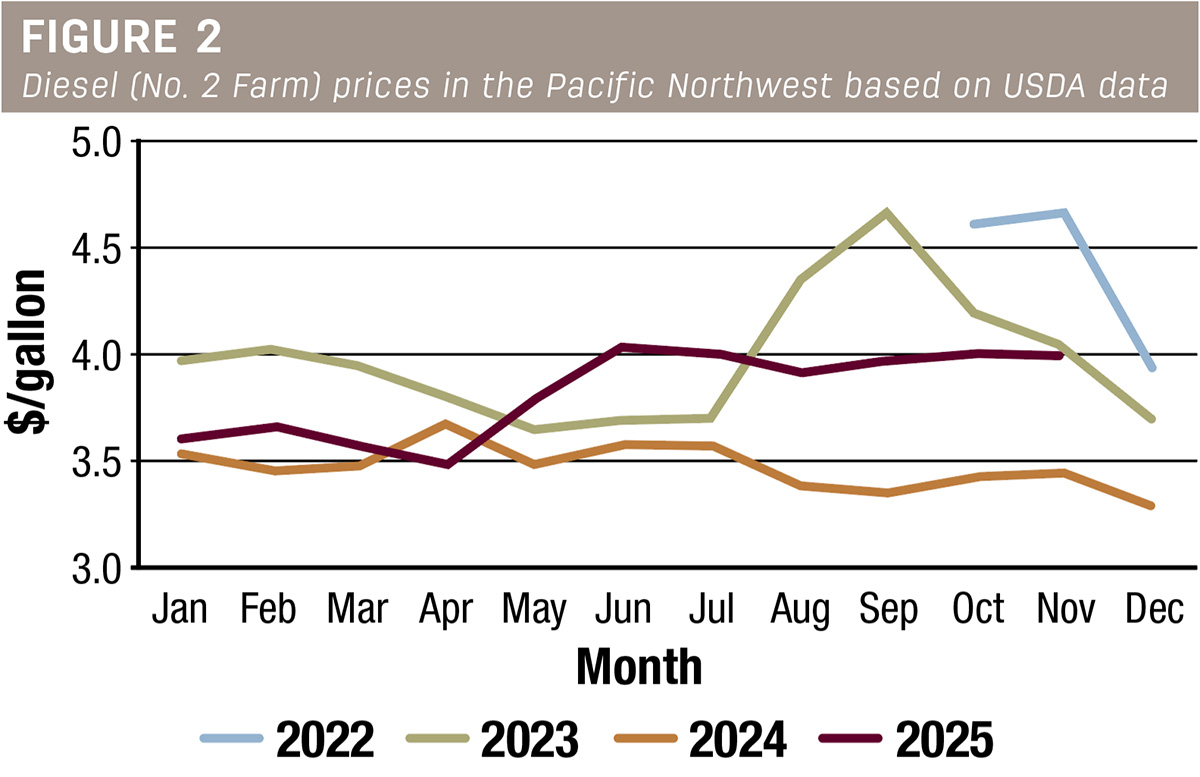
The EIA expects national average diesel prices to decline by about 4% in 2026, averaging around $3.50 per gallon. The agency also anticipates higher renewable diesel production in 2026, which will help offset some of the decline in distillate fuel oil production. Farm diesel prices in the PNW are likely to follow a similar pattern, although significant seasonal variability will remain.
Propane
Propane supply and demand follow a distinctive seasonal cycle. Production in the U.S. is relatively stable throughout the year, as it primarily results from natural gas processing. Consumption, however, increases sharply in the fall and winter. Propane inventories typically build during spring and summer when demand is low and are then used to meet heating and crop-drying needs later in the year. Prices can rise quickly when supply sources cannot respond to rapid increases in demand.
USDA data show that propane prices in the PNW were about $2.70 to $2.80 per gallon in winter 2022. They fell to about $1.90 to $2.30 for most of 2023 and remained $1.80 to $2.10 in 2024. In 2025, prices increased slightly, ranging mostly between $2.10 and $2.30. This rise partly reflects lower national ending stocks for much of the year compared to 2024. However, beginning in September 2025, national propane inventories increased above their 2024 levels (Figure 3).
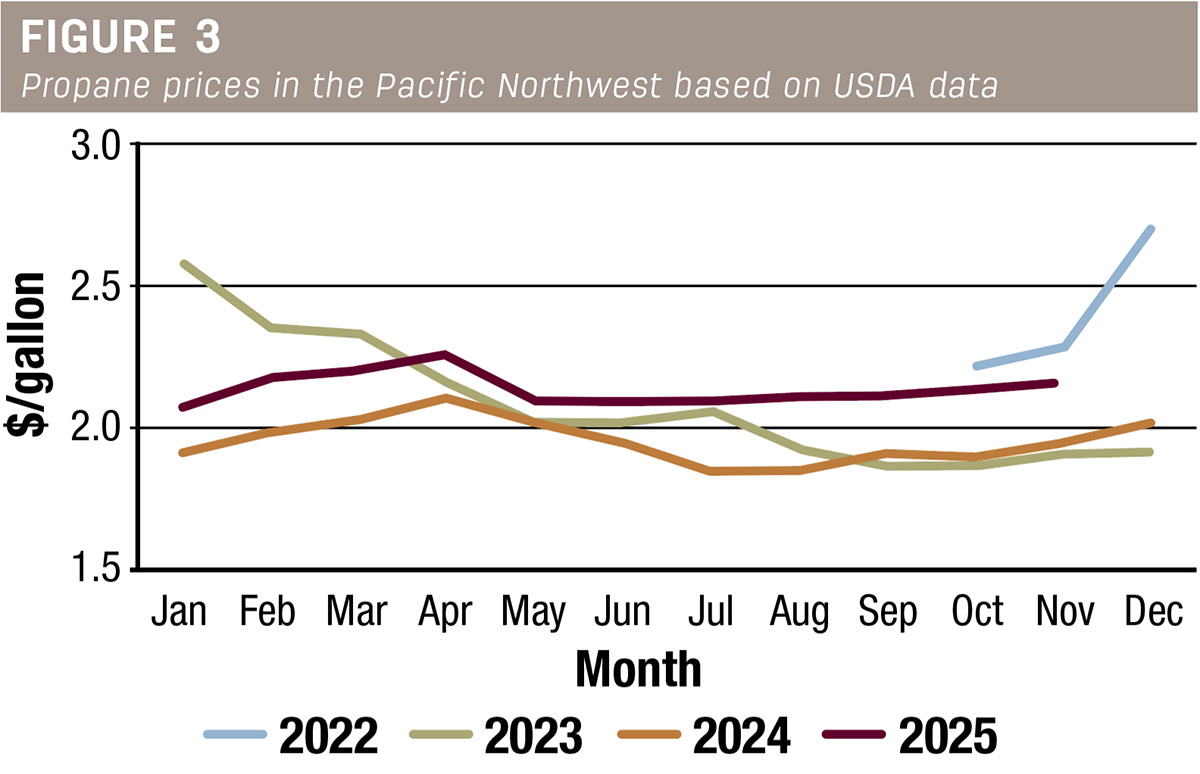
National inventories are currently strong, and the supply outlook for 2026 is relatively positive. The EIA projects national average retail propane prices to decline by 1% to 3% in first-quarter 2026 compared with first-quarter 2025. For the fourth quarter of 2026, prices are projected to fall by 3% to 8% compared with the same quarter of 2025. A severe winter or transportation disruption could still lead to short-lived increases, but overall conditions point to moderate price relief.
Overall outlook
Overall, fuel markets in 2025 reflect a combination of easing global pressures and persistent domestic constraints. Crude oil supplies have expanded and global demand has softened, yet geopolitical risks, shifting OPEC+ production policies and uneven economic growth continue to introduce volatility into global energy markets. At home, limited refining capacity, strong export activity and regional transportation challenges keep gasoline, diesel and propane prices elevated by historical standards. The EIA projects modest price declines in 2026, but Idaho’s reliance on out-of-state refineries means that local conditions will remain sensitive to both regional supply disruptions and sudden global shocks. Producers should expect gradual price improvements in the coming year, while also preparing for seasonal volatility and the possibility that global events may quickly alter fuel availability and costs.