
Water scarcity is increasingly concerning in the western U.S. Urban growth, population increase, ecosystem demands and droughts are straining limited freshwater resources. In semiarid regions such as Utah and Idaho, irrigation accounts for most of the diverted water, making it an important aspect in discussions about water conservation and sustainability. It is therefore increasingly important to identify and implement mechanisms that help reduce total water diversions from water bodies such as rivers, reservoirs and aquifers, while maintaining agricultural productivity.

Surface or flood irrigation, including border and furrow systems, is still widely practiced in many parts of the West because of its low energy requirements and compatibility with gravity-fed water delivery systems. Surface irrigation is often criticized for high levels of water diversion and nonuniform application. While this criticism can be valid, proper water management systems, such as laser land leveling and optimized applications, can make surface irrigation match sprinkler systems’ efficiency.
One promising and often overlooked solution in helping to improve surface irrigation systems’ efficiency is optimizing how it is managed. Automated surge irrigation is a promising example of such solutions, one that can significantly reduce water diversions while fitting within existing farm management systems.
What is surge irrigation?
Surge irrigation is the intermittent application of water to furrows or borders, creating a series of on and off water application periods of constant or variable time spans. This is achieved through alternating the application between two or more irrigation sets in different furrows, borders or dikes (Figure 1).
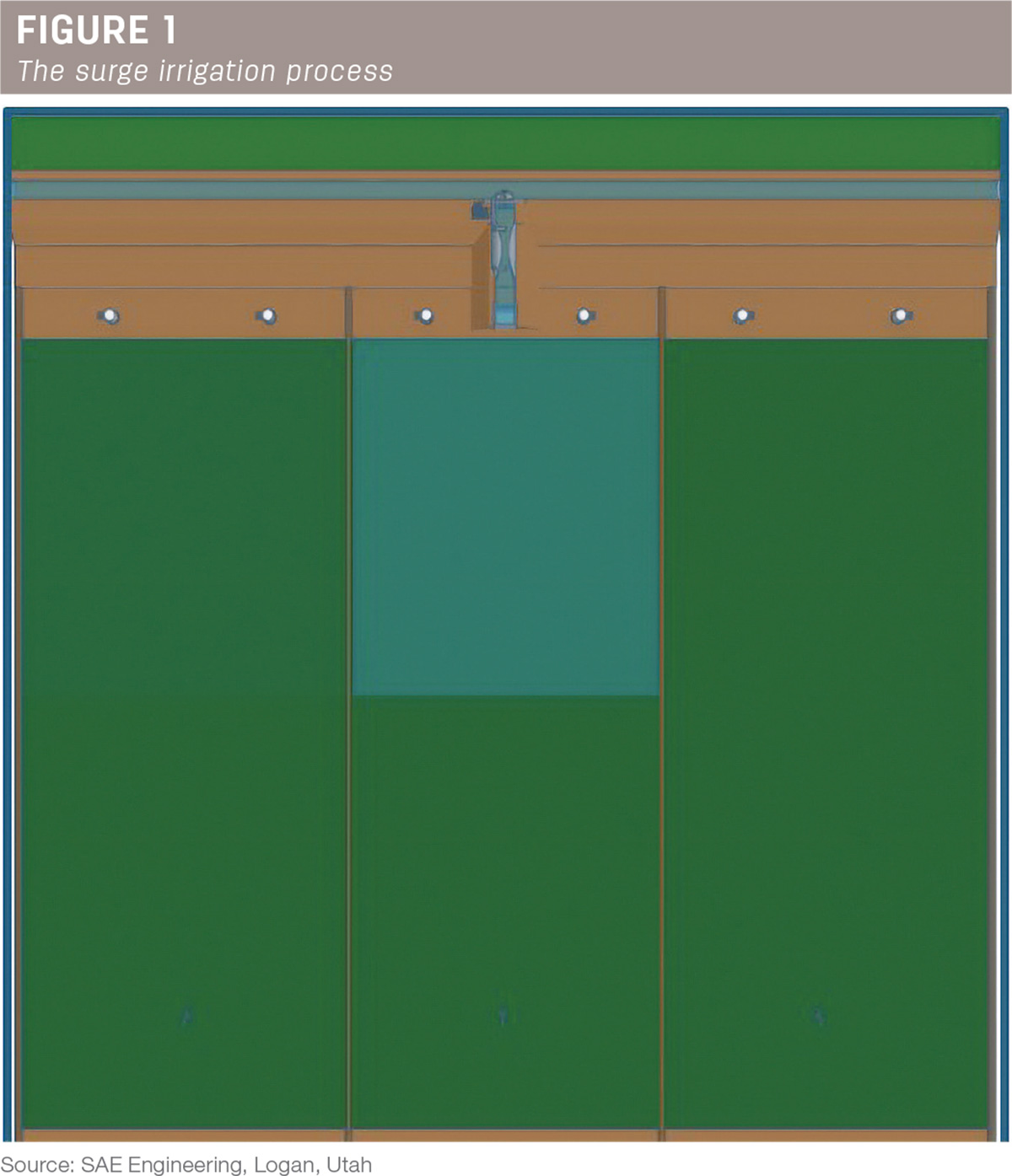
The repeated wetting and drying cycles cause a “sealing effect” on the soil surface, reducing the soil infiltration rate over time. Therefore, when water is reintroduced in the border or furrow that has been wetted, the water moves quickly past the wet length of the furrow or border to the part with dry soil. This process allows the water to advance faster through the field, with less deep percolation and better water application uniformity across the field and less tail-end runoff. The sealing effect is more pronounced in soils with high infiltration rates, such as sandy and loam soils. Besides soil texture, the surge effect is also dependent on other factors such as prior soil wetting history and duration of the on and off wetting periods.
Why automation enables surge irrigation
In traditional surge irrigation, the alternating water application is achieved by manually switching valves on and off or by opening and closing ditches. This is a labor-intensive process requiring close monitoring. In automated surge irrigation (ASI), the process can be achieved by using programmable surge valves (Figures 2 and 3) and controllers to regulate flow timing, cycle duration, and automatically and remotely turn valves on or off. ASI systems are compatible with gravity-fed canals and pipes.
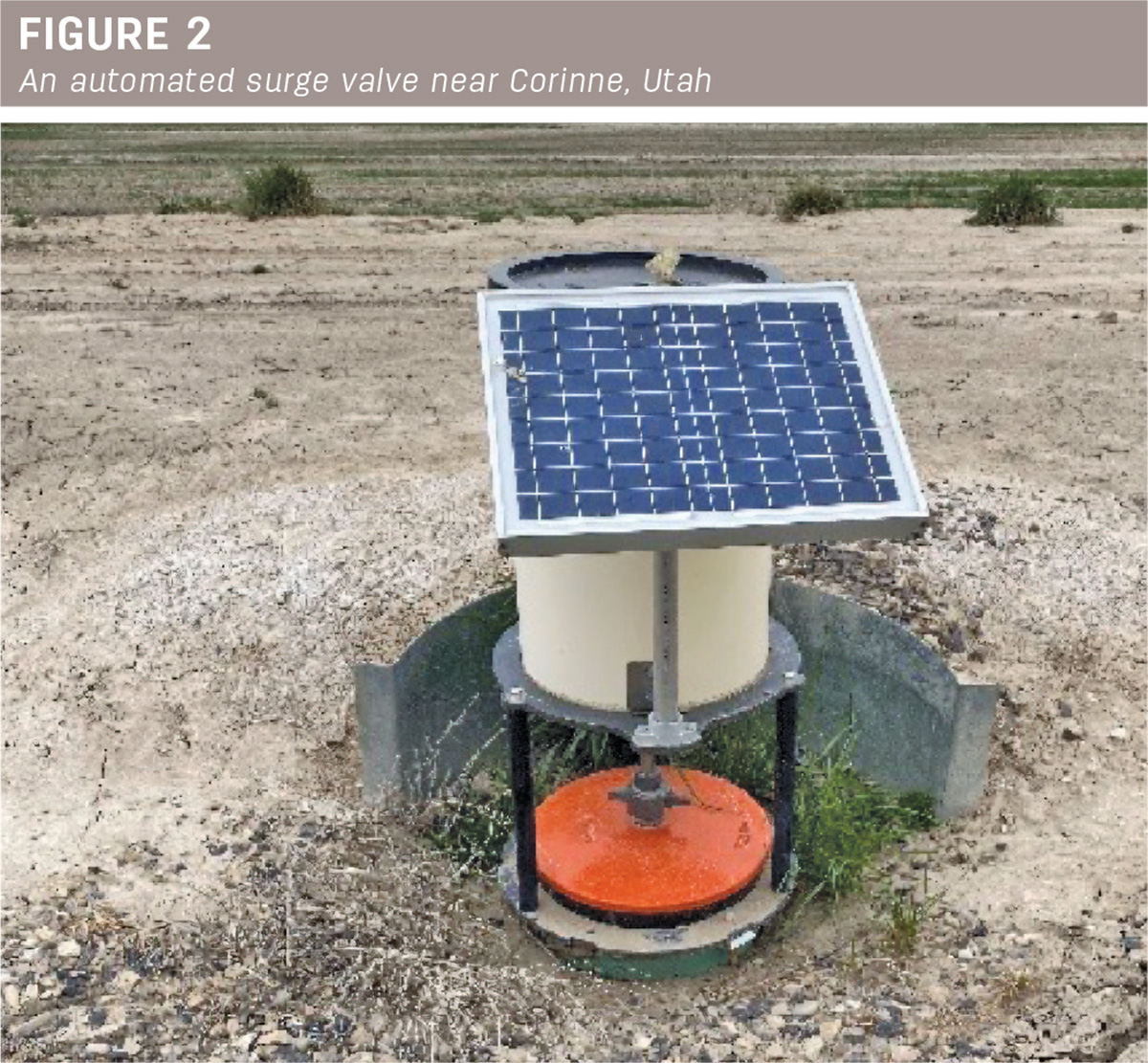
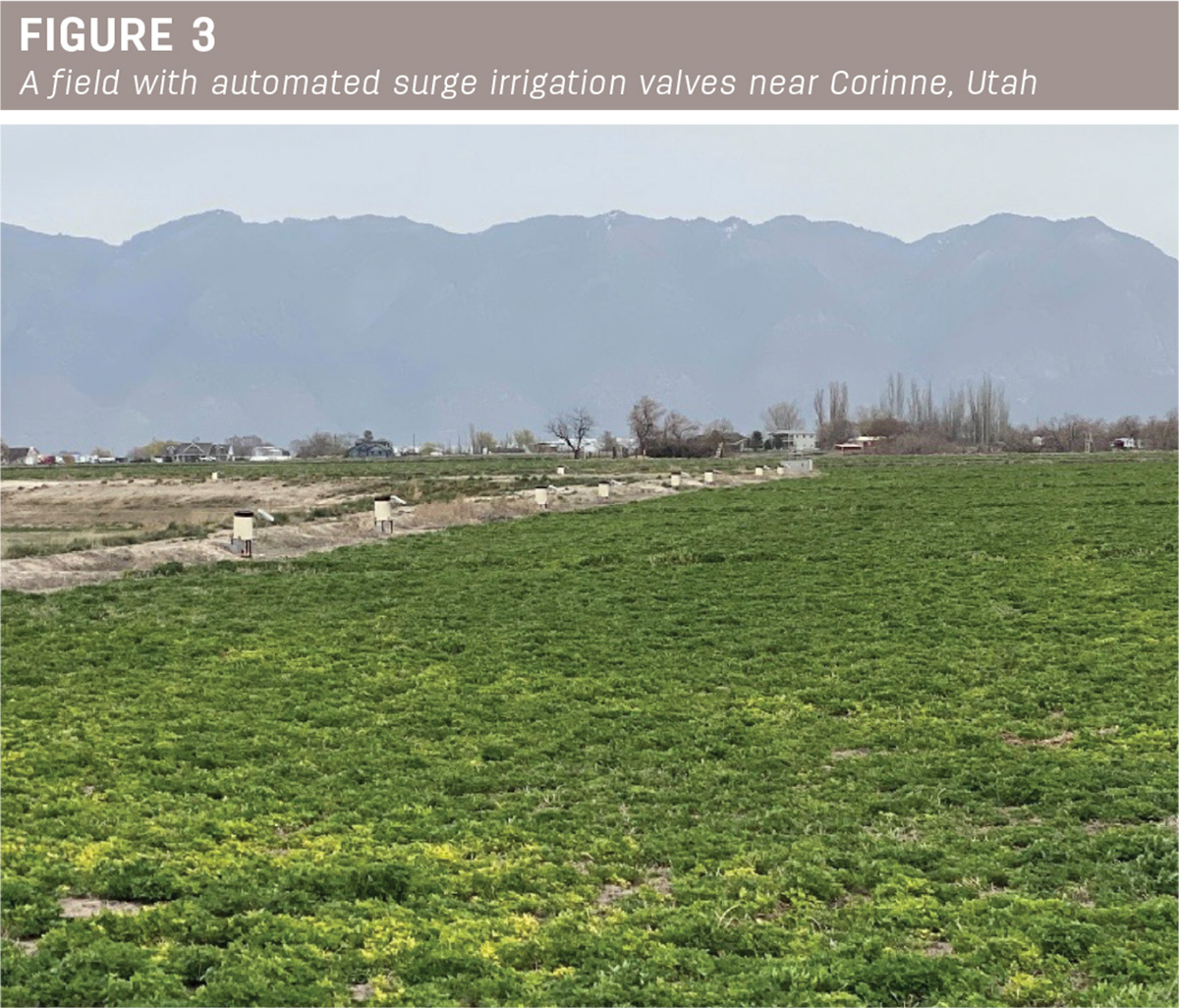
While surge irrigation has been studied for decades, automation is what makes it practical to implement. Automated systems remove the need for constant monitoring and allow irrigators to more precisely control water application and irrigation duration. This results in more even water application across the field and reduced deep percolation and tail-end runoff. The reduced water losses may directly translate into lower total applied water volumes. Over an irrigation season, the resultant reduced water diversions can be substantial.
From a grower’s perspective, ASI can be a management upgrade that may introduce consistency, repeatability and precision to surface irrigation without requiring major structural changes to farm management and operational systems.
Besides automating the water distribution at the head of the field with automatic valves, the water saving potential, efficiency and uniformity of ASI can be further enhanced by piping water distribution ditches, regrading or leveling the field, and reducing widths of border strips where applicable.
Findings from automated surge irrigation field studies
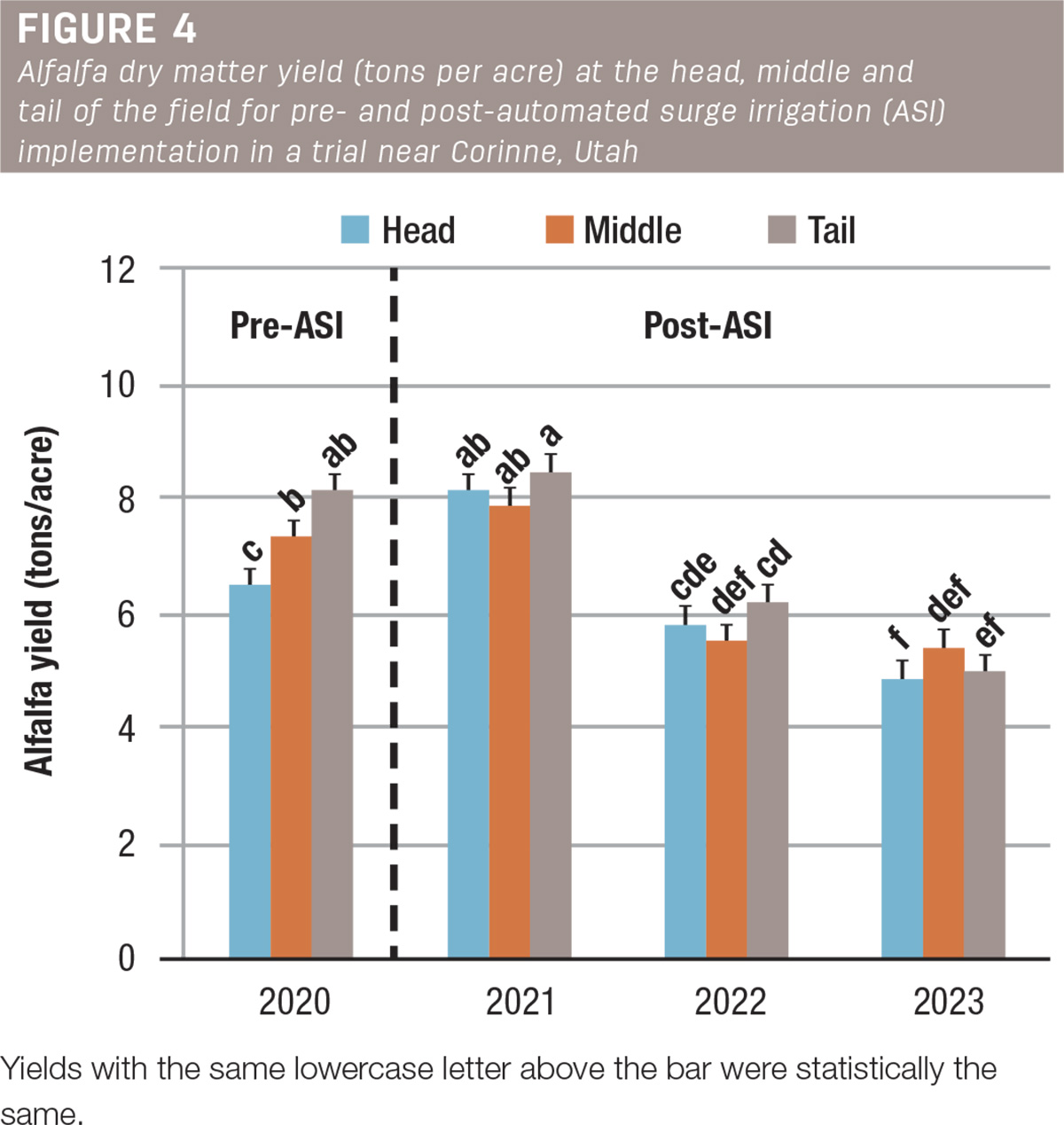
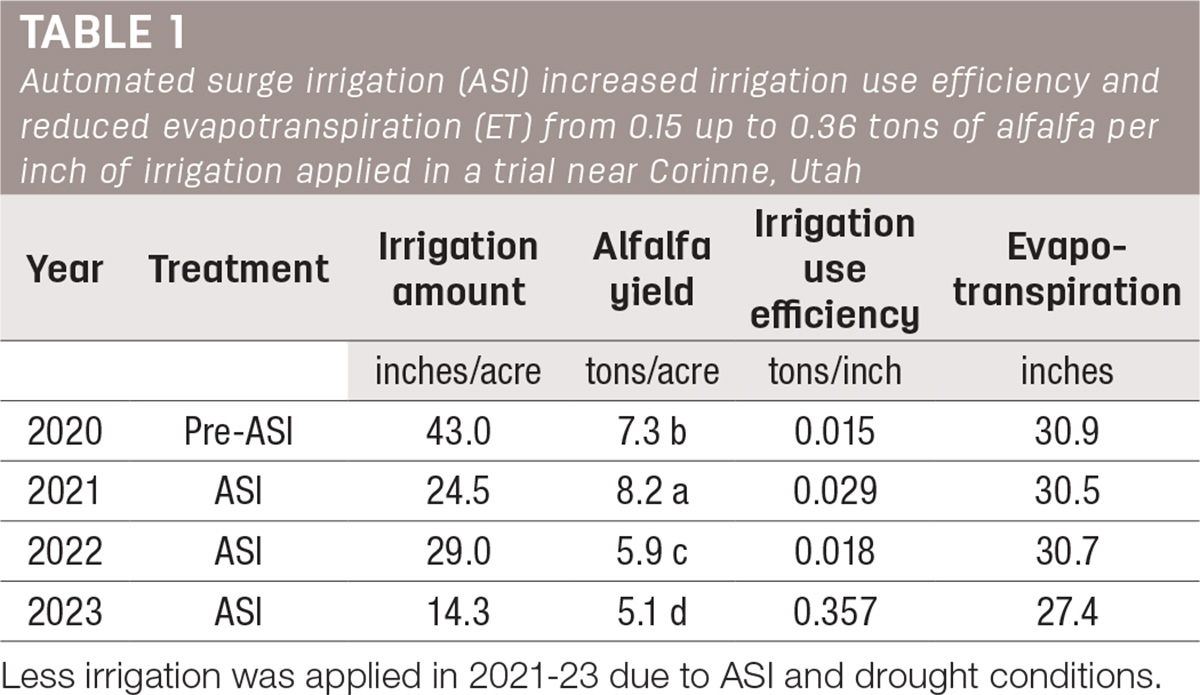
At an alfalfa trial in Corinne, Utah, ASI showed reduced irrigation water usage and increased irrigation use efficiency (alfalfa yield per inch of applied irrigation) in the first three years (2021-23) of automation (Table 1). It also improved alfalfa yield in one year (2021) (Table 1 and Figure 4). At the same site, there were no notable changes in consumptive water use (crop water evapotranspiration or ET), except in 2023 (Table 1).
Other research in New Mexico also found that surge irrigation reduced water diversion by 40% to 48% compared to normal surface irrigation. They also found that runoff using an ASI system did not exceed 3% to 8% of applied water and required 40% less time to irrigate than with normal surface irrigation.
Potential barriers to adoption
Upfront costs of equipment and installation can be considerable for ASI systems. The installation process requires expertise, and users need to learn to effectively operate and maintain the systems. If not properly managed, ASI may result in increased field tail-end runoff and ponding, resulting in reduced irrigation uniformity and yield loss.
ASI may be unsuitable where water supplies are inconsistent. A grower in Corinne, Utah, reported that during the 2024 irrigation season, fluctuating canal water levels disrupted his ASI schedule and required additional time to complete irrigation cycles. These disruptions also forced adjustments to drying and wetting cycles, which led to uneven irrigation across the field.
Potential implications of ASI on water management
ASI can achieve substantial reductions in water diversions and can be deployed quickly across large areas. Unlike conversion to pressurized sprinkler systems, it does not require major increases in power or significant changes to existing farm operations. These features make ASI a practical option for drought response, water conservation and optimization, and watershed diversion reduction programs. Further, it may also serve as a tool to help growers lower water diversions without sacrificing crop productivity.
Takeaways
Automated surge irrigation has the potential to help reduce water usage while increasing water-use efficiency without compromising crop yield. Savings on water usage, labor and time may provide benefits to some growers. These systems may, however, be costly to install and maintain and may be unsuitable in situations where growers have limited control of on-farm water delivery schedules and quantities.
References omitted but are available upon request by sending an email to an editor.
Ngoni Mufute contributed to this article. Mufute is a graduate student at Utah State University and can be reached by email.






.webp?height=auto&t=1783636475&width=285 "63802-Thomas-GPS-equipment--Automated-Magnum-Tractor--Matt-Skinner-photo(1).jpg")
