While many Canadian cattle producers have a reluctance to use growth implants in their herds, the science shows they are a proven tool to help build profits and enhance efficiency in their operation.

Dr. Lauren Younker, a feedlot production consultant with Telus Agriculture, in a webinar hosted by the Beef Cattle Research Council on Jan. 23, said philosophical factors, economics, labour, logistics and general confidence to perform implants were common barriers expressed about implants in a 2023 cow-calf survey.
Growth implants are a small hormone pellet placed under the ear skin of cattle. Given the high vascular blood flow in the ear, the hormone can be distributed around the animal and the ear does not enter the food chain.
Younker said implants are to be used with good maintenance practices such as healthy vaccinations and good nutrition, not a replacement for them. “Cattle that have a better plane of nutrition, or more groceries going into them, will have a better response to that implant,” she explained. “What it's doing is essentially helping your calves use the nutrients that they're consuming out on pasture to turn into more lean growth and more pounds for you as a producer at weaning time, or whenever you're planning on selling your calves.”
Most implants fall into three compounds, each one more aggressive in its effects: progrestins, a synthetic progesterone with less pronounced effects; estrogens (such as estradiol benzoates, zeranol, estradiol 17-beta-mimic estrogen) that improve gains on pasture when pasture quality is adequate; and androgens (testosterone propionate, trenbolone acetate-mimic testosterone), the most effective implant when paired with high energy intake in backgrounding and finishing rations.
Because of the varying potency of implants at different stages of cattle, Younker said most cow-calf producers would implant at branding typically with progestins or an estrogen-type implant. Reimplanting takes place for those who retain ownership. Androgen implants, the highest potency hormones, would be most effective when paired with high-energy rations in the feedlot.
“We always talk about implants in the feedlot world and in cow-calf too, being the silver bullet, and one of the highest ROIs that we can have. It’s because it increases our average daily gain anywhere from 10 to 30 percent and improves feed efficiency from 5 to 15 percent,” Younker said. “As a cow-calf producer, you're not going to be typically measuring how much your calves are eating because they're eating grass out on pasture. But you will be able to see that meaningful difference at weaning when you get anywhere from 10 to 20 extra pounds of calf. If that's something you're tracking year over year, implementing those implants, you will be able to see and track those gains relatively quickly.”
Younker added that producers must carefully schedule implants and reimplants on a timing calendar that makes sense with multiple factors toward marketing dates.
When calves are first implanted, the first payout sees a sharp increase with the maximum hormone release around seven to 10 days postimplant, and “then it slowly pays out over time and as that minimum concentration for productive response decreases, we’ll add in a reimplant if we’re in the feedlot setting or in a system where we can address some of those logistical constraints.”
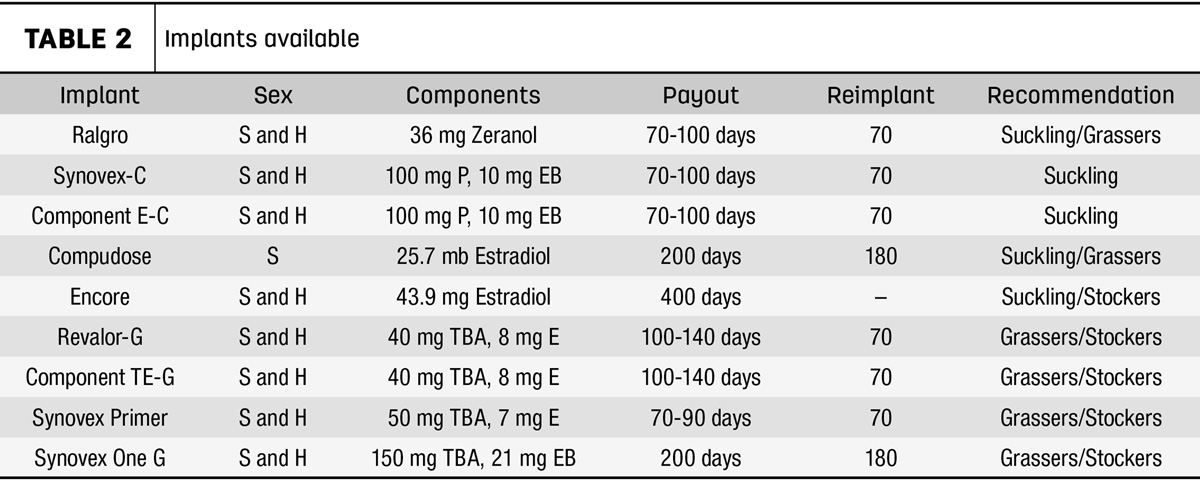
Implants that are legally authorized in Canada’s system (see Table 2) have specifics recommendations for sex, payout timing, reimplanting and classification of cattle.
Betty Green, manager of the G7 Ranch in Fisher Branch, Manitoba, explained that implant usage on her operation started 30 years ago after being asked to participate in a trial. Calves were weighed, and half randomly selected for implants, and the other half not implanted. Implants went in between 60 and 90 days old.
“The fall results at weaning showed a positive result for weight gain, and we were convinced,” Green said. “So we've never really looked back. Since that time, we have changed our protocols using a variety of implants, implanting all calves some years, then only steers. And that was primarily because we were worried about the impact on reproduction, and we had buyers who wanted unimplanted heifers.”
Implant procedures
Younker emphasized implant procedures when treating cattle require having the right tools. Proper implant procedure always goes smoother when guns are working, needles are clean and sharp, and there’s a ready supply of replacements. “A sharp needle will make the job a lot easier and will help you make sure the implant is done correctly,” Younker said.
Disinfecting a needle between each use with a solution is likewise a sound insurance method for abscess and dirty ears. A disinfectant tray with a solution of chlorhexidine or similar disinfectant added with water.
“I’ve done a lot of implant checks and would say almost all the implant wrecks I’ve seen always started with dirty ears and the wrong disinfectant use.”
For the actual implanting, Younker outlined the following:
- The calf is restrained and still
- Ear is clean and dry
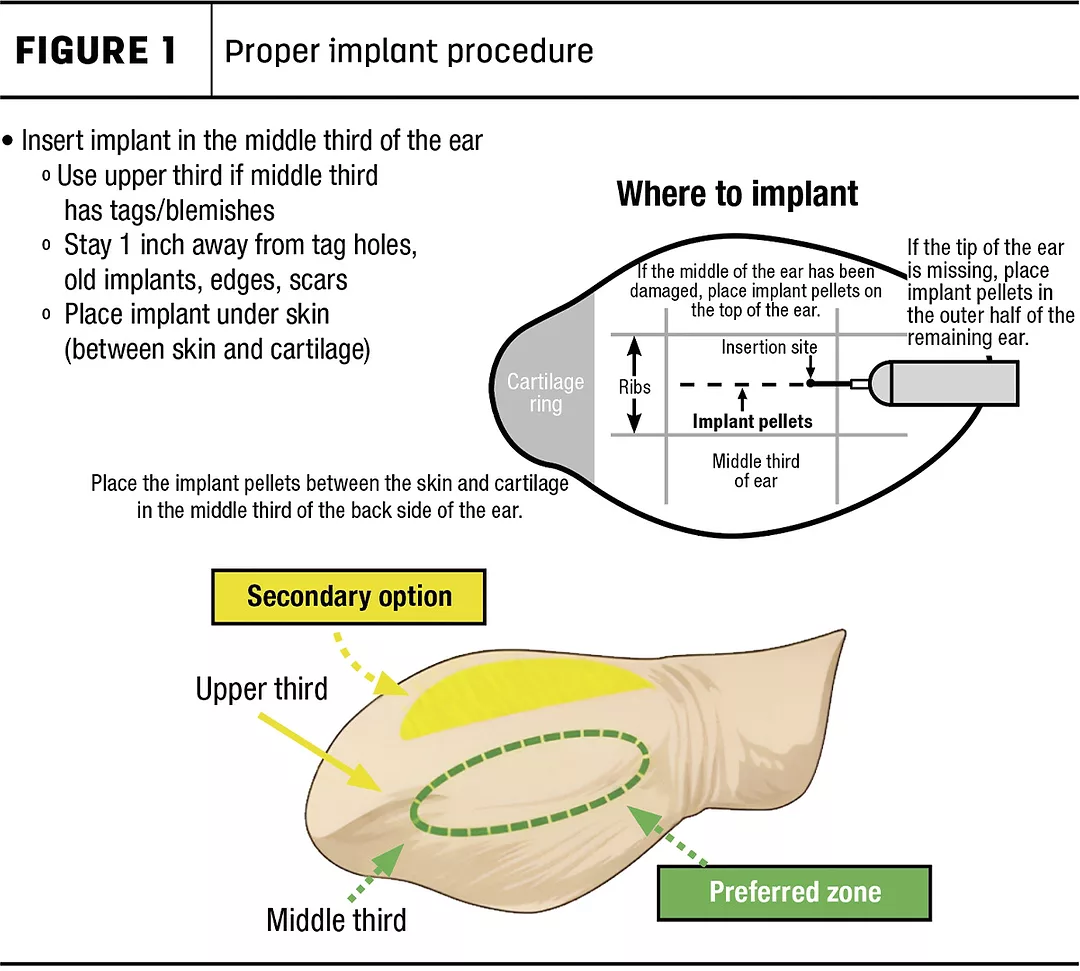
- Spot the middle third of ear – between skin and cartilage
- Insert needle shallow under the skin
- Deliver pellets in a straight line
- Pull out smoothly
You know you performed the implant correctly if you see a straight row under the skin, the pellets aren’t bunched, and the ear isn’t torn (see Figure 1 above).
If the pellet doesn’t go in, remove, disinfect and try again. If the pellets bunch up or if the cartilage is a block, you can check the needle sharpness or placement angle. Should swelling or abscess appear, review your ear cleanliness and technique.
Growth in calves both from preweaning and postweaning stages showed significant differences for implanted steers under University of Manitoba data. Average daily gain (ADG) was higher in preweaned implanted calves from birth to 83 days and continued to creep higher in the later stages of calfhood up to 168 days. Implanted calves at an average of $4.95 per pound per calf, leading to an average of $153.45 per head or $15,345 on a crop of 100 preweaned calves.
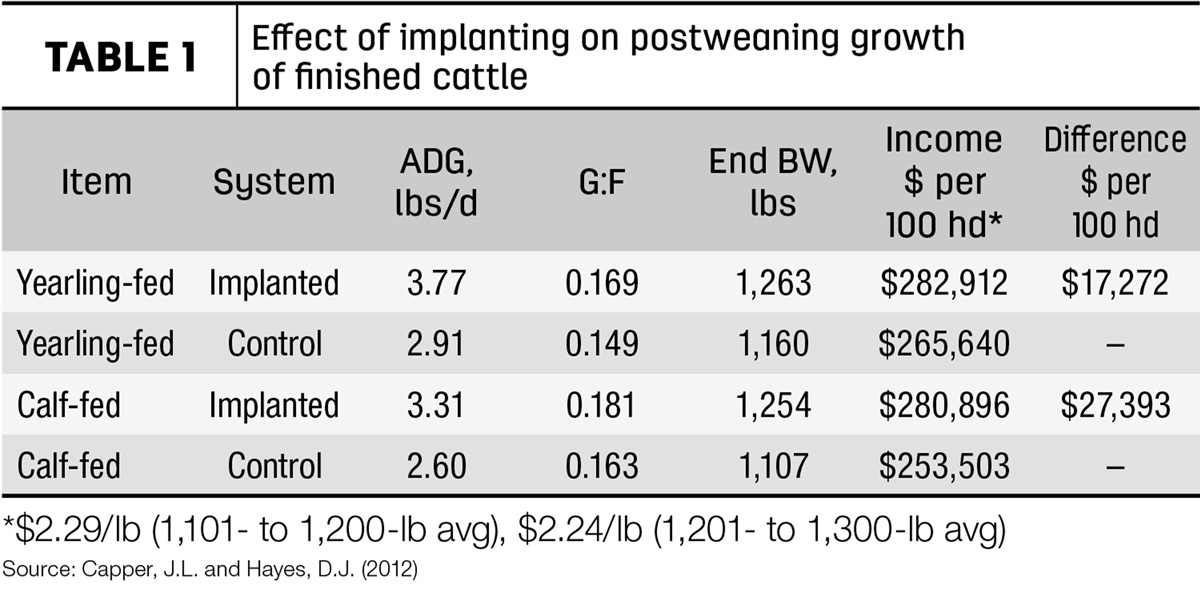
Postweaning calves saw even more greater ADG spreads among implanted and nonimplanted calves (see Table 2) with implanted calf-fed and yearling-fed livestock showing faster and higher feed conversions.
Environmental sustainability
While Green acknowledged that many producers like her were convinced to use implants for reasons linked to economic gain, the concerns of today’s consumers related to ranching’s environmental impact now add more incentive to being more efficient, and implants play a critical goal toward that goal.
Research from the University of Manitoba studied the sustainability of implants in helping producers be more time-efficient with cattle and helping consumers make informed decisions on food.
“We've all heard the concerns [about] greenhouse gases related to the production of beef or agriculture, the amount of land that's used for producing beef, the amount of water and the amount of ammonia emissions related to our industry,” Green said.
“The results that they found were pretty clear, 3 to 10 percent reduction in greenhouse gas emissions, 5 to 11 percent reduction in land use, 5 to 11 percent reduction in the use of water for producing beef, and 3 to 8 percent reduction in ammonia emissions. So in all four areas, there was an impact by using implants.”
Final notes
Green said it’s important always to tailor your selling approach directly to what buyers need. Highlighting suggestions she received from a cattle buyer in Ontario, she said producers need to tell buyers what implants you use on cattle. If you’re using the wrong implants, it can negatively affect cattle performance in a feedlot and can result in buyers not bidding on your calves.
Younker also noted that implants can go in heifers in a cow-calf setting during the suckling phase. The research shows no impact on future reproduction of those heifers, when implants are used correctly. Be sure to choose the right implant for use in both steers and heifers.
If you’re keeping replacement heifers, research suggests delayed first cycles when heifers are implanted at weaning. So consider not implanting those heifers. And sort replacements at weaning and implant the rest.
Watch the full BCRC webinar here.