
When a producer selects an alfalfa variety for his farm, beyond seed cost, the buying decision is generally based on the genetic attributes of the variety. Many factors are considered in the variety selection process; is it adapted to the growing region, does it have genetic resistance to the major pests/diseases known to occur locally and, of course, yield.

Beyond having resistance to root diseases, most of the criteria in variety selection has been based on the aboveground attributes such as forage yield and quality, leaf-to-stem ratio, fiber digestibility and resistance to foliar diseases and pests. Very seldom do alfalfa producers ask the question: What type of root system does the variety have below ground? To be fair, currently almost all the new alfalfa varieties being released are taprooted. However, going forward, asking that question about root type might become more relevant. The USDA Agricultural Research Service (ARS) and some alfalfa breeding programs are starting to look at the advantages branched-rooted varieties might have for some production regions. The importance of the roots can’t be understated since it is the root system that fuels all the top growth throughout the growing season, and utilizing various root types in variety development may aid in fine-tuning forage production in challenging soils.
Alfalfa root architecture
When alfalfa was first introduced into North America, genetic lines could be divided into four classes of root types: taproot, branch-rooted, rhizomatous and creeping-rooted. Each had evolved over time to survive in different environments. The following is a brief description of each root type and where they fit in today’s alfalfa production.
- Taprooted: These alfalfas were adapted to deep soils and their roots could penetrate the soil profile over 5 feet the first year and eventually reach depths of 25 to 30 feet in deep soils. This attribute allows it to access deep soil nutrients and soil moisture from a greater depth, providing enhanced drought tolerance.
- Branch-rooted: The branch-rooted alfalfas are adapted to shallow soils and lack a main taproot but have numerous large roots growing from the crown.
- Rhizomatous: This root system enables the plant to spread from the crown by horizontal stems and develops very broad crowns.
- Creeping roots: Creeping-rooted plants develop horizontal rootstalks from the main roots. These rootstalks can develop shoots that emerge out of the soil, becoming independent plants.
After alfalfa was introduced into North America, all these types of alfalfas were utilized to some extent by farmers and ranchers. The rhizomatous and creeping rooted plants were considered more persistent, since each plant type could spread and develop additional plants and filled in blank spots in the field. These spreading types were popular in pasture situations and at the time were considered more tolerant to adverse climatic conditions than tap- and branch-rooted plants. The disadvantage of spreading types was that they were generally lower yielding and their top growth was less upright or in some cases prostrate, making them less desirable for mechanical harvest. As alfalfa production shifted more to mechanical harvests, the spreading types became less popular. The branched-rooted types were adapted to shallow soils while the taprooted lines were better adapted to deeper soils. Eventually, over time, the taproot became the most popular root system used in variety development.
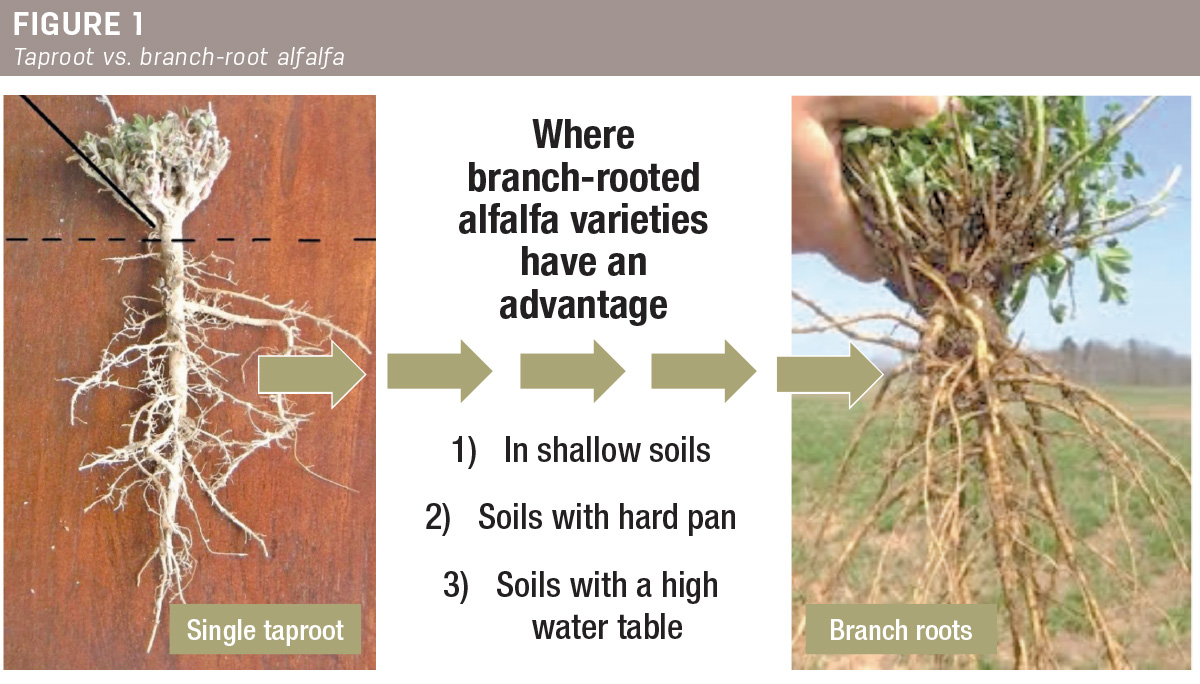
Up until recently, alfalfa plant breeders have utilized basically one root type for variety development and avoided implementing other root types for the bottom half of the plant. Since the 1970s and 1980s, almost all the alfalfa variety releases have been taprooted varieties. Taprooted types were considered the preferred root system since they were adapted to a wider range of soil conditions. Variety development using other root types was generally dismissed since they were adapted to a narrower range of soil profiles and/or their growth habit was less suited for mechanical harvests. Taprooted varieties have performed very well, but it is reasonable to assume that they may not be the best root type for all soil conditions. The concept that one size fits all may have worked for a period of time, but research has shown that there are some conditions where root types such as branch-rooted alfalfas might have an advantage over taprooted varieties.
Branched-rooted alfalfa
The following are some of the production situations where choosing branched-rooted varieties might be advisable over other root types.
- Fields with shallow soils: The branch-rooted varieties maximize root-to-soil contact, enhancing nutrient and water extraction from limited soil volumes.
- Soils with hard or plow pan layers in soil profile that restrict deep root growth.
- Soils with high water tables where water-soaked soils prevent deep root penetration.
- Soils prone to heaving: Heaving is the mechanical squeezing of alfalfa plants out of the ground during extended periods of early spring freeze/thaw cycles, resulting in plant death. Branch-rooted types with multiple large roots help anchor plants in the ground better than taprooted types.
Additional advantages
- The branch-rooted types have a larger volume of roots in the top foot of soil, which enhances nutrient uptake of applied fertilizer.
- Preliminary research by the USDA ARS indicates that branch-rooted alfalfas tend to have a greater number of N2 fixating nodules than taprooted varieties.
Varieties with both branch-root/deep-set crown traits
Branch-rooted varieties that also have the deep-set crown trait are showing promise for improved grazing/traffic tolerance. The sunken crown helps reduce traffic injury to both the crown and stem buds, while also improving winter survival and resilience in compacted ground. These root systems also contribute to nitrogen fixation and carbon sequestration benefits.
Summary
Taprooted alfalfas still dominate new variety releases; however, the case can be made that other root types, especially branch-rooted alfalfas and/or branch-rooted varieties with deep crowns, might provide production advantages in some situations. Public and proprietary alfalfa breeders are currently developing new varieties with varying root types that will give producers more choices to fine-tune their production needs in varying soil conditions.





.webp?height=auto&t=1783636475&width=285 "63802-Thomas-GPS-equipment--Automated-Magnum-Tractor--Matt-Skinner-photo(1).jpg")
