Organic certification requires that land be free of prohibited substances for three years (36 months) before the harvest of an organic crop. A common strategy among agricultural producers in Idaho and other semiarid agricultural regions is to plant an alfalfa hay stand and keep it in production for three or more years after establishment. While this strategy makes a lot of sense, especially in dairy-producing regions with consistent alfalfa hay buyers nearby, there are several motivations for considering cereal-pulse (here we focus on peas) intercropping as an alternative. These include:

- Less water is needed for an intercropped cereal-pea crop than for alfalfa hay. Typical water requirements are approximately 19-21 acre-inches for peas and barley/wheat, while requirements for alfalfa hay is approximately 28 acre-inches. Thus, the intercropped cereal-pulse crop may be particularly advantageous in limited water situations.
- Under an intercropped cereal-pea system, there is potential to market multiple products from one field. This means there may be opportunities for increased sales from growing both grain and biomass products of different types.
Field trial design and results summary
To investigate the agronomic performance of the cereal-pea intercropping system under different water availability scenarios, a field study was implemented at the University of Idaho Aberdeen Research and Extension Center from 2022 to 2024. The design of the field experiment regarding seeding rates is shown in Table 1. In addition to the seeding rate treatments, there were two water regimes: 100% growing season evapotranspiration (ET; the well-watered (WW) regime) and 50% ET (the drought-stressed (DS) regime).
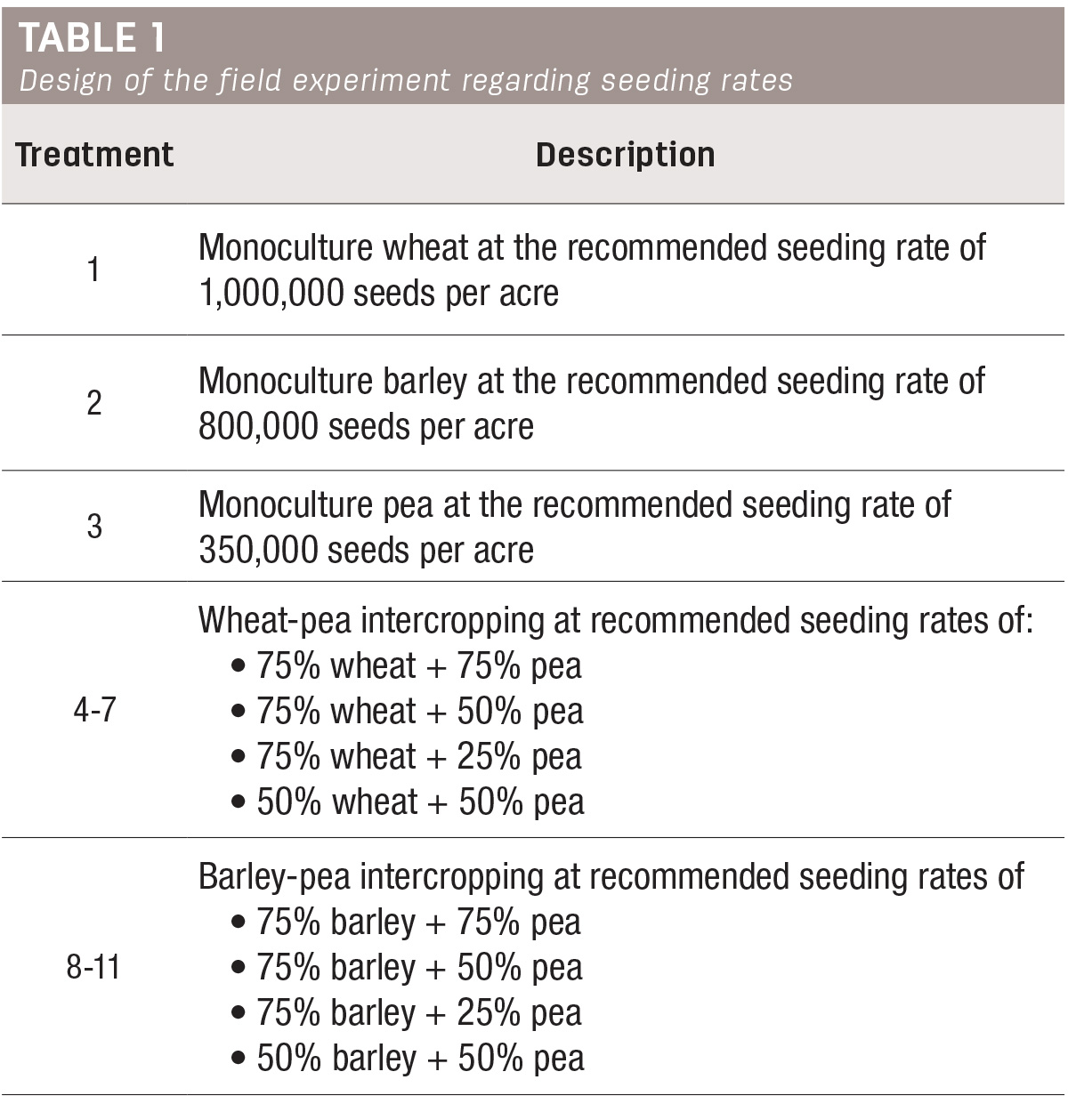
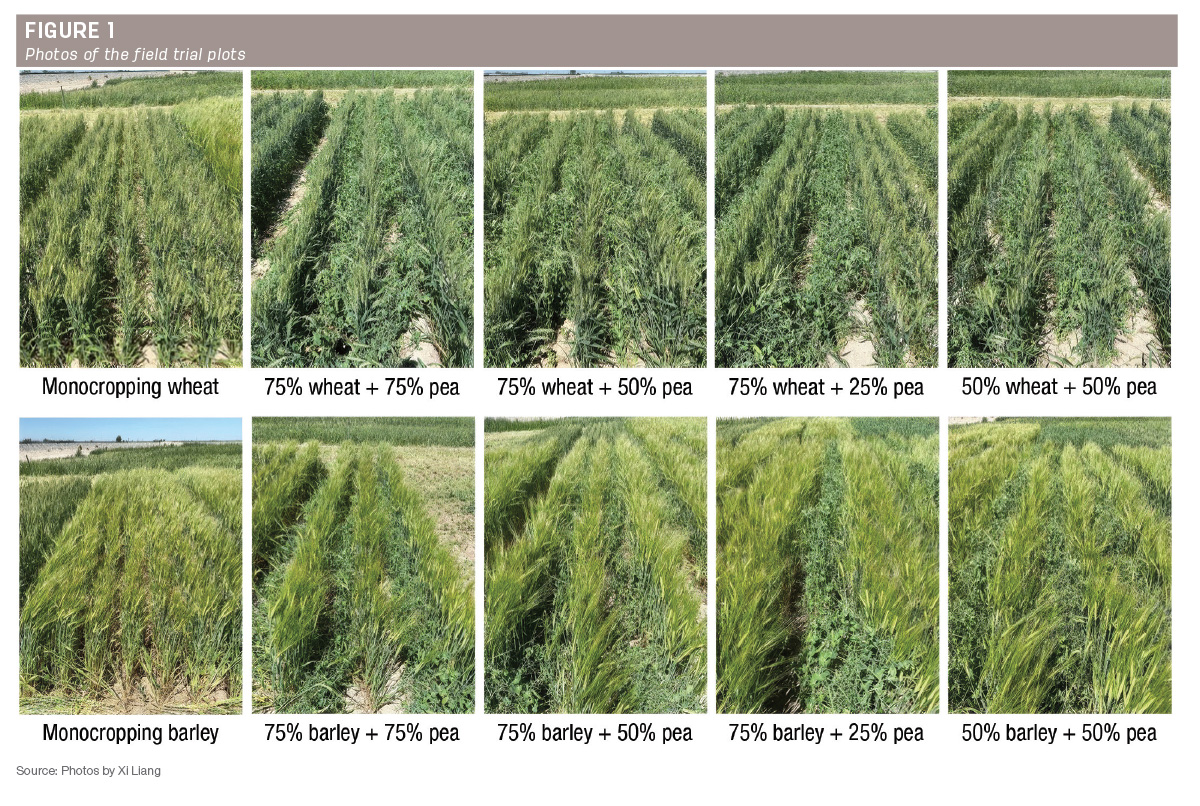
Figure 1 shows the field trial plots. More results are available upon request from the authors, and we only summarize the main yields, biomass and end-use quality (for wheat flour) based on the combined data for 2022-24 here. For yields, in most cases, replacing cereals with 25% peas (i.e., 75% cereal plus 25% pea) did not significantly reduce cereal yields under either water regime. Regarding biomass, most cereal-pea intercropping treatments had greater biomass compared to monocropped cereals, regardless of the water regime. Lastly, neither cropping system nor water regime had a significant impact on wheat end-use quality.
Profitability considerations
There are several important profitability considerations pertaining to both the revenue (yield and price) and cost (seed and irrigation) aspects of potentially cultivating an intercropped cereal-pea system during an organic transition period.
Revenue aspects
The yield-related results show that intercropped cereal-pea treatments with 75% cereal plus 25% pea seeding rates had nearly the same cereal yields as the monocropped treatments. This implies that the obtained peas can be thought of somewhat as a “bonus” product for that seeding strategy. Since pea sales prices (approximately $8 per bushel or $13 per hundredweight – cwt) are commonly higher than those of feed barley (approximately $4 per bushel or $8.50 per cwt) and wheat (approximately $5 per bushel), the bonus peas harvested may provide some revenue-generating opportunity. However, there is the risk that it may be difficult to market the combined cereal and peas together. Specifically, would the buyer require that the cereal grains and peas be separated before they buy them? Would they charge a cost for separation? Or could they be marketed as a combined product for use as either animal feed or food (e.g., for use as a soup ingredient)? Answers to these questions would vary based on the nature of the potential buyers in each region and would be worth investigating prior to adopting the intercropping cereal-pea system. Lastly – we do not cover it in detail in this article – but sales or other usage opportunities for the biomass are also worth considering.
Cost aspects
Like sales prices, seed costs are also typically higher for peas (about 42 cents per pound) than for barley (about 33 cents per pound) and wheat (about 24 cents per pound). We estimated the seed cost amounts for the 75% cereal plus 25% pea treatment at $30.72 per pound for wheat and peas, and $36.41 per pound for barley and peas. For comparison, these seed costs are about $12.48 per acre and $10.58 per acre higher than those for monocropped wheat and barley, respectively. Thus, while there is potential to obtain higher revenue from the intercropped cereal-pea products, accounting for the higher seed cost is important for assessing overall profitability. However, with alfalfa hay seed prices costing around $71 per acre, there would be substantial cost savings for seed for most cereal-pea intercropping systems (potentially more than $30 per acre) compared to alfalfa hay.
Lastly, there may be substantial cost savings opportunities for irrigation under an intercropped cereal-pea system, especially compared to alfalfa hay. Recall that common cereal-pea water amounts of 20 acre-inches for the WW scenario and 10 acre-inches for DS, while that for alfalfa hay is 28 acre-inches. Thus, alfalfa hay water needs are higher by 29% compared to the WW scenario and 64% to the DS scenario, respectively. With estimated alfalfa hay costs for 2025 in eastern Idaho (including power, repairs and labor) of about $133 per acre, irrigation cost savings could potentially range from over $30 per acre to $80 per acre for the WW and DS scenarios, respectively. Again, combining these potential irrigation cost savings with any associated expected adjustments to revenues is important for comparing expected changes in profits from adjusting cropping systems and their irrigation strategies.
Collaborators on this study include Zachary Kayler, Samira Kazemi, Hansol Lee and Linda Schott.
This work is supported by the Organic Transitions Program (grant no. 2020-02368) and Hatch program project with Accession No. 7008940 from the U.S. Department of Agriculture’s National Institute of Food and Agriculture. Any opinions, findings, conclusions or recommendations expressed in this publication are those of the author(s) and should not be construed to represent any official USDA or U.S. government determination or policy.