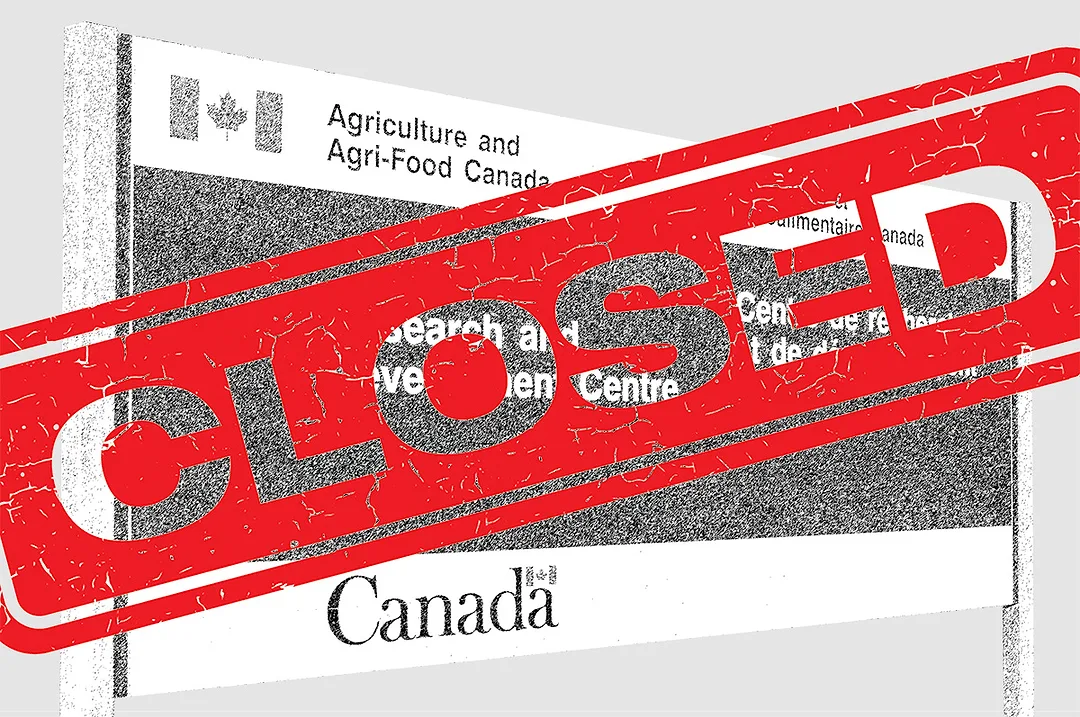
Sweeping job and program cuts across Agriculture and Agri-Food Canada (AAFC) are reshaping Canada’s research landscape, as the Liberal government targets a 15% budget reduction across all federal departments. Driven by the Comprehensive Expenditure Review, AAFC is set to eliminate approximately 665 positions, around 12% of its workforce, with 1,043 affected letters issued. Seven research facilities are slated for closure, from Nappan, Nova Scotia, and Quebec Research and Development Centres to facilities in Guelph, Ontario; Lacombe, Alberta; and several in Saskatchewan, including its Indian Head and Scott farms.

Federal Agriculture Minister Heath MacDonald addressed the planned budget cuts, stressing the need to review current programs, consider partnerships with academia and better align government resources for greater effectiveness. The November budget committed “to reduce certain science activities where a more streamlined approach could be taken or where capacity exists elsewhere.”
Reynold Bergen, science director at the Beef Cattle Research Council (BCRC), says he “partly buys” the streamlining statement because, in Canada’s international trade situation, money must come from somewhere.
“No one is keen on raising taxes, so this means moving money from one government pot to another,” Bergen says. “We were expecting AAFC cuts but didn’t anticipate their depth.”
Bergen added that the programs and individuals reduced were of the highest priority to the BCRC, making the decisions especially disappointing.
“These cutbacks are an extremely big deal,” he stresses. “They’ve likely wiped out two-thirds of our grazing management expertise, 100 percent of our beef quality research, hugely dented our ability to do food safety research and taken out more than two-thirds on the forage breeding side.”
While some staff were offered transfer or early retirement options, research fizzles as people naturally begin looking for new career paths.
“The final date when the doors are sealed isn’t when progress ends,” Bergen explains. “If situations are only temporary, with staff concentrating on finding new jobs, how will anything more get done?”
Downstream effects
Bergen says research operates much like a garden hose; after the tap is shut, water continues to flow, but eventually it dries up.
“That’s what these cuts are doing,” he says. “The science hose is long, so the full impact may not be felt until years down the road. But make no mistake, it will be felt.”
As Canada’s agri-food innovation declines, questions about its competitiveness and food security will arise. Outsourcing is risky. The private sector isn’t positioned to take over forage and meat science, since Canada’s market is small. Other countries will focus on what’s important to them, not Canada’s priorities of cold tolerance or winter hardiness.
Additionally, many research trials require years and even decades.
“We at the BCRC are funding projects running three to five years,” Bergen says. “We didn’t sign on to get them two-thirds of the way. We want them done. Our researchers bend over backward for the industry’s work. It’s heartwarming as research is their life, but it’s become rather heartbreaking. Ending anything partway through guarantees we achieve nothing.”
Moreover, negotiating trade agreements always involves experts ensuring food safety and beef quality standards match those of partner countries before deals are finalized.
“Without experts to either defend our beef or have the scientific background to evaluate and ask the right questions of those wanting to ship beef into Canada, we’re at a clear disadvantage,” Bergen says. “Up to 60 percent of what we produce goes to other countries, so we need expertise to grow, defend and maintain our market access. How do we do this without our experts?”
Collaborative research disruptions
“Canada supports extensive collaboration among researchers at different centres and universities,” says Cathy Holtslander, director of research and policy at the National Farmers Union (NFU). “When people and places are removed from the picture, the capacity to learn, understand, test and verify is weakened.”
Holtslander says she believes losing the seven AAFC facilities and the Organic and Regenerative Program will significantly weaken the entire research network by disrupting this academic collaboration. The shutdown of the Lacombe, Nappan and Quebec City centres, which are key to barley, alfalfa and sustainable grazing research, creates a major gap, especially for cattle producers, since these centres lead crucial work on feed crops and pasture management.
“All these facilities involved our farmers in extension outreach,” Holtslander says. “Research farm and centre field days are an excellent way for them to learn about the latest research, ask questions, see plots and experiments, and discover new approaches. With fewer opportunities and longer distances between centres, these benefits will disappear immediately.”
The closures mean all ongoing scientific work will halt, including the 2026 research plots.
“Projects funded by universities, nonprofits and farmer checkoff commissions that rely on AAFC facilities and piggyback on their research are also cancelled,” Holtslander says. “This represents massive lost opportunities as well as financial investment that can’t be recovered.”
Internal and external responses
Holtslander notes these cuts make Canadian agriculture less resilient to climate change and supply chain disruptions, increasing the risk of farmer exits, shortages and higher food prices.
“We’ll no longer be available to address urgent and emerging problems such as new strains of disease, changes in pest populations, shortages of fertilizer and herbicide-resistant weeds,” she says.
Canada became a top wheat exporter by investing in public research focused on quality, not just quantity.
“Our high quality helped us overcome challenges like distance and short growing seasons,” Holtslander says. “International customers were willing to pay more, and farmers could successfully grow crops in their own varied growing conditions.”
Holtslander sees agriculture as a complex, evolving system that presents ongoing challenges from soil health to market shifts, driven by climate change and global instability. Public research is essential, as it offers shared solutions and accessible knowledge.
“We’re in unprecedented times due to climate change and rapidly changing international relations that affect growing conditions and markets,” Holtslander stresses. “If we don’t invest in public research, farmers will face these problems alone with trial and error, which is extremely risky. Investing collectively in research ensures everyone benefits from discoveries and advances.”
Grief, anger and anxiety are understandable as the AAFC’s cuts to people, labs and decades-long collaborations are shocking. Their impact will be worsened if this entire situation is an ending rather than a starting point for more meaningful change.