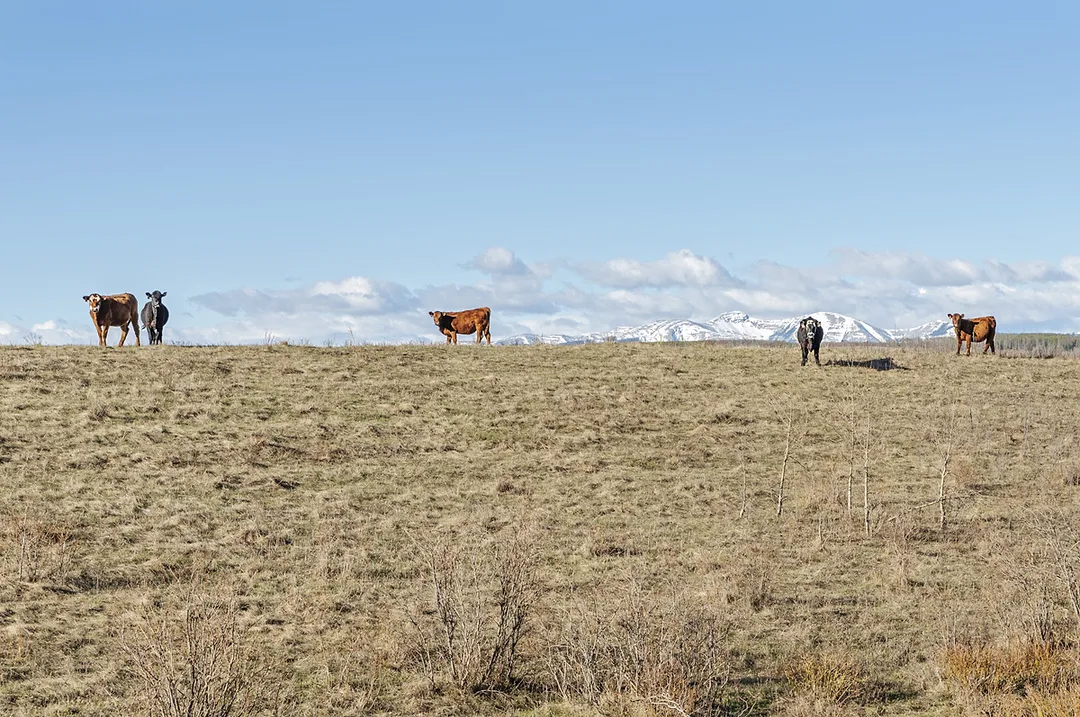
Winter has faded in the rearview mirror, yet the summer road ahead is dogged by one unwelcome word: drought. Or, at the very least, excessive dryness. On beef ranches in parts of Alberta and Saskatchewan, producers are also facing forecasts of an El Nino effect, which could worsen the conditions.

Last April, The Weather Network offered three scenarios for El Nino’s impact on the Prairie provinces:
- Warmer temperatures for most of Alberta and the extreme southwestern of Saskatchewan
- Warmer temperatures across the West
- Cooler across the Prairies (but close to normal for Alberta and southwestern Saskatchewan)
The monthly Drought Monitor from Environment Canada and Climate Change (ECCC) noted drought conditions eased across most of Alberta during last winter. In Saskatchewan, above-normal precipitation during winter caused a significant improvement in drought conditions, prompting the removal of the Severe Drought classification.
Management shifts
Excessive dryness and drought have become part of many beef producers’ management plans in the past 10 to 12 years. They’ve struggled to cope in spite of low rainfall totals, adapting cropping practices with drought-tolerant varieties and hybrids to maximize available moisture. In parts of Alberta, growers opt for irrigation to help boost nature’s shortcomings.
But for livestock producers in southern Alberta and southwestern Saskatchewan, management has shifted considerably in the past decade. For some, there are deadlines for rainfall to replenish fields of native prairie grass and forages; if those deadlines are met, the season can proceed. If not, destocking or culling may be necessary.
Jeff Yorga is a producer with just such a timeline built in to his annual plans on his farm near Flintoft, Saskatchewan, southwest of Regina. He counts on rainfall in April, May and early June to sustain the hay and pastures he grows. If there’s insufficient rain by June 15, no amount after that will make any difference, meaning he sells his cattle accordingly – first the older cows, then the yearlings – always trying to keep the nucleus of the herd together.
“It’s an important decision versus trying to maintain the herd size at the expense of my pastures and hay crops,” says Yorga, the president of the Saskatchewan Stock Growers Association. “We don’t know what’s going to happen next year, and you can only buy yourself out once.”
He does all he can to maintain feed levels, including supplementing with grains in winter and using a total mixed ration (TMR). During the growing season, Yorga grows alfalfa and bromegrass for the majority of his forage stands, and in drier years, he harvests those earlier to protect feed quality. Depending on the year, he’ll also try to work with a local grain farmer to grow some green feed.
The decision to cull his herd is never an easy one, but Yorga points to the practice in Australia, where droughts tend to be more severe. Yet, instead of incentivizing producers to buy feed to maintain their herds, he believes producers should protect their feed sources.
“The right move is to cull the cattle and maintain your grass, and try to get to the next year,” says Yorga. “For a lot of folks who grew up in the 1980s, they already knew that, but there’s a generation of us who didn’t know that firsthand. Now we do.”
The same yet different
In southern Alberta, long-term dryness is also affecting cattle producers, depending on herd size and locations. However, the big difference for many is access to irrigation. Craig Lehr, a delegate with the Alberta Beef Producers, manages two operations, one on his home farm near Medicine Hat and the other in the Cypress Hills, straddling the border with Saskatchewan. Depending on the year, his home operation can calve out 1,150 to 1,200 head. With the feedlot near Medicine Hat and Cypress Hills, they’ll background between 6,000 and 7,000 calves.
They irrigate about 1,000 acres for forages to the feedlots, plus a cover cropping program for winter grazing to reduce costs. On the dryland farming side, they grow barley, wheat, triticale and peas. Much of his summer ground is native prairie grass.
Although drought isn’t as big a challenge as in other regions, Lehr is still concerned with the abnormally dry conditions of the past 11-12 years. He knows his water tables are down, as are the dugouts in the field.
“We had zero runoff this year, and our dugouts are very low,” says Lehr, who is also past chair of the Beef Cattle Research Council. “Even if we had grass, we’d be cutting stocking rates just due to water. We’re going to run out of water in [the dugouts] this year, which I don’t ever remember happening.”
He echoes Yorga’s statement about advanced planning taking on a greater urgency, especially in a bid to get cattle fed without stressing the supply of hay or grass in the fields. He’s thankful for the flexibility that comes with the two locations, plus irrigation and his cropping diversity.
“We’ve ended up overgrazed – not horribly – but the way some of these summers have gone, if you don’t give it that rest the next year, it hurts you,” says Lehr. “We’ve had rougher years for moisture, but we’ve been able to grow some grass here and there, and that’s important.”
Integration is one solution
For Bart Lardner, the Ministry of Agriculture’s strategic research program chair in cow-calf and forage systems, managing pastures or supplementing feed supplies – or making the hard decision to destock or cull herds – is part of annual planning. His go-to quote is, “Drought’s just around the corner,” yet no two regions or operations are the same; what qualifies as “drought” or how its impact is defined is always different. Some producers have a deadline for culling or destocking, while others will do everything they can to supplement their feed sources or move cows to another region.
What’s changed more significantly in recent years is the need for longer-term planning. Producers can supplement feed with ditch hay, straw or blends with annual weeds, but what they really need to do is have emergency plans in place, including a year’s worth of grazing stockpiled.
“They’ve let it rest for that previous year, say in 2025, so they have that grazing for ’26,” says Lardner. “The first priority is to get fibre to feed the cow herd, whether it’s low quality or even poor quality, as long as farmers are aware of the antiquality constituents.”
What might help even more is for beef producers and cash croppers to collaborate. Despite aversions of cash croppers to allow cattle on their land amid concerns about compaction, Lardner notes there are many advantages to having beef cattle in crop fields.
“The ruminant digestive system is not a very closed system,” he adds. “Only 10 percent of nitrogen in the diet is retained and used for the animal, so 90 percent is excreted and only 20 percent of phosphorus is retained. Producers need to rethink where it’s deposited. My research has shown the tremendous deposition of manure and nutrients left on that field when the cattle are out there.”