
I watched them hunker down in the furrow, start scratching in the dirt. You know how a farmer does, using the handle of his pliers, maybe an old pocketknife or screwdriver. They find a few seeds right at the depth they want them to be. Pushing the dirt back over the seeds and patting it a little, they walk 50 yards farther into the field, start scratching again.

After 13 years owning and operating an excavation business alongside our small ranch in south Texas, we wanted to farm full time. Farming was in my husband’s blood, and I had been raised in the Central Valley of California irrigating with siphon pipes and pulling weeds in my dad’s sweet potato fields. We were excited about this new chapter of our lives but also overwhelmed with the enormous learning curve we knew was ahead of us. Observing the neighbor’s stand of corn emerging in perfect synchrony like little green soldiers standing at attention, Derek said he was gonna have to go visit Randy.
Randy Ellis was a man whose crops you admired even if you weren’t a farmer. If you have a chapel ceiling to paint, go see Michelangelo. If you have a crop to plant and grow and harvest, go see Randy. Derek wasted no time in driving over to his farm shop. It was early in the morning, and Derek found him in his office at a bare desk with a notebook doing some figuring. He looked up at Derek with that gaze from his era, much as I would imagine General Douglas MacArthur looked at a fresh recruit. Introducing himself, Derek shook his hand and told him he was attempting to plant his first corn crop. He was there because he admired Randy’s farming and had a few questions for him.
Randy leaned back in his chair. There was a long pause before he finally said, “I’ve been watchin’ you over there. Why don’t you jump in the truck and we’ll go look at your planter.” After helping Derek make some critical adjustments to the planter, he said, “When it comes to farming, the small things matter. You gotta be particular.” Randy didn’t just say particular; he had a way of saying it with emphasis on the first syllable “par-ticular” that made you sit up and pay attention. He shook Derek’s hand again, grinned a little and said, “I’ve been needin’ a pup to follow me around.”
Randy would never tell us if we were doing something wrong. The way to learn was to walk behind his tractor because we knew his experience with farming methods produced superior results. He never worked ground before it was ready. He said too many farmers get in a rush because they have a lot of acres to cover. “You think you’re gettin’ away with it, but come harvest you’ll see it on the yield monitor.” Often in the evenings he would drive the half-mile over, walk the rows, comment on the weather, might say he was going to spray some fungicide the next day or so. That was our cue to be looking for disease in the crop.
Over time, the relationship morphed into one of mutual respect. Randy would ask Derek which way he thought the grain markets were going to move or which new hybrids he was thinking of planting. When he purchased a new combine, we bought his well-cared-for older machine. Randy was over to help set it when we started harvest. After riding a round shelling corn, he shook Derek’s hand as he crawled down and paid him the ultimate compliment, “You’re doin’ a good job. You’re a par-ticular farmer.”
We moved to Idaho several years later to farm in this beautiful mountain valley. We scoop up a handful of the fertile, alluvial soil and let it trickle through our fingers. The small things still matter. I watch our 13-year-old daughter, wearing a hoodie she personally emblazoned with FARMHER, follow her dad out to the field of soft white spring wheat being planted. They hunker down behind the drill and start scratching in the dirt with the handle of his pliers. She wants to farm and is full of questions. Derek says you can’t rush planting to be the first in the field; ground temperature has to be right. You push it, come harvest you’ll see it on your yield monitor.
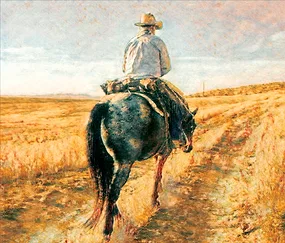
On a recent trip back to Texas, Derek pulled up on Randy’s farm. He was on the tractor, knifing in fertilizer. Right up against 80 and still putting in 16-hour days when the ground is right. Derek climbed in and rode a couple of rounds. They talked about weather, grain exports and the agricultural outlook. Randy said someday he sure would like to come visit us, always has wanted to see the farming in the Northwest. Derek shook Randy’s hand, watched him turn back into the furrows. He just stood there a while thinking how lucky he was to have had a neighbor like that. As the tractor disappeared into the dusk, a variation of a timeworn line came to his mind, “Old farmers never die; they just fade away.”

.webp?t=1687979285&width=640)


.webp?height=auto&t=1783636475&width=285 "63802-Thomas-GPS-equipment--Automated-Magnum-Tractor--Matt-Skinner-photo(1).jpg")
