As Canadians shed their coats from a moderate winter season, the results are portending a drier and hotter weather trend going into spring and summer, especially in the western provinces.

Matt Makens, an atmospheric scientist with Makens Weather and who serves clients in Canada, the U.S. and Australia, says oceanic patterns may push that trend into another year.
The ocean warming and cooling patterns, known as El Nino (warm Pacific waters) or La Nina (cooler water), typically affect western Canadian provinces with a usual pattern based on analog models.
La Nina made a return back to northern climates in 2025, after some lighter El Nino patterns in the two previous winters. “For western Canada, northwestern, northern U.S. states, La Nina is tied to colder winter months. And for Canada, it can be and I want to underline and emphasize, can. It can be a good moisture provider of snowfall on the mountains and the nearby prairies in those cold-season months.”
Typically that pattern has a consistency to it, Makens said. But atmospheric movement broke up that pattern for western provinces and only provided fluctuations in cold weather.
“It would have been cold, but because the strength kind of varied month to month, week to week, we had some of these warmer pockets. So technically, the winter for the vast majority of Canada was warmer than average.”
“El Nino and La Nina, that is an ocean phenomenon,” Makens added. “The atmosphere will respond not just to this but to all kinds of other things … The atmosphere we measure that response to, it was not resoundingly a La Nina atmosphere throughout the cold season.”
Soil moisture conditions
Makens pointed to mapping in soil moisture for the provinces that shows some holding patterns, even some improvements in northern sections of Manitoba and Saskatchewan. But even with year-over-year soil moisture spikes, the trendline continues to affect southern regions in the provinces. That creates looming issues headed into midyear.
“If you narrow your focus and look at more recent patterns, the dryness that we've seen in southern, southeastern Alberta, southwestern Saskatchewan, that has been a notable dry pocket, those soils are drier and that is feeding into also the drought in Montana and the Dakotas, and that is the area that the drought will be the focus to start spreading from as we go throughout this summer.”
In temperature and precipitation models, June through August has the potential for some more intensity related to drought conditions (see Figure 1 and 2). Producers should see the onset of drier and hotter areas by the start of summer at the end of June or early July. And some spikes could come sooner.
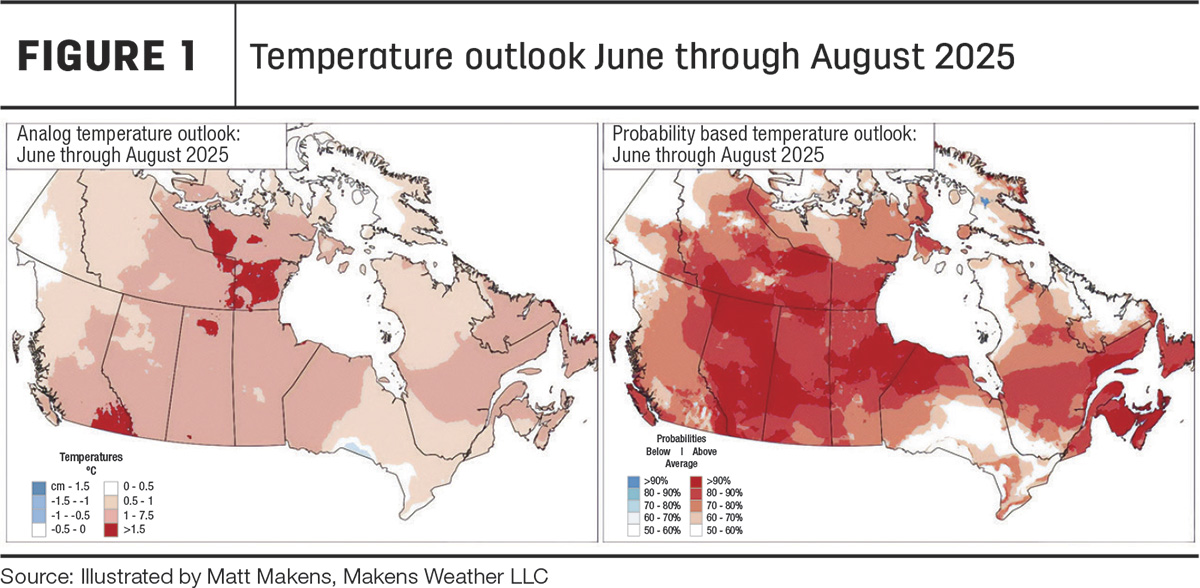
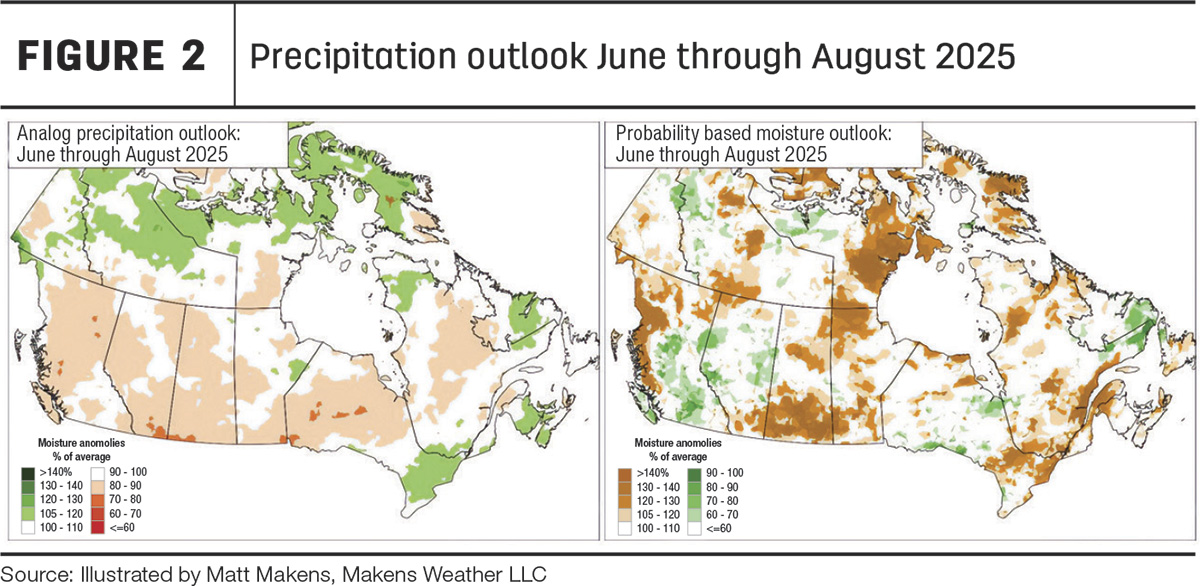
“If you were to take a forecast in two, the historical perspective has not changed on the drought this summer. And if you look at the modeling perspective, which is only forward-focused as computers look at the future, that focus is also very dry.
“There may be a debate on when that dryness kicks in, in that computer modeling, but it is for sure here by late this summer, and in some cases very early this summer. So if you look at both hands, both point to a very dry summer across the prairies extending into central parts of all those provinces.”
Length and severity of La Nina
While most producers understand the implications behind a La Nina or El Nino oceanic water pattern and how it affects their ranching or farming region, there is a detail called a neutral pattern, Makens explained. That classification matters because a region isn’t in either stage, but between the two.
“There is a strong historical tendency to be dry in a lot of North American beef production areas. So for a long time, many forecasts discounted this thing called neutral. The philosophy was neutral means it's going to do whatever it wants. And maybe there's an element of reality to that.
“But the bigger reality is, if you look at history, and I'll go back to 1950 or 1990 whatever you want to go back to, and you look at these neutral patterns for North American beef production, neutral patterns behave much more like La Nina than it does El Nino, meaning a lot more drought on the industry. So when I give forecasts, I include neutral, as if it's one of an equal amongst El Nino and La Nina, because it has that historical tendency to be just as powerful to the industry.”
Wherever Makens addresses audiences craving to know how oceanic patterns change or stay the same, he frequently uses historical data to explain what could happen in future years. Much of the model can be based on how the Atlantic and Pacific oceans “behave and how they orient.”
The predictable models with changes approximately every five years were sustainable, with some changes around the late 1990s, when Makens says patterns evolved.
“Prior to the late 1990s, with a Canada focus, La Ninas were wetter. They brought more snow. Since the late ’90s, things have changed because of this big pattern."
This is where models grow problematic, Makens said, simply because records before 1900 were not kept with consistency.
“We can't say that's how the history of these oceans has always behaved. So that's why I put so much emphasis on if history repeats itself, then that will be the case, but there’s maybe so much we need to learn about how these oceans behave that will prove me wrong.”
But looking into the future and using the analog data, Makens sees a neutral pattern holding for oceanic waters going into 2026 and a potential for another winter of La Nina patterns.
“These computer projections are not considered the history like I do, but we're seeing some confidence building in this neutral to La Nina (stage), again next year.”