
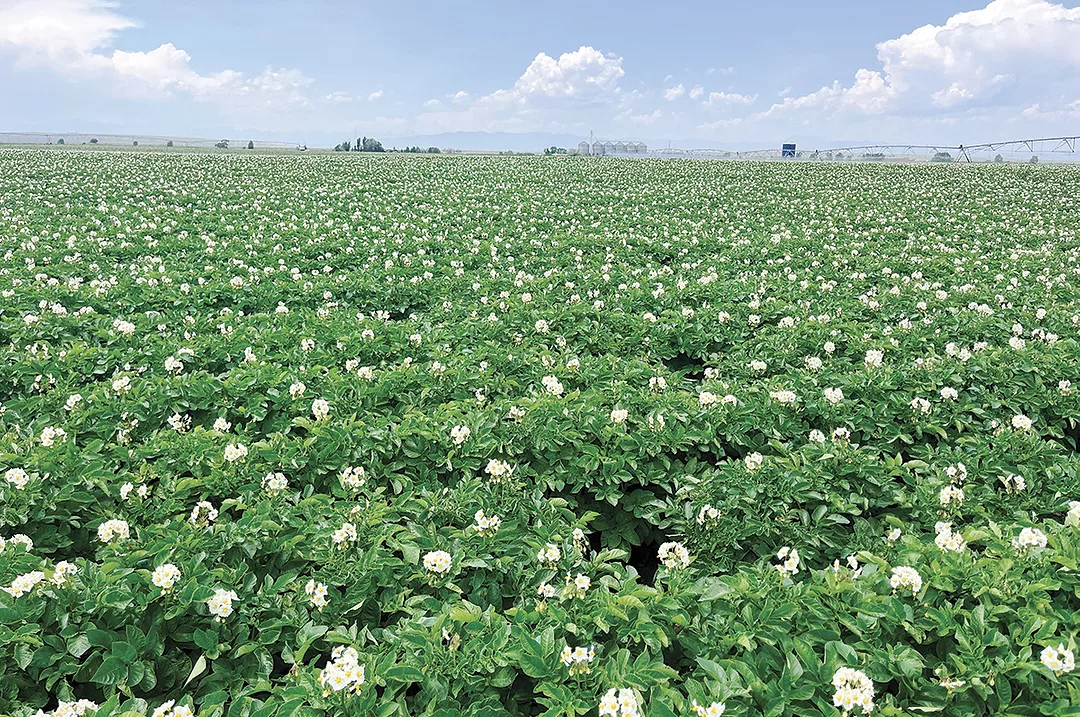
A bird's-eye view from an airplane shows what water means to thirsty crops in the Idaho desert. Last December, Ag Proud – Idaho reported that the agricultural sector contributes $37.5 billion in revenue, or 17% of Idaho’s total economic output. One in every nine jobs in the state is based in agriculture. The economy in Idaho is largely dependent on agriculture, and water is the lifeblood that drives it. Water is also generally understood as the greatest limiting factor in Western agriculture today, and Idaho is no exception. Water supply shortages, gaps in irrigation uniformity and deficiency in soil moisture easily show up as crop stress and ultimately, yield and quality of harvested crops. Improvements in irrigation efficiency and availability of adequate moisture are needed to ensure the highest yield and quality will be produced.

Fortunately, the agricultural industry is well supported with technology, expertise, research and innovation. Land-grant universities across the western U.S. have devoted vast resources toward improving irrigation efficiency. In addition, modeling for water requirements is well developed as well. “In-field monitoring” of soil moisture conditions are commonplace, which points to the mantra, “If you measure it, you can manage it."
Another tool has emerged from a different industry altogether. Ninety percent of golf courses use soil surfactants to improve aesthetics and turf conditions. This helps explain why golf courses can maintain near-immaculate conditions in the heat-stressed days of summer. Soil surfactants, when utilized correctly, can optimize soil moisture that would otherwise be limiting and leave the cool-season grasses vulnerable to heat stress. When coupled with well-established “best management practices” for irrigation efficiency (i.e., proper maintenance, moisture monitoring, irrigation scheduling based on evapotranspiration and other precision irrigation practices), soil surfactants can be implemented to fully optimize irrigation water supply and improve efficiencies.
Soil surfactants have made their way into production agriculture and have extensive testing done at the university extension network and independent third-party contract research operators. Their benefits are well documented. This past February, compiled research conducted by the University of Idaho was shared at the Idaho Potato Conference, specifically how soil surfactants can be utilized to offset limiting factors, such as runoff and keeping up with evapotranspiration rates of common crops grown in Idaho.
Two common challenges are present with our silt loam soil type and sloping ground. We cannot get enough water in the ground to maximize crop production without significant runoff and match evapotranspiration rates, particularly in the long and hot days starting in late June and into early August. Sandy soil has a different set of challenges; it’s difficult to maintain soil hydration, especially for shallow-rooted crops such as potatoes, because applied water tends to infiltrate beyond the root zone. In the long, hot days of summer, available moisture becomes the greatest limiting factor to optimal crop yields and quality. Soil surfactants tested at the University of Idaho have consistently shown beneficial results and have improved yields and quality, and solutions are available for differing soil types typically found in southern Idaho.
Products evaluated by the University of Idaho have shown a measurable increase in the amount of applied water infiltrated into the soil and then held in the profile. There has been a range of 10% to 20% more water that’s in the profile available to grow the crop over both years evaluated. The significance of this is even greater when you consider the frequent “wet/dry” conditions present with center-pivot irrigation. Maintaining adequate moisture is key to top yields and quality.
Of additional significance is: There are different soil surfactants available on the market, with varying functions. These swing from “penetrants” on one end of the spectrum to “hydration” products on the other. Using a penetrant type of product can be beneficial to prevent runoff, but can fix this problem while creating a new one – less water in the root zone. This is where product selection becomes important, using a multifunctional product that addresses both issues. In other words, preventing runoff and improving overall hydration in the root zone. Precommercial testing of products demonstrated reduced runoff at the University of Idaho Research and Extension farm in Kimberly. Data collected in the project also shows yield of sugarbeets was maintained with 80% of full irrigation with a soil surfactant, as compared to 100% irrigation without. Additional testing showed yield improvements on corn and potatoes using soil surfactants with full irrigation. Weather monitoring by AgriMet station gives predictive modeling for evapotranspiration rates and irrigation requirements for given crops by location and was used in the product evaluation.
Idaho has a wealth of resources, including water supply, productive soils and agriculture industry professionals who bring everything together to produce an abundance of cereals, potatoes, sugarbeets, animal feed and specialty crops. Stewardship of all of these resources, including water, will keep Idaho production agriculture a leader for generations to come.






.webp?height=auto&t=1783636475&width=285 "63802-Thomas-GPS-equipment--Automated-Magnum-Tractor--Matt-Skinner-photo(1).jpg")
