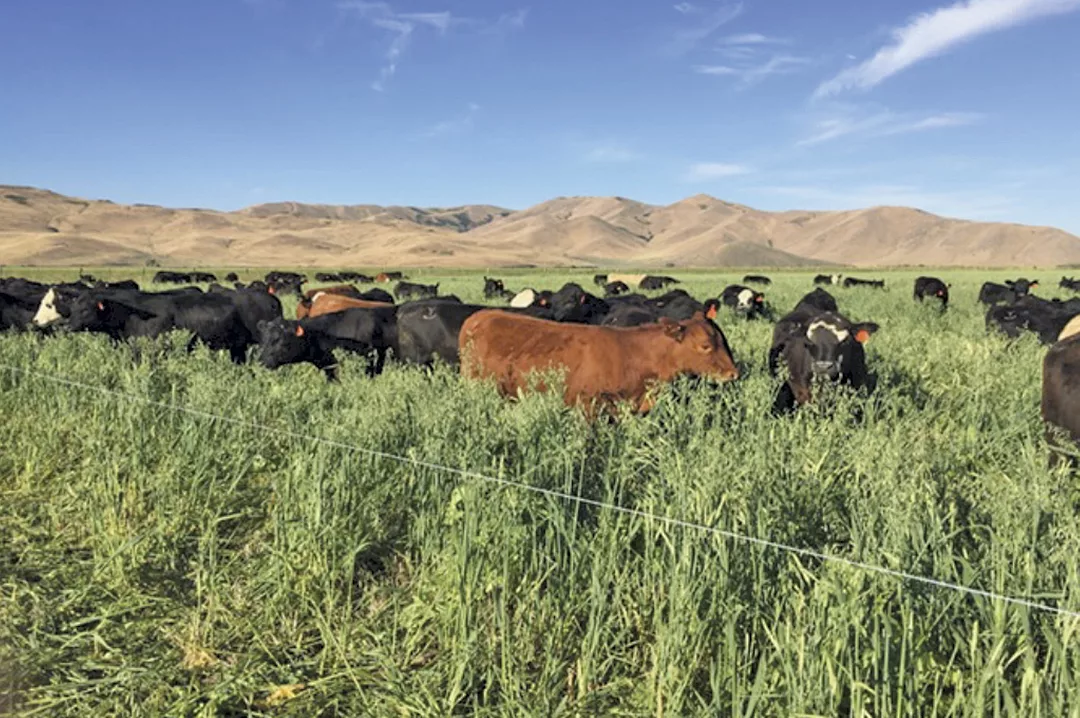
Unless you have been living under a rock for the past decade or so, you have surely heard talks or read articles about soil health and the benefits a landowner can get from employing the principles of soil health. Depending on the source, there are either four or five principles of soil health. Maximizing diversity and incorporation of livestock previously were viewed as separate principles, but are now combined into the single principle of maximizing biodiversity. Whether you are looking to incorporate the principles of soil health on your farm or looking to increase forage production for livestock, cover crops can be a viable solution.

If you are practicing soil health principles in a whole-farm situation, then you are surely planning grazing rotations as part of the yearly farm plan. What I find more common, at least among the farmers I work with in southern Idaho, are people looking to either extend the grazing season or find additional grazing opportunity after the cash crops have been harvested. When the cover crop can be planted will determine what species might work best in a given situation. There are so many variables between location, timing, water availability and management that I will only be able to give some general suggestions.
When someone calls my office to discuss cover cropping, my first question is always “What are your management goals?” Off the top of my head, several grazing considerations come to mind: late summer – fall grazing, fall – winter grazing, spring grazing, profitability and several of the soil health objectives such as armoring the soil and cycling nutrients. Even if soil health isn’t your primary goal, there are some interesting things to think about.
Data from the USDA National Resources Conservation Service (NRCS) suggests that improving soil organic matter by 1% will increase water-holding capacity of the soil by an additional 1 inch per acre and increase nitrogen (N) availability by 10 to 40 pounds per acre. Additionally, I found some unpublished data that indicates a 1,000-pound cow will deposit 0.25 pound of N, 0.15 pound of phosphorus (P) and 0.52 pound of potassium (K) per day through manure and urine. It doesn’t take a large herd to cycle a lot of nutrients back to your soil. My recommendation is to ensure you have well-defined goals as you consider incorporating cover crops for grazing.
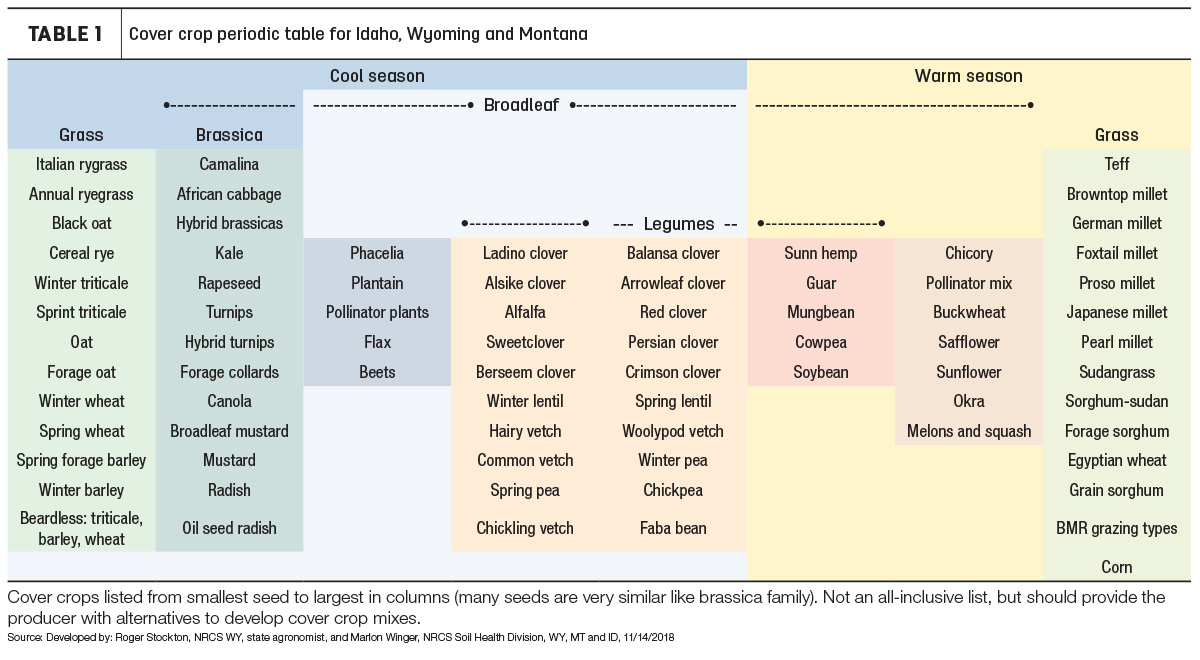
If you are new to cover cropping, navigating the variety of species available can be challenging, even daunting. Often, someone has attended a presentation about cover crops, and they are excited about the possibilities, then they start researching and get lost in the details: what species, what mix, planting rates, etc. There are several cover crop periodic tables that can be found online. The NRCS developed this tool, breaking cover crops into cool-season and warm-season species and then further into broadleaves, legumes and grasses.
One I like to use for Idaho was developed a few years ago by Roger Stockton and Marlon Winger, both with the NRCS, and it was organized specifically for Idaho, Wyoming and Montana (Table 1). When selecting species for grazing, there are some things to keep in mind. According to the Missouri Soil and Water Conservation Department, annuals provide more energy and protein than perennials and legumes provide more energy and protein than grasses. Cool-season grasses provide more protein than warm-season grasses. Grasses grow faster than legumes, although legumes provide more energy.
Planting timing with cover crops, as with any crop, is critical to success. If you have other farm operations taking place at the same time, labor can be an issue. Planting later in the season may lead you to be short on heat units to get a successful crop. There is a difference between establishing cover crops and having enough growth to graze. If you are planting after another crop, such as wheat, are there residual herbicides that might be taken up and affect livestock? Be sure to read those labels.
When trying to decide what to plant, I believe in the "keep it simple" principle; you don’t have to start with the 12- or 15-way mixes. Start with a three- or four-way mix and then adjust and add as you gain experience. To start, use a simple "Rule of Three" – choose a grass, a legume and a broadleaf. What you plant will depend on when you plant and when you want the feed available.
Seed mixes get expensive in a hurry. Most farmers I talk with seem to agree that $30 to $40 an acre for seed is enough. You want a mix with about 1 million seeds per acre. There is a lot of information on the internet about how many seeds per pound there are for the common species used in mixes. When selecting a legume, experience has taught me that unless you can leave them in for a full growing season, leave the perennial legumes out; they are likely to be the most expensive per pound and they don’t compete well in a mix until the competition is removed.
Annual legumes work just fine for grazing. Several years ago, some extension colleagues and I established a grazing demonstration on a few farms. We used a mix consisting of 10 pounds triticale, 26 pounds of peas (forage and winter) and 2 pounds each of red top turnip and daikon radish drilled into grain stubble, right after harvest, and the volunteer grain added to the grass portion. This mix worked well; the cattle grazed on it through late November. In the spring, the triticale regrew for some spring grazing. The winter peas came back a little but weren’t significant to the forage yield. It would take a document the size of this entire magazine to discuss the various species and their suitability for grazing.
When considering species, keep in mind toxicity from prussic acid and nitrate poisoning. The warm-season grasses are the species of concern for prussic acid, and many of the other species can be nitrate accumulators. I always tell livestock owners to just get the forage tested before turnout; yes, it will cost some money, but considering the replacement cost of livestock, it is cheap insurance.
A couple of final thoughts: Several of the cover crop species can become weeds on your farm. Hairy vetch has up to 30% hard seed and can persist for several years. Cereal rye is a wonderful grass choice, but if you have wheat or barley in the rotation, it can become an issue if allowed to produce seed. Buckwheat grows fast – but again, if you have wheat in the rotation, avoid this one. Asian export markets will reject whole loads of wheat if buckwheat is detected. Buckwheat also has a hard seed that can persist. Annual ryegrass, not to be confused with cereal rye, is an excellent forage, but it is listed as a weed of concern in many grain-growing areas.
My final caution with cover crops is that they can provide a nice winter home for voles, and this can be a real issue if voles are a problem in your area. Anecdotally, at one demonstration site where cattle grazed on cover crop through the winter, the hoof action seemed to have destroyed the voles' habitat and the voles moved to the neighboring nongrazed plots. In the spring, the grazed plots had nice regrowth, whereas the nongrazed plots were grazed off by voles all winter.
Cover crops can make an excellent forage for livestock if thoughtful management and planning take place. Consider your location, planting timing and when you want the forage available, and then consult the Cover Crop Period Chart to explore species. The Sustainable Agriculture Network has an excellent reference book titled Managing Cover Crops Profitably. It is available free as a PDF download or you can purchase a hard copy.
Lastly, your local extension faculty or NRCS staff can provide more information and help you work through a cover crop grazing plan.