
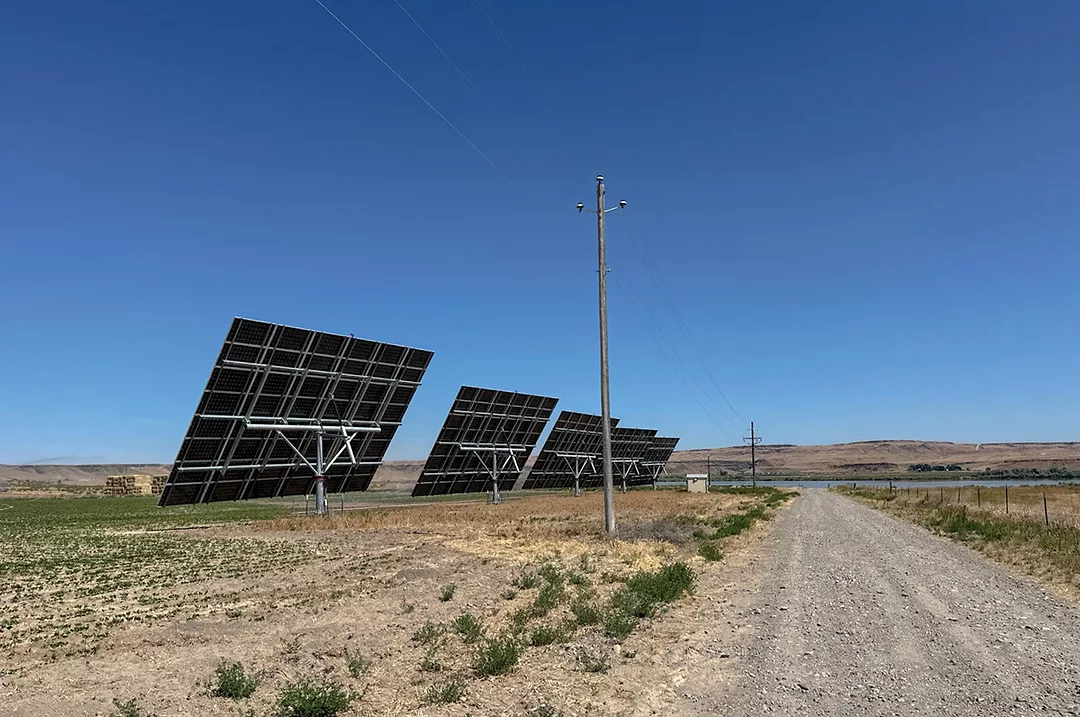
Farmers throughout Idaho may be on the lookout for ways to save power on their farms while continuing to be efficient and quality producers. Solar panels are an up-and-coming technology that may be the type of investment a farm operation is looking for. Using solar panels to power irrigation systems may be game-changing for Idaho producers.

There are several factors producers want to be knowledgeable about before installing solar panels. First, what are the cost savings on power? Quinn Skillin, an energy consultant for EGT Solar Inc., says, “Most agricultural solar systems break even in six to nine years without any incentives. But here’s the real kicker: With USDA’s REAP grant and accelerated depreciation (MACRS), that payback can drop to two to three years or even less in some cases. Once the system is paid off, it can provide 30 to 40-plus years of clean, essentially free power. Compared to Idaho Power’s ever-rising rates, solar can deliver energy at less than half the cost over the long term.”
Morgan Meyers, a producer in southern Idaho, utilizes solar panels on his farm. He has 22 sites among three counties. Meyers says, “It felt like although it was more upfront cost, it would reduce our annual power bill. I think we save over 200,000 dollars per year in power.”
A closer look at costs
As for the cost of installing solar panels for agriculture, Skillin explains, “The cost depends entirely on the size of the irrigation system and how much power the pumps require. A small booster pump on a well might only need a few panels and an inverter, while a large pivot system pulling 100-plus amps will need a much more substantial setup. Every system is custom-designed based on actual energy usage. That said, solar has become one of the most cost-effective long-term solutions for agricultural energy use.”
USDA’s Rural Energy for America Program (REAP) provides funding options, such as loans and grants, for agricultural producers to install renewable energy systems or develop improvements in energy efficiency. According to Skillin, “It covers up to 50 percent of the total project cost for solar and other renewables. It’s underutilized in southern Idaho, especially among small and midsize farms.” This funding opportunity has the ability to aid multiple farmers looking to switch to solar power on their farms.
According to Meyers, “They cost us like 2 dollars and 35 cents per watt they produce to offset irrigation power costs. We are not paid for the production like the wind farms and hydropower, but rather it’s a 1-to-1 offset production to consumption. Some sites are self-consuming or produce less than is consumed, and some sites run credits. Excess credits are allocated in January of each year to farms and meters next to production. Farmland has to be continuous or contiguous to where power is produced and has to be on the same feeder line.” There is a bit of an upfront cost, but after considering the cost savings in power, some producers believe solar panels are an advantageous investment.
Maintaining the system
Even though solar panels don’t contain moving parts, there is still some level of maintenance that they require. Maintenance of these solar panels includes greasing them once a year, rinsing them off in order to remove any dust or debris, and replacing electronic components when needed. “Overall, it’s a low-effort system with a long lifespan,” states Skillin.
A significant concern expressed by producers contemplating installing solar panels is the use of farmland. Not many farmers are willing to give up farmland in exchange for the solar panels. Fortunately, there are solutions to this dilemma. Solar panels can be installed in field corners, where there is little to no crop, on roofs of barns or sheds, and along irrigation ditches. However, some producers do choose to give up a portion of land. “Sometimes sacrificing a small plot of ground results in massive long-term savings,” claims Skillin.
Producers are enticed to switch to solar power for their irrigation, mainly due to the cost savings. However, there are other advantages to utilizing solar power. “It’s environmentally responsible, which our potato buyers like, especially Walmart,” explains Meyers. Solar panels allow clean and renewable energy to be generated while maintaining a low carbon footprint. “Some producers also value the sustainability aspect. Solar helps reduce emissions and can add resilience to your farm’s infrastructure. A growing trend is agrivoltaics, where crops and solar panels coexist on the same land, allowing you to produce food and energy from the same acre,” claims Skillin. Whether the producer’s goal is to save some money, increase sustainability on their land or just be more environmentally responsible, solar panels may be the right tool to incorporate onto the farm.
According to Jordan Rodriguez, a communications specialist for Idaho Power, there are about 250 irrigation customers throughout Idaho with on-site generation. “Our number of customers with on-site generation has increased in recent years, but the growth rate and total number of customers using solar panels is larger in the residential segment than it is amongst agricultural customers,” explains Rodriguez. Idaho Power works with customers who have installed solar panels, inspecting the system. Inspections confirm safety of the system and that it is running properly.
In the grand scheme of things, not many Idaho producers have yet switched to solar panels to power their irrigation systems. There is definitely room to improve energy efficiency, and Idaho producers can help with that.


.webp?height=auto&t=1783636475&width=285 "63802-Thomas-GPS-equipment--Automated-Magnum-Tractor--Matt-Skinner-photo(1).jpg")
