Some days, it’s crystal clear. We can literally see it. Over the same period of time, lake water levels in the dammed-up Colorado River at Lake Mead dropped by 27% and irrigated alfalfa acreage above the river basin’s aquifer grew by 27%. So let’s talk about that.

It’s muddy water now until the end of the year, literally. That’s because the rules that guide river water withdrawal in the basin expire in 2026. The facts are grim. The region is in the grips of a two-decade drought, and groundwater levels are dropping. Droughts of 50 years persisted from the late 1500s until the mid-1800s in this region. Discussions on today’s alfalfa genetics and role in the decline of groundwater levels during a half-century drought stir up a lot of sediment and sentiment.
A century of thirsty yield increases
2016 was the third consecutive year of record global warmth in 137 years of North America-derived alfalfa genetic improvements. Medicago sativa L. is a long-lived perennial legume with a central taproot. Its wild origins trace back to the arid region of ancient Persia. Domesticated and planted throughout the Mediterranean between 490 and 200 B.C., North American introductions occurred in Mexico (1520), Chile (1600), Georgia in the U.S. (1736) and into the Heartland and West Coast in 1850 and 1851.—Historical Diffusion of Alfalfa, Journal of Agronomic Education, 1977
Current genetics are the results of a century of university-led research focused on reducing dormancy, increasing disease resistance, improving relative feed values and increasing yield.
“Water use is high in alfalfa because it has a long growing season, a deep root system and a dense canopy of vegetation.”—Glenn E. Shewmaker, extension forage specialist, from Alfalfa Irrigation and Drought, University of Idaho publication, 2013.
Forty-three years ago, we had more snow
Alfalfa acreage in the nine top-producing states more than doubled in 1983 from the previous year due to the high snowpack in 1982. Lake Mead, located in the lower Colorado River Basin, reached maximum pool capacity. By all accounts, the lake holds approximately 19.3 trillion gallons of mostly snowpack meltwater when full, at 31 million acre-feet.
Twenty years ago
There was about 80,000 acres of alfalfa in the Lower Colorado River Basin – and more snow. A lot more.
Things changed
According to researchers, 2000-21 was the driest 22-year period since at least 800 B.C. (See Rapid intensification of the emerging southwestern North American megadrought in 2020–2021)
Fast-forward to 2024
We have much less snow. A lot less. We have 2 million acres of alfalfa drawing groundwater in the basin. A lot more. We are seeing a two-decade decline in lake levels. A long time. During a prolonged period of basinwide drought. A long time. With the exception of a small uptick from snowmelt in 2000, Lake Mead has dropped approximately 160 feet in elevation since 1999. Lake Mead is projected to drop below full pool capacity in July 2025. At the current projected level, the impoundment lake has lost 5 million acre-feet or 1.6 trillion gallons of water. By all tabulations, that’s the same amount of water needed to irrigate one season of alfalfa. This number has received regulators' and reporters' notice. So let’s talk about it.
Alfalfa yield response to water applied is linear
To achieve the higher alfalfa yields of 7 to 10 tons typically seen in the Lower Colorado River Basin, producers irrigate to harvest upward of 1 ton per acre for every cutting. The more alfalfa irrigated, the more cuttings can be made before mid-August.
“It takes about 6.6 inches of applied water to produce each ton in arid climates.”—Glenn E. Shewmaker
Evapotranspiration
Nearly 40% of the nation’s alfalfa hay is produced by 11 states. Of that, an estimated 28% of total acreage is growing in the Colorado River Basin. Three to 6 acre-feet of groundwater is pumped per acre to obtain these higher yields.
“Evapotranspiration (ET) is the primary use of water by alfalfa. Systems designed and operated to apply less than 7 gallons per minute are not able to match ET and must rely on soil water bank to supply the deficit.”—Glenn E. Shewmaker
Out West, where groundwater depletion accounts for 53% of terrestrial water loss in the Upper Colorado River Basin and 71% in the Lower Colorado River Basin, nearly all the alfalfa is irrigated. Since 2016, irrigated alfalfa in the Lower Colorado River Basin has yielded 200% more tonnage than the Upper Colorado River Basin.
“ET remains one of the most challenging hydrologic components to estimate as it depends on various climatological parameters such as temperature, solar radiation, wind speed and vapor pressure, and also physical soil properties, land cover and heterogeneity of the surrounding environment.”—Kyle R. Knipper, research physical scientist, USDA ARS, Sustainable Agricultural Water Systems Unit. In Improving evapotranspiration estimates in the arid West using multi-platform remote sensing
Four years and five months ago
On March 29, 2020, research hydrologists with the USGS Water Resources Mission Area predicted the Upper Colorado River Basin would see natural flow in the upper basin from snowmelt reduced by 14% to 31% by the year 2050. No matter how we stir up the sediment, continued warming, lack of northern latitude snowpack and basinwide evapotranspiration will reduce river flow to Mexico. Half of the baseflow of the Colorado River Basin is derived from groundwater. As long as this drought continues, limit irrigation is going to be a significant part of the next round of water regulation discussions.
2026 Lee Ferry Divide deadline
The Department of the Interior’s Bureau of Reclamation ultimately has the authority and responsibility to implement the apportionment and allocation of water to the Upper and Lower Colorado River Basin states. A federally mandated Environmental Impact Statement on post-2026 water management in the basin is under development.
“The post-2026 process is a multiyear NEPA process that will identify a range of alternatives and determine operations for Lake Powell and Lake Mead and other water management actions for potentially decades into the future.”—Bureau of Reclamation Colorado River Post 2026 Operations
All existing water management plans are set to expire at the end of 2026. There is no withdrawal consensus among Wyoming, Colorado, Utah, New Mexico, Arizona, Nevada, California and Mexico. Each basin has its own "plan." The so-called "Alternatives Report" gave the stakeholders five options discussed over 60 meetings. Eleven stakeholder proposals were made public Nov. 20, 2024.
Read the Jan. 17, 2025, published report – Management of the Colorado River: Water Allocations, Drought and the Federal Role – Congressional Research Service Report – updated March 17, 2025.
Other solutions proposed
Read through the 300 strategies added into the United States Bureau of Reclamation’s post-2026 operations exploration web tool webpage.
As of July 29, 2025, Lake Mead's water level sits at 1,054 feet. Storage level is below 10 million acre-feet. For a graphic look, visit online.
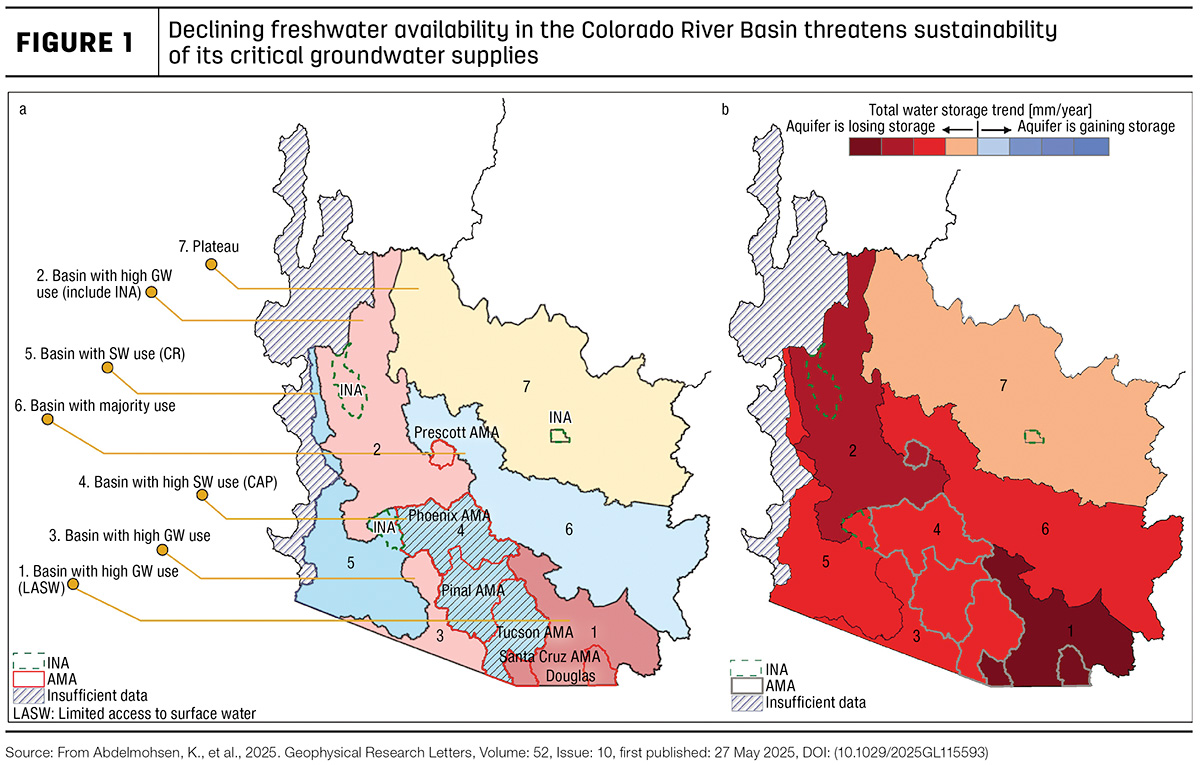
For more, see Declining Freshwater Availability in the Colorado River Basin Threatens Sustainability of Its Critical Groundwater Supplies in Geophysical Research Letters (May 28, 2025).