The jump from bumper pull trailers to fifth-wheel (or gooseneck) trailers is massive. With the hitch location at or slightly ahead of the rear axle of the towing vehicle, sway while towing is almost totally eliminated. The need for weight-distributing hardware is eliminated as well.

The hitch on most gooseneck trailers drops onto a 2 5/16-inch ball. This ball needs to be anchored to the frame of the towing vehicle. As with the receiver hitch that mounts to the rear of a pickup’s frame, gooseneck ball hitches are available to match the make and year of the towing vehicle.
Yes, this means cutting a hole in the floor of the pickup bed. Using the “measure twice, cut once” mindset, the installed gooseneck ball and hardware will fit snugly in the hole that is cut. The commercial hitches will bolt directly to the frame of the pickup. It’s not that difficult for a bright farm shop person to fabricate their own fifth-wheel hitch. If you go this route, look at the factory-built hitches and make sure you attach directly to the frame of the vehicle using robust bolts and lock washers instead of welding. The least expensive kits will leave the ball stationary. For not that much more, the ball can be laid down or reversed to leave an uncluttered floor of the pickup for use when not towing.
Most fifth-wheel travel trailers use a different type of hitch, kind of a miniature of the fifth-wheel hitches used on over-the-road freight-hauling trucks. These stand taller in the bed of the tow vehicle and make it difficult to use the towing vehicle for anything but towing or personal use. Note that adapters are readily available to allow travel trailers to be pulled with the ball hitch point set at floor level.
Stability while towing is one of the main reasons to consider a fifth-wheel trailer. Having the connection point directly over or slightly ahead of the rear axle on the towing vehicle eliminates the bumper-pull antic of “the tail wagging the dog.”
Placing the hitch ball ahead of the rear axle of the tow vehicle can eliminate the tail-heavy-nose-high stance of a pickup pulling a loaded trailer. This won’t affect the stability of the combination and will all but eliminate blinding oncoming traffic with your headlights.
The manufacturer’s combination weight rating is not a suggestion. Adding helper springs, like air bags, will not increase that weight rating. The safe control of the loaded combination in all circumstances is more important than just the horsepower to move it up the road.
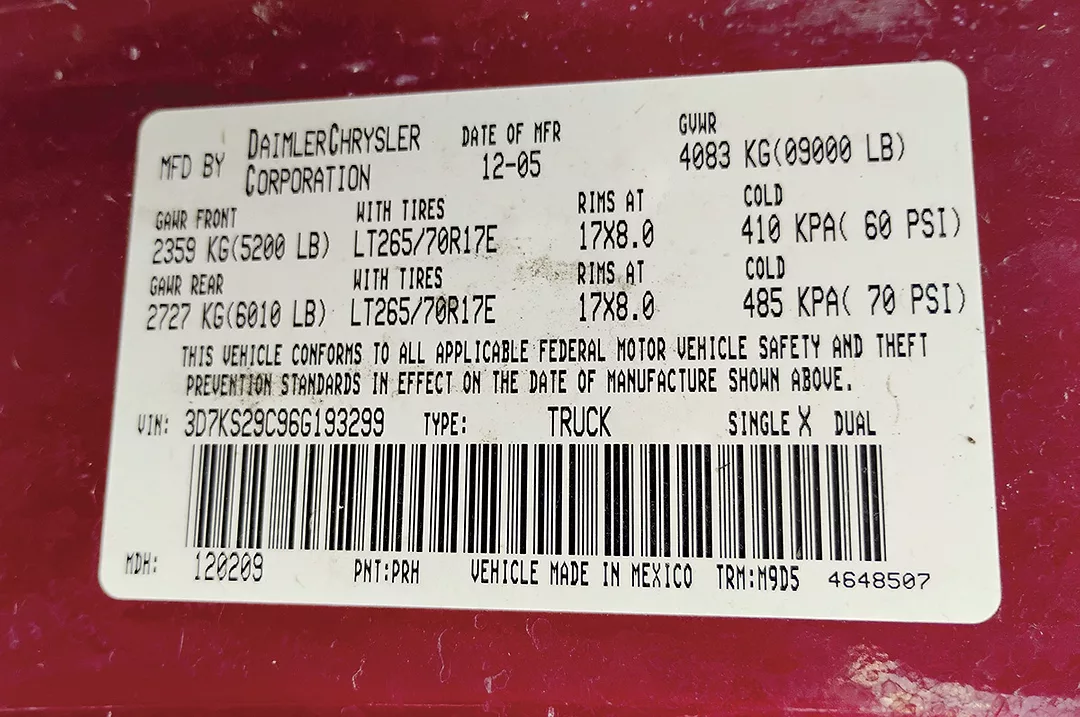
All vehicles, for example, comparing different 3500 series Ram pickups, are not the same. The data plate on the vehicle will show the gross vehicle weight (GVW) and probably not the gross combination weight (GCW). One truck may have all the heavy-duty options to be rated at the higher GCW than the other. Engine, transmission, engine and transmission cooling, frame and suspension options are required for the higher ratings.
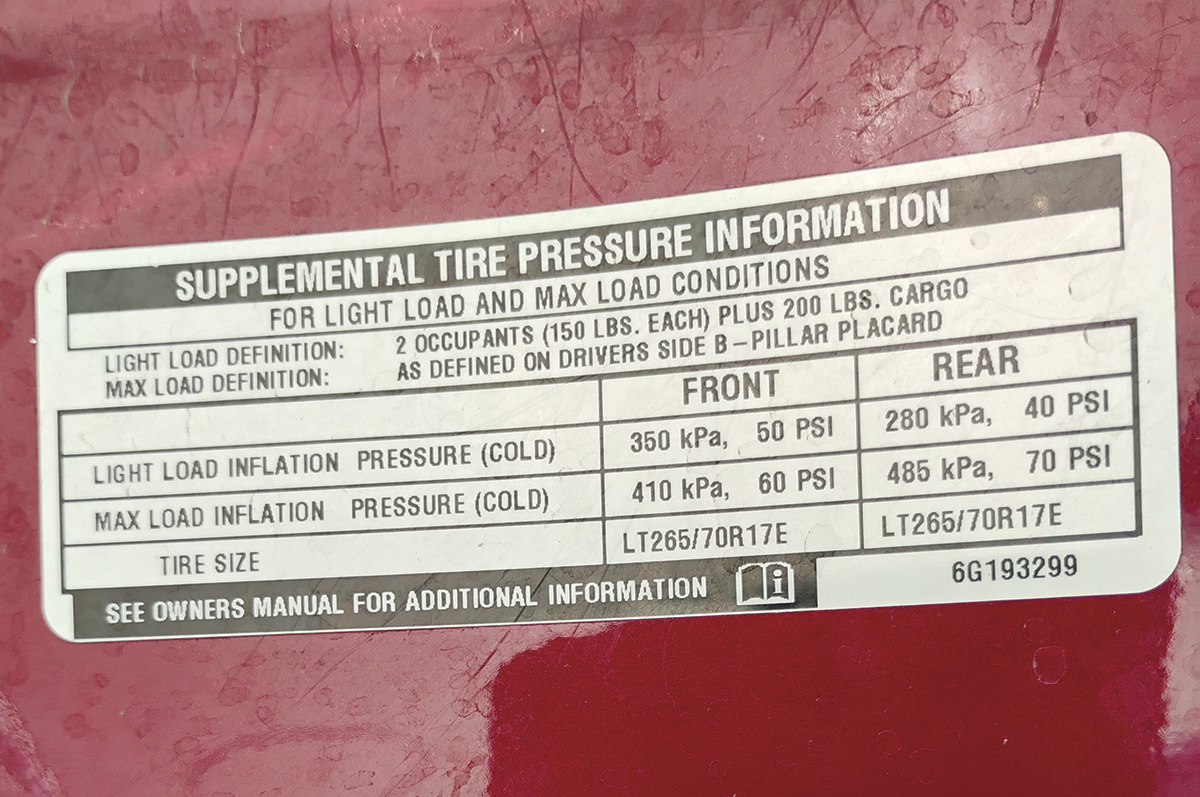
Sticker displays recommend tire size and air pressure settings to ensure optimal performance, safety and fuel efficiency. Image by Brad Nelson.
Manufacturers participate in a designated course of uphill and downhill pulling with loaded trailers, and the performance of actual towing pickups determines which manufacturer gets the bragging rights for the highest combination weight that will have the blessings of the truck’s maker. Starting on a grade, maintaining a specified speed uphill without overheating, is one part. The ability to slow and stop that combination is also factored in. The “slow” portion includes maintaining a safe downhill speed on a long grade and having the ability to safely stop anywhere along that long downgrade.
This procedure, established some years back, makes the manufacturers more honest in stating what their product is safe to tow down the road.
Balancing the weight of the load is still critical for safe towing. When fully loaded, each axle of the towing vehicle should be at or below the maker’s stated weight for each axle and for the towing vehicle. As an example, my 2006 Dodge mega cab rates the front axle at 5,200 pounds, the rear axle at 6,010 pounds, but the GVW at only 9,000 pounds. The sum of the two axles' weight is 11,210. When loading, you don’t want to overload the tires and axles on either the tow vehicle or the trailer.
There’s another data sticker that lists the air pressure for varying loads. All tires have molded text on the sidewall of the tire stating the weight capacity and air pressure requirement numbers.
There seems to be an interesting ongoing debate as to trailer tire quality versus trailer tires blowing out in use. Heat is the issue. Low air pressure causes an immense buildup of heat. Higher speed makes this exponentially worse. If you’re going to load it heavy and drive it fast while a tire is lacking adequate air pressure, it’s a-going to go boom!
Tire pressure monitoring devices are readily available via the internet. They are modified valve caps that, via a battery in each, send a signal of the air pressure to a monitor inside the cab. These are available in sets of four to six, so good for two- or three-axle trailers. Last time I checked, the price was just south of $100. The caps are specific for location, so you know which tire has the issue. The user sets the parameters for high- and low-pressure warnings, as well as for high-temperature warnings. I have sets of these on my vehicles, and they’re surprisingly accurate.
Note that safety chains are still required on the hitch. A plug-in spot for the trailer lights will need to be in a reasonable spot near the hitch point.
Trailer brakes will, of course, need to be working. Disc brakes are now a thing for trailers, both electric and activated at each wheel hub, and hydraulic, with a centrally mounted electric pump providing the "oomph" to make the brakes work. As with everything else, durability, robustness and state-of-the-art are going to cost more. Ask enough questions so you understand how the brakes work on your new or new-to-you trailer. As always, the greatest factor in safe trailering is the “nut” behind the steering wheel.