Idaho’s barley fields became more than just a harvest site in 2024; they became a proving ground. For the first time, the state launched a barley yield contest, adding a competitive edge to the season and spotlighting the precise practices happening on local farms. The idea came from Brett Wilken, a barley merchant with The Scoular Company, who saw the potential to push the industry forward. “I helped with a wheat contest 15 or 20 years ago, and it really helped drive innovation while also improving yields,” Wilken says. “There were contests for corn, sorghum, all these other crops, but no barley contest.”

Wilken first took his idea to the Idaho Barley Commission (IBC) in the fall of 2023, where they quickly agreed that the contest was an important step forward in the barley industry. Wilken then broached the idea to the National Barley Growers convention in Minneapolis in June 2024. Industry leaders voiced their support and plans were made to host the pilot contest for Idaho barley growers. Industry sponsors including Lemkin, Syngenta, Anheuser-Busch, McGregor, Novonesis, Willbur-Ellis and Scoular came alongside the IBC to support the inaugural contest.
When designing the structure of the contest, all parties involved knew it would be key to have subcategories within the contest. Location, topography and the planted variety are just a few factors that impact yields, and the organizers wanted the contest to reflect those factors. Sydney Anderson, communications and program manager for IBC, shares, “We have three different divisions: spring dryland, spring irrigated and winter irrigated. Those are all categories we made keeping in mind all of the different regions, not only within Idaho but other states like Montana, which primarily dryland farms. We want to make sure all states and regions have an even playing field.”
The contest also features a “Percentage Over County Average” division. Anderson notes that the irrigated fields of southern Idaho have different yields than the dryland farming of northern Idaho. Both Wilken and IBC wanted the contest to account for that. The county average division allows growers to be competitive at a state level while factoring in the feasibility of local yields.
The extensiveness and inclusivity of these contest divisions not only benefit the competitive producer but also provides a more widespread database on barley production. “Everybody has equal opportunity. We want to get as much interest as possible because this initiative gives back to the grower while also providing more data. So it really is a win-win," says Anderson.
Last year's results
During the 2024 harvest, Trevor Mulberry produced the highest-percentage yield over county average, bringing in 239 bushels per acre – 72.4% over the Twin Falls County average yield. Joey Wallace with Driscoll Bros. Farm of Jerome County took home the title of the highest yield in the state at 241 bushels per acre with his winter barley. Dustin Miller of Mix Miller Farms in Jerome County claimed the top spot in the spring-irrigated barley category with 201 bushels per acre.
These already impressive winning yields become even more astonishing when considering that the past five-year production average for Idaho is 106.2 bushels per acre and the 2024 national barley production average was 77 bushels per acre.
Dustin Miller, a fourth-generation farmer in Hunt, Idaho, shares that there wasn’t an individual factor that made the high yield happen, but rather credits it as the sum of planting a good variety and implementing calculated decisions throughout the year. Honing in on basic farming practices, such as irrigation and fertilization, can have significant impact when it comes time to harvest. “We don’t ever try to stress the plant for water. We do a split application of fertilizer; we put some on when we plant, then again with our herbicide and fungicide, and then again when it’s flag-leafed to give it another boost.” Miller also notes the importance of crop rotation and soil health to the farm’s success. He has found that rotating barley with sugarbeets has kept soil fertile and leads to high-yield harvests.
Wilken agrees that there are many factors that come into play for the yield increases seen over the last several years. “The farm management systems for applying water, applying fertilizer and all of those kinds of things are a lot more detailed than they used to be. It used to be you just threw a flat rate of seed out there and a flat rate of fertilizer, and it’s not that way anymore. There isn’t any one part that stands out in my mind. It is all of those factors working together.” Mix Miller Farms is a prime example of all of those factors working together for a high-yield crop.
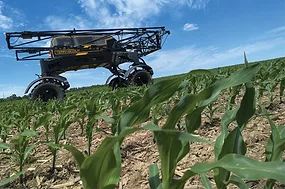
Mix Miller Farms takes advantage of cutting-edge farming technology. During the 2024 crop, Miller utilized spray drones on the barley fields. “Not having to dry your ground out to get a ground rig and leaving tire tracks and huge ruts and getting stuck makes a difference.” While traditional fungicide and herbicide spray rigs generally require water to be turned off for at least several days, which can stress the barley, field drone spray application allowed Miller to have water off the fields for as short as 24 hours before applying and then irrigating again.
Miller shares that despite the winning yield, the 2024 barley crop did face its fair share of setbacks. A late frost, mice and voles all took their toll on the barley. Despite these setbacks, Miller shares, “It wasn’t that long ago that if we got 140 bushels [an acre], we thought that was awesome.”
Coming into the 2025 harvest contest, Miller is excited to see what this year's crop has in store. “I think when people see these guys get 200 or 220 bushels, they will ask ‘Can we do that?’ and that would be a game-changer for an operation.”
Aside from the bragging rights that come along with such incredible yields, 2024 contest winners were presented with paid-for trips to the 2025 Commodity Classic that took place in Denver, Colorado. As the contest grows and more industry partners get involved, IBC is excited to continue to expand the incentives for contestants.
While the 2025 contest is structured similarly to the pilot contest, it is now open to barley producers across America. “It was in the plan from the beginning to make this a national contest,” Anderson shares. “There are many states that are competitive with their barley production. We are excited to see how the contest develops on a national scale within the next few years!”
Anderson encourages barley growers to enter their 2025 yields. “It’s anybody’s game. The harvest reporting process is super easy, and you can usually get a field representative to sponsor your entry, so it’s a ‘why-not’ situation. You and your crop might surprise you, so I would tell anyone, even if your crop isn’t looking how you might have wanted – enter anyways and you might be surprised where you end up! The National Barley Yield Contest wants the opportunity to highlight the growers within Idaho and across the nation as well.”
2025 contest information
The entry deadline is Oct. 15, 2025.
Contest divisions
- Irrigated Spring Barley
- Irrigated Winter Barley
- Dryland Spring Barley
Each division will also include a “Percent Over County Average” category, recognizing entries that most significantly exceed their respective county's historical average yield.
County winners: In each county, the contestants with the highest percent over the average county yield in each division will be named the county winner. All county winners will receive acknowledgement and publicity.
State winners: First-, second- and third-place state winners in each division will be recognized and given plaques, as outlined below. All first-place winners from each division (Irrigated Spring, Irrigated Winter, Dryland Spring).
National winners: First-, second- and third-place national winners in each division will be recognized and given plaques, as outlined below. First through third placings in each division will be awarded prizes, to be determined at a later date. First-place winners in each division will be awarded a grand prize, to be determined at a later date.
Entry forms and more information can be found on the Idaho Barley Commission website.


.webp?height=auto&t=1783636475&width=285 "63802-Thomas-GPS-equipment--Automated-Magnum-Tractor--Matt-Skinner-photo(1).jpg")