
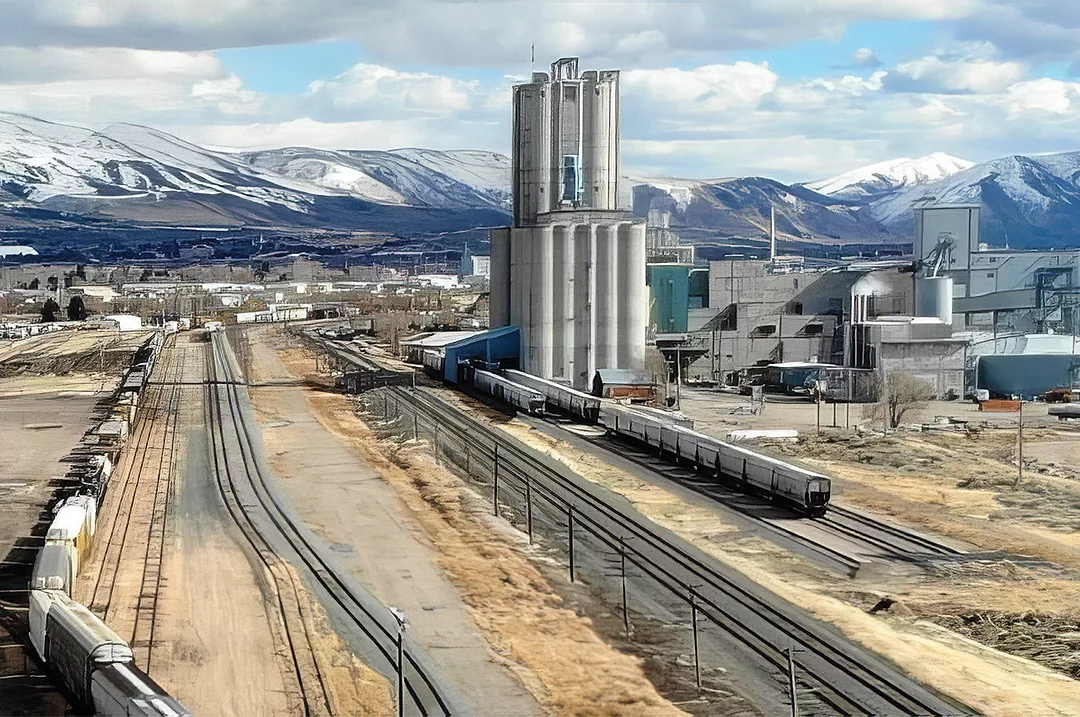
This article draws on the interesting Idaho Farm Bureau news release from March 24, 2021, which described that Idaho’s first intermodal rail terminal in Pocatello was planned for operations by mid-2021. The terminal, managed by the global supply chain company Savage, is named the “Savage Railport – Southern Idaho intermodal terminal." The news release stated that various stakeholders expected that establishing the terminal would help facilitate the export of containerized hay and other agricultural commodities to foreign buyers via rail from Pocatello to the Northwest Seaport Alliance ports in Tacoma and Seattle, Washington. Now that the terminal has been operational for about four years, this article aims to describe why such an infrastructural investment can help increase international trade opportunities and to analyze whether the expected impact of increased hay exports from Idaho is observable in publicly available data.

Background on transactions costs and trade
A key variable in economic models that describe trade of goods between businesses in two spatially separated markets is “transactions costs.” Transactions costs are composed of several different costs needed to facilitate trade. A main one is transportation costs of moving the good from one market to the other. However, other cost components may be relevant, especially in the international trade context. These other costs include, but are not limited to, taxes, permits, storage, contracting fees, financing and insurance. If transactions costs required to facilitate trade between the two markets are too high, then trade will not occur.
Infrastructure investments, such as that of the Savage Railport – Southern Idaho intermodal terminal, influence export-related transactions costs in several ways. First, they allow for direct reduced transportation costs via rail rather than trucking. Second, they facilitate the containerization of the commodity closer to the production source, which can reduce transportation and other costs such as permitting and storage. Lastly, they provide access to experts in logistics and contracting to help establish links with the follow-on transportation companies in the Tacoma and Seattle, Washington ports. Thus, such an investment would be expected to lower transactions costs between southern Idaho businesses and those in other countries, especially in Asia, and in doing so, facilitate more exports of containerized hay and other agricultural commodities from Idaho.
Trends in Idaho hay exports
Two public data sources were utilized to examine whether there is evidence to demonstrate that increased exports have occurred. The first is the U.S. Census Bureau USA Trade Online (UTO) database, which has records of total annual hay trade values and volumes from Idaho. The second database is the U.S. Department of Agriculture Agricultural Marketing Service (AMS) “Idaho Direct Hay Reports” (note: the name of this report changed from the “Idaho Weekly Hay Report” in August 2020).
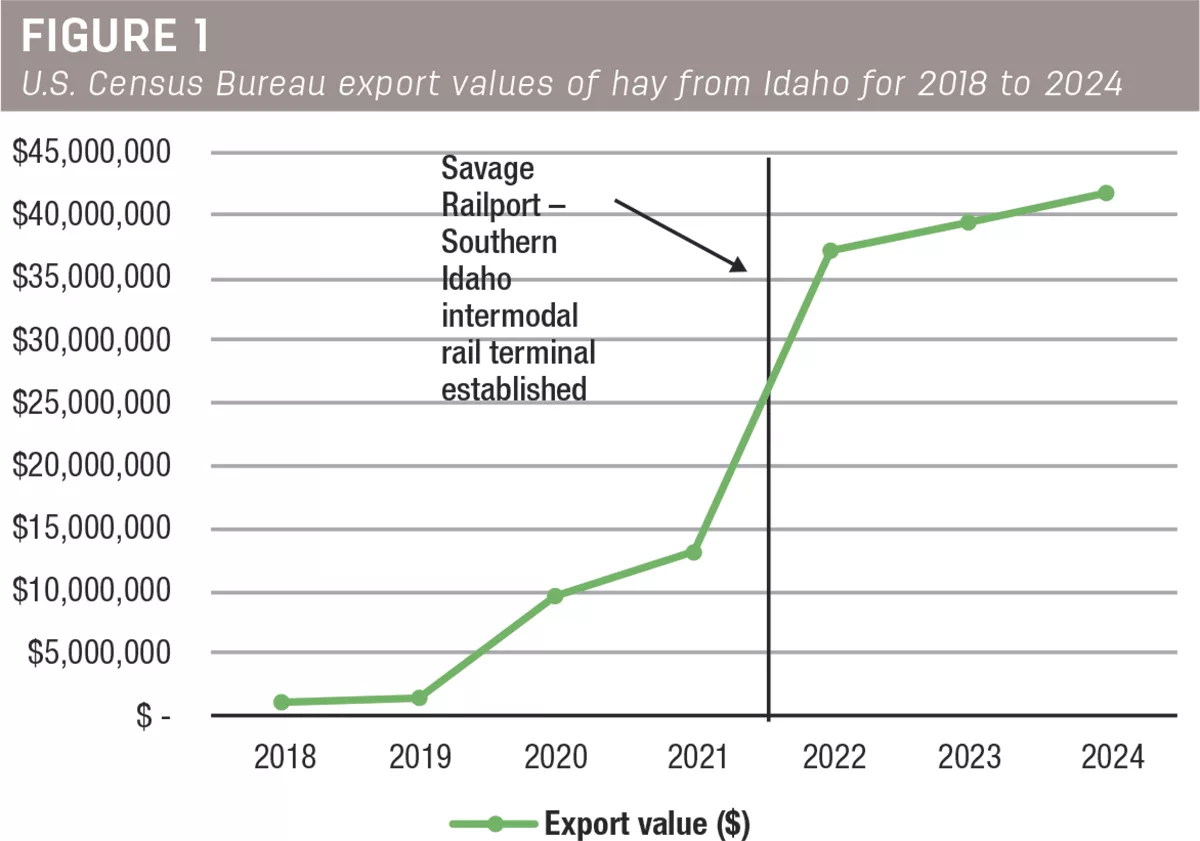
The U.S. Census Bureau UTO data are examined first and are Idaho hay export values (in $) from 2018 to 2024. The period represents three years before and after the establishment of the intermodal rail terminal. The HS commodity code used in obtaining the data was 1214 for “Rutabagas, Hay, Clover & Other Products." It is important to note that these data do not account for all possible exports from Idaho. For example, Idaho hay may be sold to a marketer in Washington who stores it and sells to a foreign buyer after one is identified. That such export would not show up in the Idaho data, but rather those for Washington. However, the intermodal rail terminal likely facilitates more hay being permitted and registered direct for export in Idaho than via Washington traders than was the case before the terminal was established.
The U.S. Census Bureau Idaho hay export value data for 2018 to 2024 are plotted in Figure 1, along with a line representing the mid-2021 period of opening the intermodal rail terminal. Figure 1 shows that hay exports were higher in 2022 than 2021, and that they continued to increase from the 2022 value in 2023 and 2024. The average value of exports from 2018 to 2020 (pre-intermodal rail terminal) was $3.98 million, while that for 2022 to 2024 (post-intermodal rail terminal) was $39.54 million. Thus, these data do suggest that the establishment of the Savage Railport – Southern Idaho intermodal terminal did facilitate increased exports.
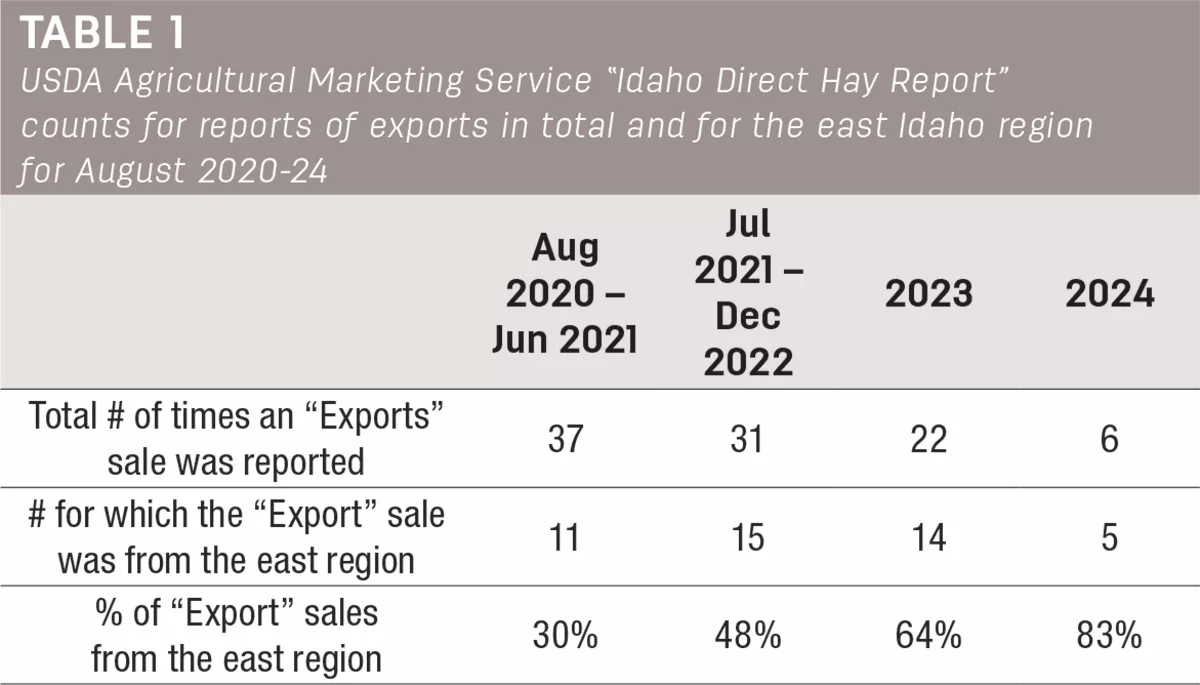
Data from the USDA AMS “Idaho Direct Hay Reports” provide similar evidence but from a more regionally specific lens. These reports are now released on a biweekly (formerly weekly) basis. Each report has information on hay sales by region (e.g., east, south-central), type (e.g., alfalfa, timothy grass), quantity sold, prices and “Freight/Use.” The “Freight/Use” indicator provides information on the hay buyers, and one of those is “Exports.” It is important to note that the USDA AMS uses a “voluntary reporting” method in which data are primarily obtained via phone calls and emails. Thus, while these data represent confirmed trades and prices, they are not representative of all trades that occur.
The format change of these reports in August 2020 was an improvement in that they previously did not specify the sales region. Given this current format, I reviewed all reports from August 2020 through 2024 and identified those for which there was an indication of “Export” in the “Freight/Use” section and noted the region from which the report originated.
Table 1 shows the number of reports for which exports were recorded and the percentage of reports from the East region, where the Savage Railport – Southern Idaho intermodal terminal is located. While there are fluctuations in the total number of export sales reports from year to year, the percentage of total export sales from the East region was higher from July 2021 to 2024 than before June 2021. Thus, these data also provide evidence that the Savage Railport – Southern Idaho intermodal terminal facilitated increased hay exports from Idaho.
Main takeaway message
While many factors influence international buyer behavior, including production conditions, exchange rates, trade and monetary policy, infrastructure investments can help facilitate exports. U.S. Census and USDA AMS hay export data examined in this article showed that following the establishment of the Savage Railport – Southern Idaho intermodal terminal in Pocatello in mid-2021, Idaho hay producers and marketers had several years of increased exports.




.webp?height=auto&t=1783636475&width=285 "63802-Thomas-GPS-equipment--Automated-Magnum-Tractor--Matt-Skinner-photo(1).jpg")
