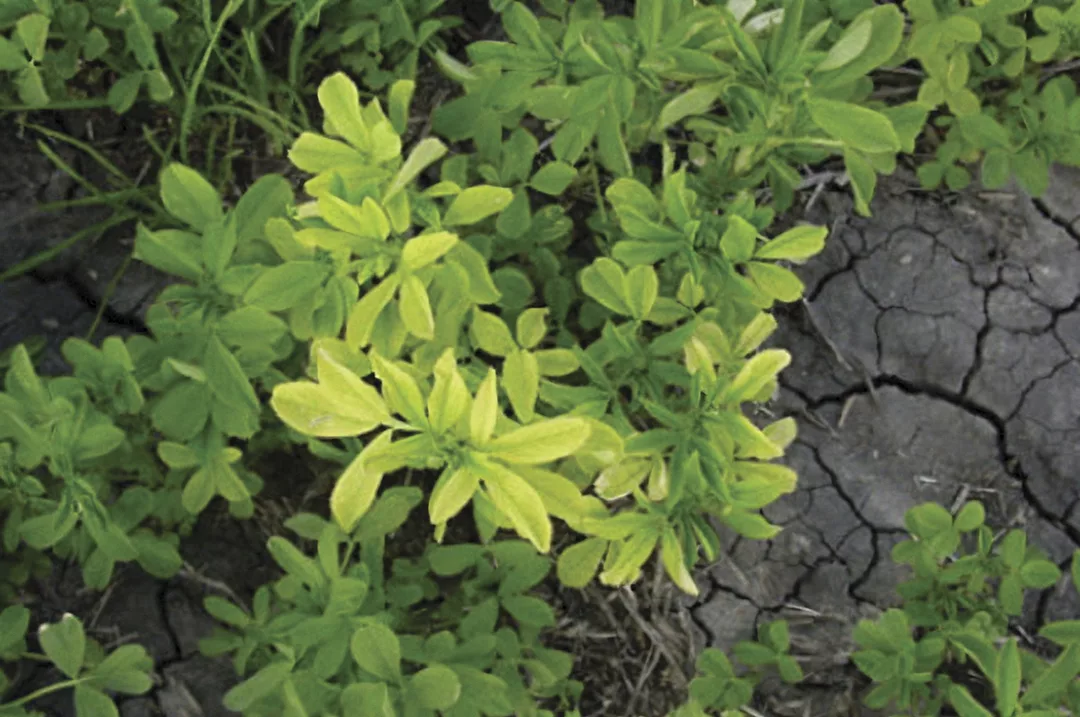
Boron (B) plays a key role in alfalfa health and forage quality that is sometimes overlooked. When B is missing, the signs are obvious.

“If alfalfa is deficient in boron, one of the symptoms is the newest growth will have smaller leaves or be more crinkled and the leaves don’t develop properly,” says Tryston Beyrer, crop nutrition lead for The Mosaic Company. “If it's a severe deficiency, you may see chlorotic or difference in colors – white or reddish color on the top parts of the alfalfa plant.”
He adds that the reasons for that is B is important for new cell growth and stem and leaf elongation, and it's one of the key areas that researchers see deficiency occurring in alfalfa. Growing larger leaves is one of the best ways to increase forage quality, as the leaves can have 400 to 500 relative feed value (RFV), while stems are often about 100 RFV. Getting more leaves-to-stem ratio is important for alfalfa quality.
Boron is also important for root growth.
“That's one of the reasons why we want to apply it in the fall, especially to new or younger stands, to help establish a better root and foundation that can allow for better nutrient acquisition of other nutrients, such as potassium, which can help with better winter survival and nutrient uptake when you have sufficient B levels,” says Beyrer.
Boron also supports cell wall formation and stability, which is essential for root tip development and elongation, and it’s critical for the formation and function of root nodules, which enable effective nitrogen fixation and regulates ion mobility across membranes, influencing nutrient absorption and stress resilience in alfalfa.
Above the ground, B aids in the movement of sugars and energy to growing tissues, especially reproductive structures, and it directly impacts fertilization and contributes to the synthesis of carbohydrates and proteins, which supports overall plant vigor.
Beyrer adds that across years of replicated trials and multiple site conditions, B has consistently proven to be one of the most responsive nutrients in alfalfa systems – second only to zinc (Zn) in corn.
Alfalfa trials
When you look at B recommendations, B on alfalfa is probably the second most recognized and responsive micronutrient that occurs in several different crops.
He said that if you look at different university recommendations, they recommend a pound of B per acre to a lot of the alfalfa stands, especially when it’s sandier soils or higher-rainfall environments.
“Alfalfa is highly responsive to boron – it recognizes when and where we apply in different amounts of fertilizer,” says Beyrer. “With alfalfa, there are multiple cuttings when we can apply potassium or boron throughout the year – probably the most common is after first and third cutting.”
Boron is also a leachable nutrient when it's negatively charged. A producer may ask, “How do I apply it on an annual basis?” knowing that it might leach below the root zone in those kinds of environments.
Beyrer explained that there is mobility in the soil and in the plant, and they're different.
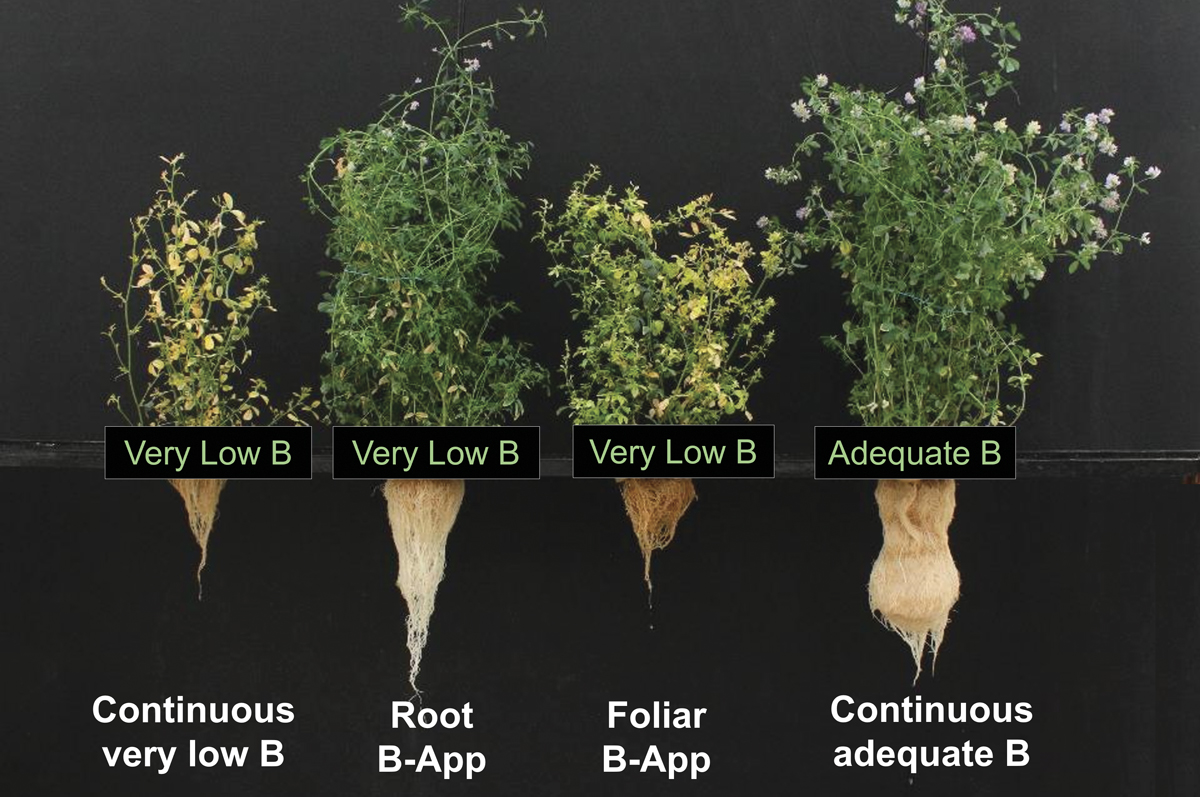
Continuous adequate boron is important for optimal plant health. In this study, root-based applications promoted more root and shoot growth than foliar applications. Image by Dr. Cakmak, Sabanci University.
“That's why it's important for the plant to acquire boron through its rooting system throughout the growing season and to ensure that it has continuous supply of boron,” adds Beyrer. “With foliar applications of boron, it's treating the leaves that are exposed and any subsequent growth won't necessarily be getting the full benefit."
When it comes to fertilizing alfalfa, Beyrer says that timing is often debated – but recent trials indicate positive outcomes whether B was applied in the fall, spring or split across the season, the yield results came out nearly identical. That consistency is more than a data point – it’s confirmation of the importance of B and the flexibility it offers to growers.
For some producers, a one-time fall application is a strategic choice. It simplifies planning, supports overwintering and still delivers strong stand performance during harvest.
“If you’re already applying potash, it’s worth ensuring boron is part of the mix,” says Beyrer. “It’s a small addition that can make a big difference in stand longevity, yield consistency and overall return on investment.”
Boron interacts with potassium
Beyrer says that in their research, they found if alfalfa is deficient in B, it can result in less potassium (K) uptake.
“So by having more sufficient levels of boron or an anion charge that can complement potassium uptake, it can better facilitate that uptake as well,” adds Beyrer.
Risks in overapplying boron
Boron is a micronutrient with a narrow margin between deficiency and toxicity, adds Beyrer, making application rates and fertilizer sources critical to crop safety and performance.
Typical B recommendations are about 1 pound of B per acre, with more aggressive guidelines – such as those from the University of Minnesota – suggesting up to 2 to 3 pounds per acre in certain scenarios. However, exceeding 3 pounds is generally discouraged. While some managers may suggest rates to 5 pounds, applying 10 pounds of actual B risks plant-level toxicity, especially in sensitive crops.
Beyrer says it also depends on the fertilizer source.
“When you look at the recommendation rates of boron, even for like a 5-ton-per-acre alfalfa crop, it may only physically uptake about a half-pound of boron per acre, but a lot of times those recommendations of a pound per acre is just to get enough granules out there to fully cover that soil profile with those traditional fertilizer sources,” says Beyrer, who also recommends soil testing to manage B application.
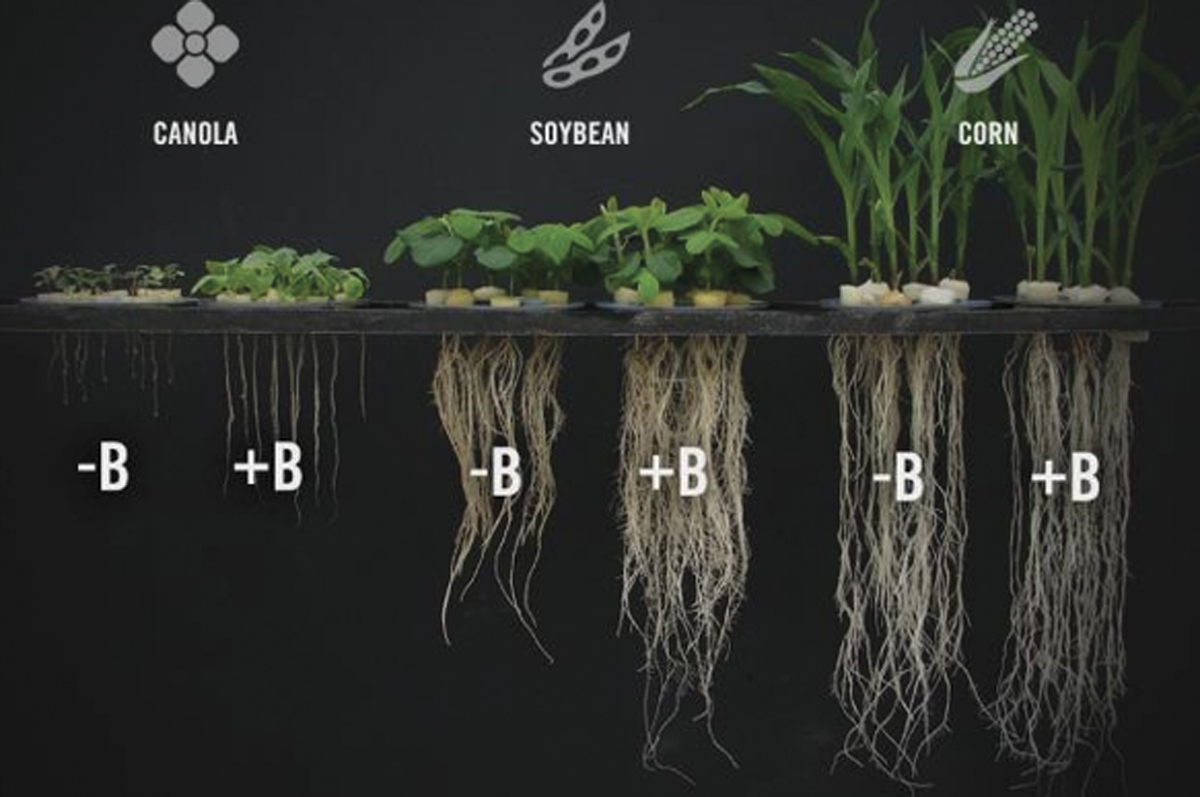
Plants with adequate boron (+B) show significantly more robust root and shoot development compared to those grown in boron-deficient conditions (-B). Image by Dr. Cakmak, Sabanci University.
Soil tests guide boron management
Fall soil testing remains a cornerstone of nutrient management, and B deserves a closer look – especially in high-yielding forage systems. Standard soil tests should include B analysis, with levels below 1 part per million typically considered low and warranting an application.
As Beyrer explains, “Soil tests can guide producers and help manage boron application. If it’s less than 1 parts per million, I recommend applying.” But he’s quick to add that nutrient uptake and removal values should also be considered when making decisions.
For example, a 5-ton alfalfa crop removes roughly 0.5 pound of B per acre, while actual uptake may be slightly higher. During a four-year rotation, that adds up to 2 pounds of B needed just to match removal – more if yields exceed expectations.
This year on Beyrer’s farm, alfalfa yields are pushing 7.5 to 8 tons per acre, thanks to favorable rainfall. Some growers are even targeting 10-ton hay crops, which he says dramatically increases nutrient removal. In these cases, revisiting the fertilizer program is essential not just for B but also for K, S and other key nutrients.
Innovations with boron research
Beyrer says that researchers are striving for higher yields but need to have a better understanding of how plants are using B and what levels are needed to unlock additional yield potential.
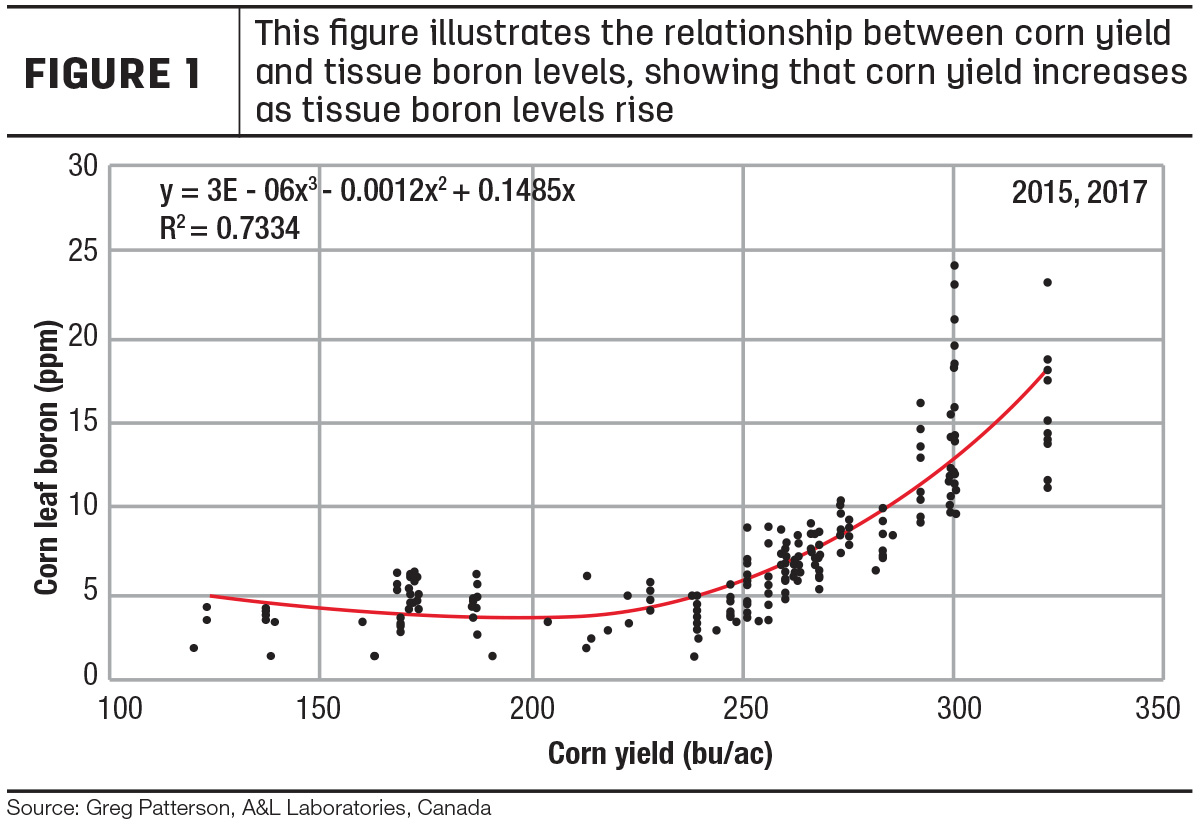
Some research on corn from Canada indicates when looking at the amount of B that is in the plant, they found at less than 200-bushel yields, maybe the B isn't as critical, but as they started getting into upper-200-bushel yields, there is a strong correlation with higher yields and plants needing higher amounts of B (Figure 1).
“The first part of this is acknowledgement that there is a need and opportunity from boron,” says Beyrer. “From there, it will be matching the right fertilizer sources and timing to provide boron when plants need it. By recognizing boron’s role, it means giving alfalfa the foundation it needs to thrive, from root to crown, stem to leaves.”
Beyrer adds that even with low soil test values, restraint is key. Application rates should reflect crop demand and the fertilizer source’s release characteristics to avoid toxicity. For producers riding a good hay year, now’s the time to reassess removal rates and adjust nutrient plans accordingly.