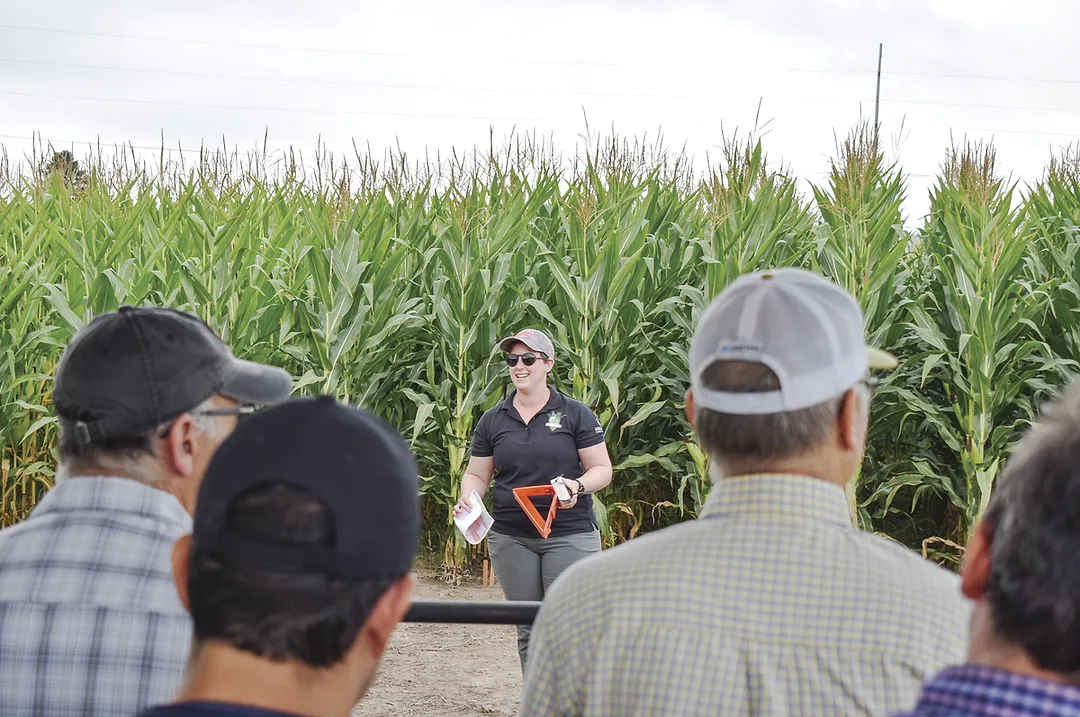
Insect pests take a toll on crops each year, and many strategies are used to try to control them. Often the best results come from combining several tactics through integrated pest management (IPM). Emily Bick, assistant professor of precision pest ecology and extension specialist for field and forage crops at the University of Wisconsin – Madison, leads the Original Digital Entomology Lab, where her team develops tools and strategies to support data‑driven precision management practices.

“I focus on how we can have better timing and spacing of interventions,” says Bick. "Much of this has to do with understanding the basics of insect biology, behavior and growth patterns, and the phenology – nature’s calendar – the study of recurring seasonal biological events such as plant flowering, bird migration and insect hibernation, and how these life cycles are influenced by temperature, rainfall and day length.”
Bick has done a lot of research with phenology models.
“The way weather impacts pests is interesting and very different from the way weather impacts people,” says Bick. “Insects grow in life stages rather than day by day. Their growth is stimulated by temperature. There are also some other environmental factors, but if you want to slow down an insect’s development rate, you put it in a refrigerator.”
That insect will last longer – and literally be older – while staying in an earlier life stage such as larval or nymph instar, depending on what type of insect it is. This is one way insects have adapted to their environment to survive.
“Pest phenology is highly dependent on temperature, weather, water conditions, conditions in which that insect overwinters and spring conditions,” says Bick. “If the insect phenology is mismatched with the crop phenology, we run into different problems. For instance, not all insects in our state overwinter here. Migratory insects fly here from southern states in the spring, and it depends on when they migrate here, when they start laying eggs and those eggs start developing.”
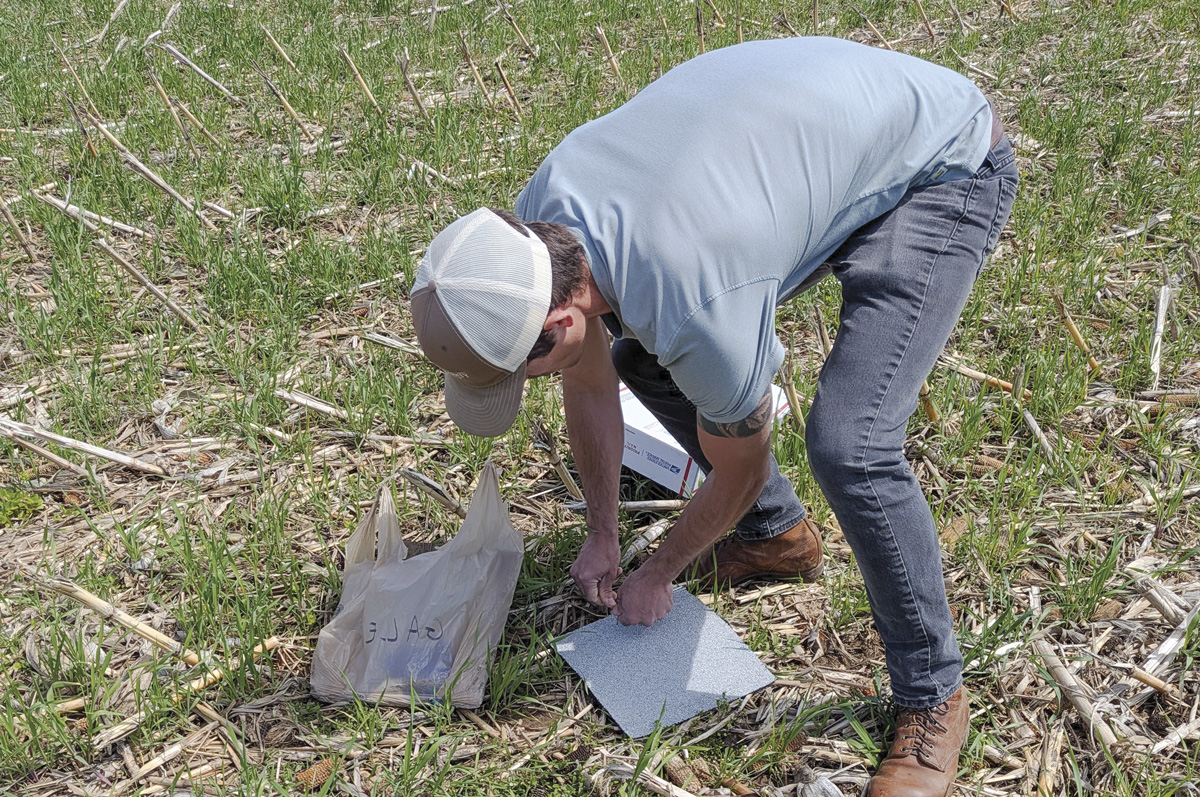
A student checks a tile for the “SlugNet” project, collecting field data to monitor slug activity in crop residue. Image by Emily Bick.
This spring brought record flights of true armyworms, a pest that affects corn, soybeans, forages and cover crops. Thousands of moths moved through the region – far more than last year – even though last year’s pressure was already severe. The difference this season wasn’t overwintering survival or local spring conditions; these moths arrived from elsewhere.
Because flights occurred before corn emergence, egg‑laying happened in green cover rather than bare cornfields. As a result, larvae hatched in wheat, rye and other cover crops instead of in corn. The outbreak was driven by a phenology mismatch: Moth arrival and egg‑laying were out of sync with crop development, creating a perfect window for early feeding.
“We are running into issues with growers who planted corn into cover crops and now their corn is at a young stage, and the juvenile true armyworms are munching away at the corn and causing economic damage," adds Bick.
For growers who planted differently, the concern shifts to the second generation of true armyworm. In Wisconsin, two or more generations can overlap, and these later waves behave differently than the migratory adults that arrive in spring. Instead of long‑distance movement, subsequent generations tend to stay local, making short in‑field shifts that keep pressure close to where eggs were laid. This creates a different management challenge – one driven by local population buildup rather than migration.
On the other hand, even though it was a cold winter in Wisconsin, there was snow cover.
“Snow is great insulation, especially for pests that live here year-round, like slugs and alfalfa weevils that overwinter here – even though it was cold last year, the snow blanket protected them,” says Bick.
People think cold winters kill insects, but they lay so many eggs that even if part of them hatch in the spring, they have adequate population.
In corn, the number one pest is the corn rootworm.
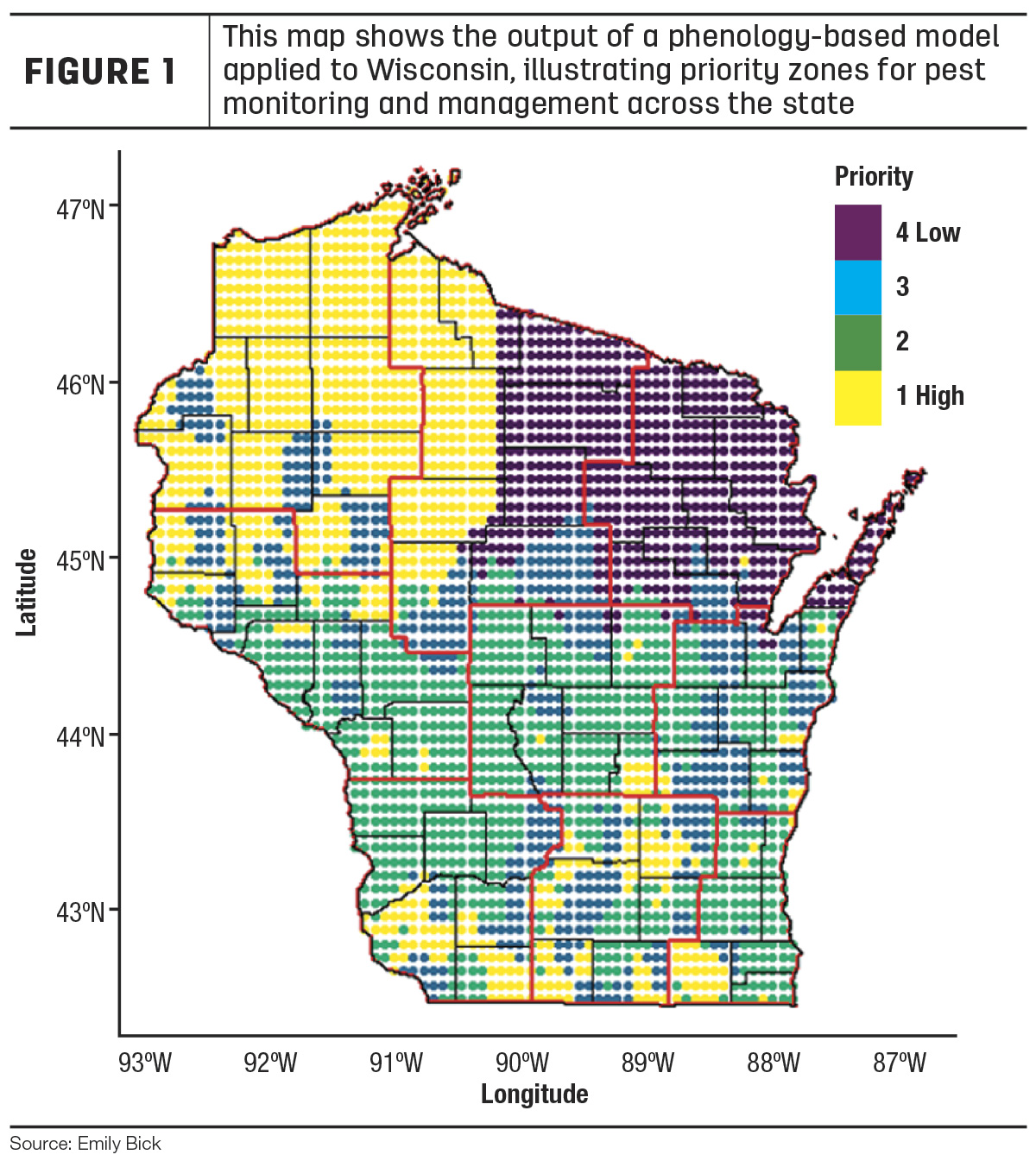
There are three species – Southern, Northern and Western corn rootworm. In Wisconsin, producers mainly deal with Northern and Western. These pests lay eggs in the fall and overwinter as eggs, in cracks in the soil. Bick says her lab is trying to determine where the rootworms are actually located (Figure 1).
One of the best things to do is rotate crops.
“If we have continuous corn, we will have continuous corn rootworms. They can lay eggs in soybeans and other crops, but if the larvae eat something other than corn, they die,” adds Bick.
Crop rotation can reduce the number of eggs in the area. When continuous corn is planted and corn rootworm traits no longer provide adequate protection, it signals that a different mode of action will likely be needed the following season. That may mean shifting to an insecticide or selecting a different trait package to regain control. Bick’s lab is actively evaluating these trait options to help identify which protections remain effective under current pressure.
Bt traits (derived from the soil bacterium Bacillus thuringiensis) are genetic modifications in crops like corn that produce insect-killing proteins. When ingested by target pests, these proteins activate in the insect's alkaline gut, binding to receptors and causing fatal paralysis.
“The classic Bt traits are not holding up like they used to,” says Bick. “With this pest, there is nothing we can do in season, but if you are having a bad year for corn rootworm and don’t want to rotate your crop, you can change your strategy at planting time. Instead of planting the same Bt trait cascade, you could plant something with an RNAi trait or use an in-furrow insecticide.”
Ribonucleic acid interference (RNAi) technology is a cutting-edge biotechnology trait used in corn to control pests like corn rootworm. It works differently than traditional Bt traits by causing a gene silencing effect that stops the insect from producing the proteins vital for its survival.
“My lab has been working in partnership with extension and NRCS on slugs, and we’re trying to figure out what is driving our high slug populations the past couple years," says Bick. "It’s partly moisture but also has to do with how well our state is adopting cover crops.”
Many farmers are using conservation cropping practices that leave more crop residue and retain more moisture in the soil.
“This creates better habitat for slugs and they lay more eggs,” adds Bick. "Some of the best practices for soil health enhance soil biology and some of that may be pests.”
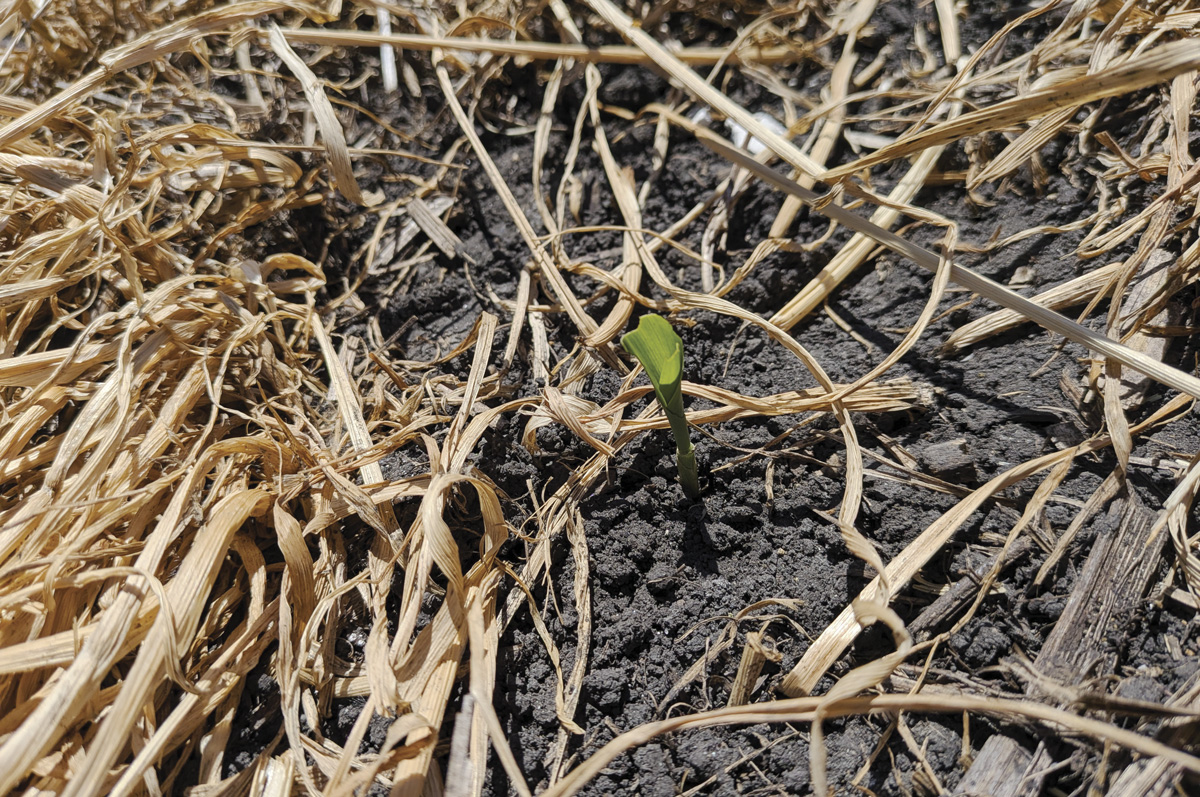
A corn seedling emerges through dry residue, showing early‑season true armyworm feeding damage on the first leaf. Image by Emily Bick.
Bick emphasizes that this challenge doesn’t mean growers should abandon these practices; it simply reflects the next problem to solve. She notes that part of the university’s role is to work through issues like this and provide growers with clearer, more economical management options.
Monitoring and scouting remain essential for catching pests before they cause economic loss. Understanding when key insects will appear helps growers stay ahead of pressure from species like true armyworm and fall armyworm. Smaller larvae are the only stages where insecticides provide reliable control; once true armyworm reaches roughly three-quarters inch in length, chemical control is no longer effective.
Knowing the susceptible life stages of European corn borer, other boring insects and corn earworm is essential for effective control. Management options only work when the insect is still exposed; once the pest bores into the plant stem, control becomes far more difficult. Catching these insects at the right time is what allows growers to intervene before damage is locked inside the plant.
“We’ve put together some tools to help farmers stay ahead of these. For insect pests, we've launched an insect pest text alert service – cooperating with extension and the Department of Agriculture, Trade and Consumer Protection, which is regionally specific,” says Bick. “Farmers can receive a text as often as once a week to provide heads-up on what’s in their area – time to scout the fields and look for them. They get on-time information; the text links to a website with a short form answer on how to scout, what to look for, what to spray with if you find these pests and the thresholds.”
The team has also launched a slug‑net monitoring network, with 30 sites across the state tracking where slugs are active and how populations shift through the season. Alongside the monitoring effort, they’re conducting on‑farm research trials to evaluate which practices offer the most help for growers dealing with slug pressure and to better understand how management decisions influence slug activity.
There is ongoing research regarding insect trapping to make sure the people doing these projects are trapping in the right locations. The lab developed a trap spacing metric that is published and in use in Wisconsin, guiding the placement of insect traps.