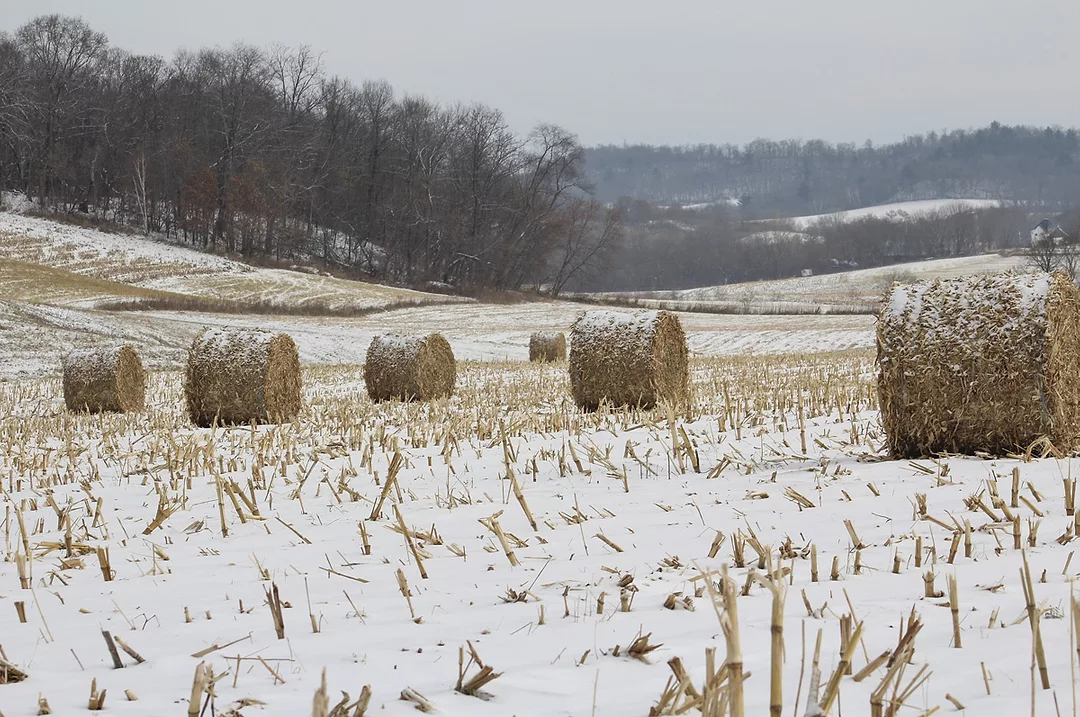
Imagine this scene: It’s winter in the heartland – and not the beautiful, white, fluffy, preholiday winter when everything is full of wonder and possibility. This is the bleak, cold, windy, postholiday winter when people want to travel south; the snow along the roadsides is full of windblown dirt, and it’s enough already. To make matters worse, looking out across those vast, productive fields of the Midwest, one can often see large blowing swells of dirt that will end up embedded in the snow along the roadsides. (Sidenote for the purists – using “dirt” is intentional here, because it is displaced soil.)

Aside from blighting our winter wonderland, this blowing dirt is a visceral reminder that Old Man Winter is a thief who robs the land of nutrients and negates the hard work, management, time and fertilizer dollars that farmers carefully put into the land. Farming is a constant battle with nature – even in winter, when everything is frozen, nothing is growing and nobody wants to go outside. Fortunately, steps can be taken before the freeze to bolster defenses and bring the battle to that old man’s icy doorstep.
Every thief has their preferred tools of the trade. Safe crackers use stethoscopes, pickpockets use distractions and winter uses cold and wind. Wind is ever-present and persistent, and controlling it is critical to foiling winter’s scheme. Without anything to get in its way, wind will gain speed and momentum, stripping the fields bare. Though wind can never be stopped, its speed can be controlled, thus slowing its momentum. Windbreaks are an effective way to do this, and they come in several flavors.
Thinking of a windbreak doubtlessly evokes images of trees interspersed among crop fields, usually in long strips and (if done right) with multiple species of trees of varying height. These traditional windbreaks are great for slowing wind speed and have been proven to be an effective defense against the winter wind again and again. There is difficulty here, though, in that these windbreaks take years to mature, cost a lot of money to install and often divide up the fields, making it more difficult and time-consuming to cultivate. There is another option, though.
The math of windbreaks says that the area of protection is approximately 10 times the height of the windbreak. That is to say, if a windbreak is 50 feet tall, it will provide wind protection to the land for 500 feet from its base. So, if the goal is to provide 100% wind protection, windbreaks need to move closer together as they get shorter. Using the mind’s eye, we can imagine what it would look like as rows of trees get shorter and closer together until they stand only a few inches tall and a dozen or so inches apart.
Of course, if we were to make this daydream real, it doesn’t make sense to use trees. It would make more sense to use something that can be planted at the imagined spacing – something like ryegrass.
Cover crop, anyone? Keeping the field covered in the winter months is a windbreak on a smaller scale in height but a much larger scale in breadth and width. Of course, this can be achieved with heavy crop residue, too, but the wind has a better chance of stripping the residue away than of blowing away a rooted plant.
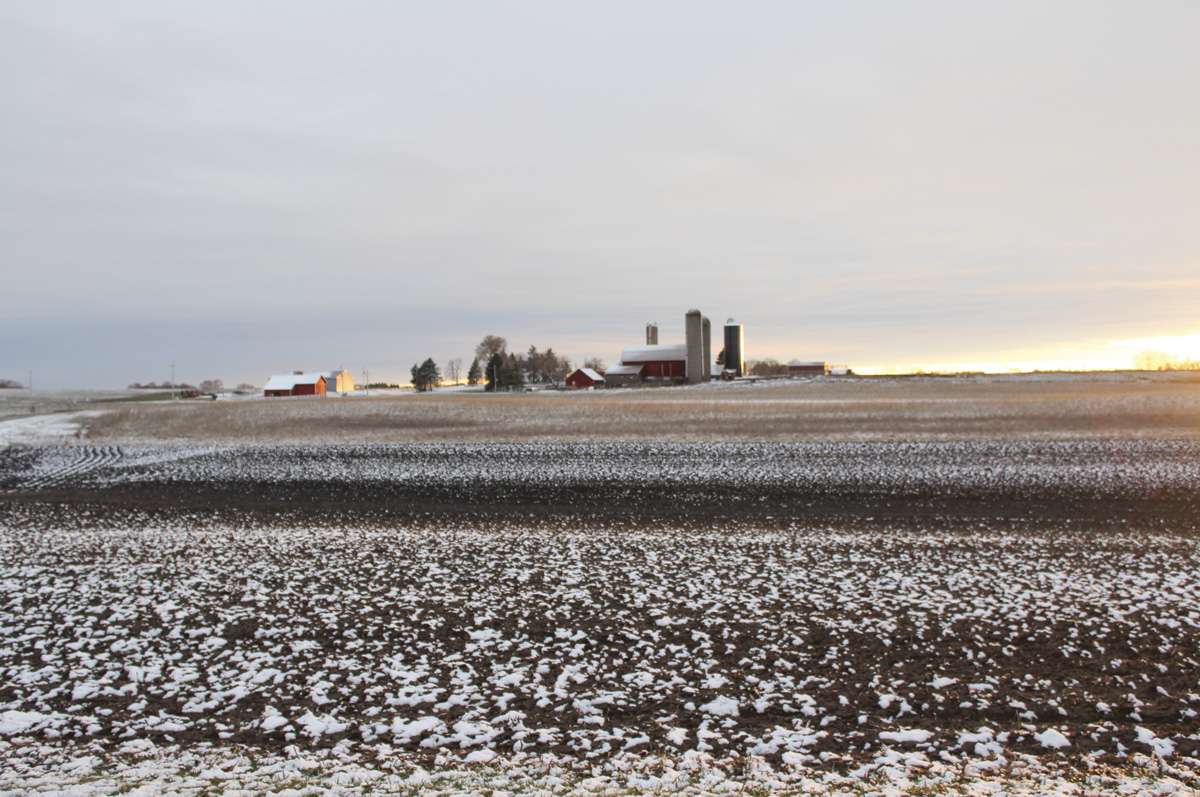
No ground cover can result in significant winter soil losses. Image by Buffy Uglow.
In one last effort to rob the land, winter will, at the end of its reign, deploy its secret weapon: water. It’s odd to think of water as a tool of winter thievery, what with the cold making most of the water into ice and all, but it’s precisely that ice and water relationship that can cause trouble. The freeze-thaw cycles of winter allow water to work its way into the soil little by little. When the water refreezes, it forms ice lenses that open fissures in the soil profile.
Windbreaks and cover crops can help here, too, by keeping the snow cover in place. Keeping the snow on the field increases albedo, or reflectiveness, of the land, helping to bounce off what little warmth the winter sun provides to create the freeze-thaw cycle. This is a good thing, as it mitigates these cycles and the consequent damage to the soil structure.
At the end of the season, when the sun finally begins to share its warmth with the earth once again, the ice and snow melt, and that water needs to go somewhere. If the land has a slope, the water will obviously follow it and can take topsoil with it; this is what most people envision when they think of winter thaw and melting snow. Remember, though, that water easily carries nutrients downward through the soil profile. If ice lenses have created nice, wide pathways in the soil, kiss those nutrients goodbye.
There’s nothing to impede that downward progression, and those valuable minerals can easily find themselves below the reach of the upcoming crop’s searching roots. Again, cover crops can come to the rescue; aside from mitigating the ice lenses that cause the cracks, their roots give the water a more tortuous path and slow down infiltration. Think of the game Plinko – a bare field is Plinko with one peg, and a cover-cropped field is Plinko with 50 pegs. (In this analogy, the Plinko puck is obviously the water and those expensive, precious nutrients.)
There’s an existential question at play with cover crops: If you’ve been robbed but never notice, has a crime been committed? Some would say no, because crime requires a victim. Being a victim requires a grievance, and somebody who never notices that anything has happened has no grievance. Others say that robbery is a crime regardless of whether it’s noticed – the act itself is a crime.
Then there’s a third variant in which there is a robbery and the victim knows about it, but the victim disagrees that the burglarized item was of any significant value. Here again, we have no grievance and hence, no victim. Old Man Winter is definitely robbing our farmers every winter, but whether it’s a crime, and what to do about it, is up to each individual. The main resistance to both traditional windbreaks and cover crops, hands down, is the implementation cost. There’s no question that inaction also has a cost; the difficulty is that the cost is a hidden, unknown mystery. Ultimately, the decision of whether to plant cover crops is a choice between the devil you know and the devil you don’t.