
Idaho has a new top ag commodity: beef cattle. Livestock sector gains led Idaho farmgate cash receipts to a second consecutive all-time high in 2025. Net farm income is forecast to see a small year-over-year increase, with livestock sector gains outweighing losses in the crop sector.

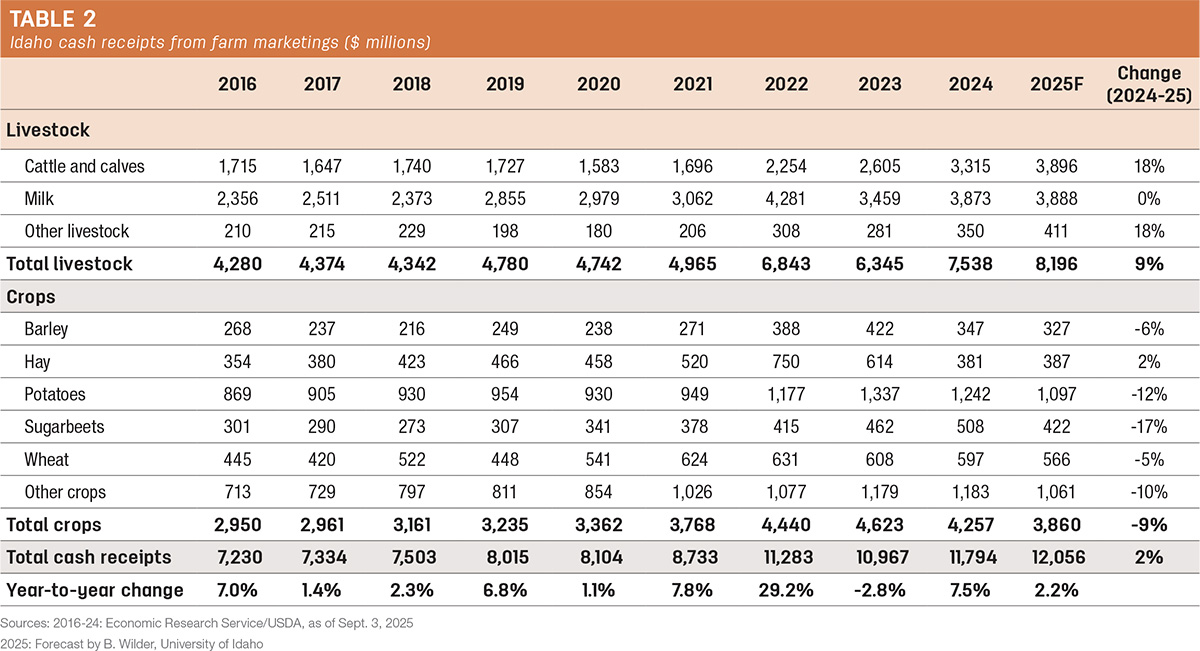
Cash receipts for livestock and crops in 2025 are estimated at $12.1 billion, a 2% increase over 2024. Cash receipts for cattle and calves are estimated at $3.9 billion, narrowly surpassing milk receipts ($3.85 billion) for the first time since 2003. The livestock sector is forecast to comprise 68% of total cash receipts, the largest share since the data series began in 1924. Cash receipts for Idaho’s highest-revenue crop, potatoes, are estimated at $1.1 billion, down 12% from 2024.
Net farm income for 2025 is estimated at $2.7 billion, 6% higher than in 2024 but 1% below the previous five-year average. Expenses are estimated to be an all-time high of $10.4 billion, 3% higher than 2024’s all-time high of $10.1 billion. While Idaho’s agriculture industry appears strong in aggregate, nearly all revenue gains for the past two years can be attributed to the livestock sector. A majority of crop producers are expected to be worse off than a year ago.
Highlights
- Farm goods leaving Idaho directly for export are forecast to reach an all-time high of $1.44 billion in 2025, up 6% from $1.36 billion in 2024.
- Idaho agriculture is driven largely by livestock. Cash receipts from milk, cattle and calves, and other livestock (trout, sheep, chicken eggs, etc.) comprise 68% of total 2025 agricultural cash receipts. Hay, silage, feed grains and byproducts from sugarbeet and potato processing are used as feed for Idaho livestock.
- Cattle and calves are expected to post their fourth consecutive new all-time high for cash receipts in 2025 at $3.9 billion, up from $3.3 billion in 2024. If realized, this will make revenues from cattle and calves the highest of all Idaho agricultural commodities for the first time since 2003.
- Milk revenues are expected to hold steady at $3.85 billion in 2025, up marginally from $3.8 billion in 2024. Revenues from milk production are expected to reclaim their place as the highest of all agricultural commodities produced in Idaho in 2026 or 2027.
- Idaho, the country’s top potato producer, is estimated to see a moderate decline, with cash receipts of $1.1 billion, down from $1.25 billion in 2024.
- Except for 2009 – a year of disastrously poor milk prices – livestock cash receipts have surpassed crop cash receipts for every year since 2001. In 2025, livestock cash receipts are estimated to surpass crop cash receipts by more than $4.3 billion.
- Idaho’s net farm income for 2025 is estimated at $2.7 billion, up 6% from 2024’s $2.6 billion.
- Federal government payments to Idaho producers in calendar year 2025 are estimated at $100 million, an increase of 4% from 2024.
Contribution of agribusiness to Idaho’s economy
Agribusiness is a vertically integrated industry comprising food production and processing. In providing food to national and international markets, agribusiness creates business sales and jobs throughout the Idaho economy and contributes to the state’s gross domestic product (GDP). Agribusiness export dollars ripple throughout Idaho’s economy, creating (directly and indirectly, as of 2022):
- $37.5 billion in sales or 17% of Idaho’s total economic output
- 126,800 Idaho jobs or approximately 12% (1 in every 9) of jobs in the state
- $14.5 billion in value-added or 12.8% of Idaho’s gross state product (GSP)
Idaho farm cash receipts
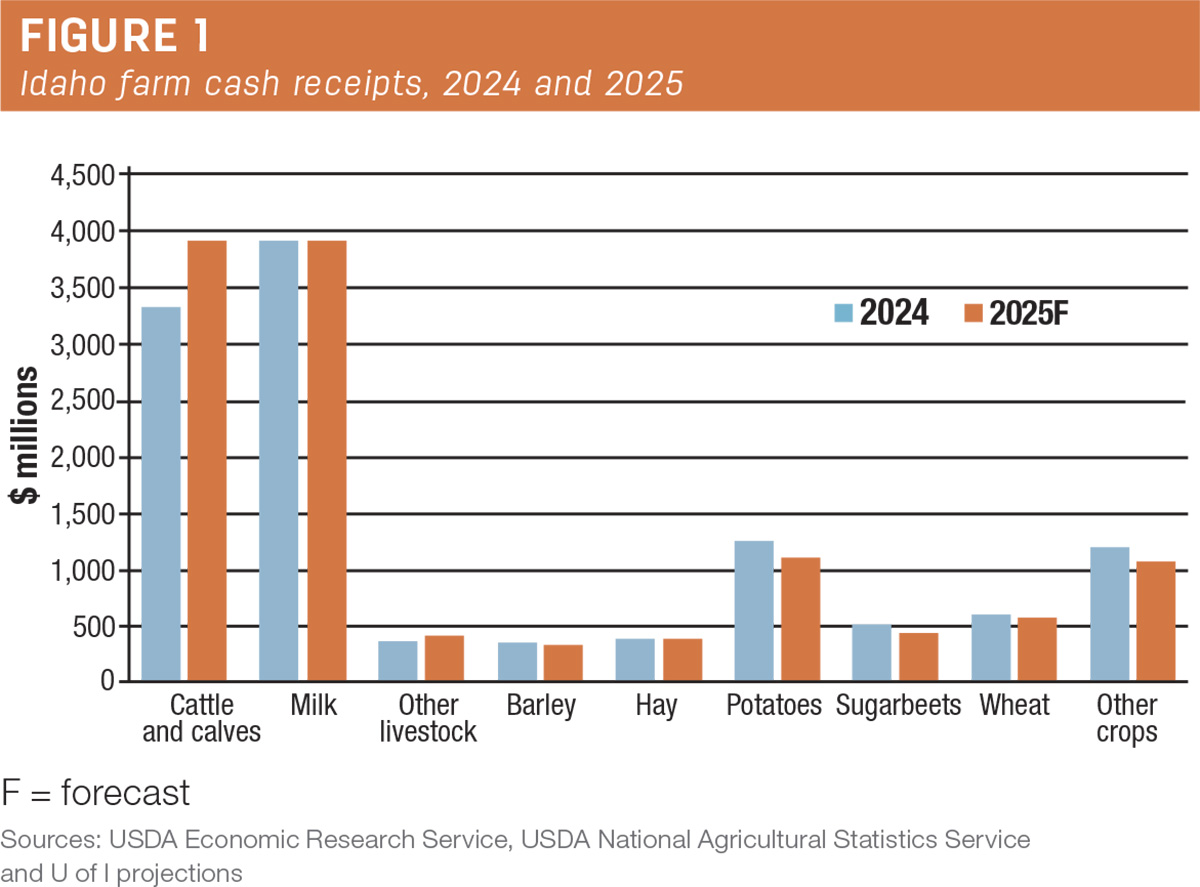
Idaho’s 2025 farm cash receipts are estimated at a record high $12.1 billion, a 2% increase over 2024’s $11.8 billion and 18% over the previous five-year average of $10.2 billion.
Crop revenues in 2025 are estimated at $3.9 billion, down 9% from 2024’s $4.3 billion and 6% below the previous five-year average. Hay (up 2%) is the only crop forecast to have higher year-over-year revenues, yet hay receipts are expected to be 29% below their previous five-year average. Sugarbeet receipts are expected to be down 17% but are the only crop forecast to keep receipts above their previous five-year average. Receipts for all other major crops (barley, wheat, potatoes and other crops) are expected to fall 5% to 12% year over year and move below their five-year averages.
Livestock revenues are estimated at an all-time high $8.2 billion, up 9% from 2024. Receipts from cattle and calves are the largest component of this category, with projected 2025 cash receipts of $3.9 billion (up 18%). Cash receipts from milk are estimated at $3.85 billion (flat). Receipts from other livestock are estimated to be $411 million (up 18%).
In real dollars (inflation-adjusted to 2017), estimated cash receipts are 16% greater than the previous 10-year (2015-24) average. High inflation over the past five years has led to a 28% disparity in real versus nominal cash receipts. In inflation-adjusted terms, Idaho farmers earned just 3% more than in 2014, which was the most recent all-time high before 2022.
Idaho agricultural exports
At $1.36 billion, exports of food and agricultural products made up 32% of Idaho’s total exports ($4.2 billion) in 2024. The next-largest industry is machinery and electrical equipment at 25% of exports. In 2024, Idaho’s largest agricultural trade partners were Canada (32%) and Mexico (19%). The majority of Idaho agricultural exports were dairy products (21%), potatoes and related products (18%), other vegetables (11%), live animals (11%) and oil seeds (9%). From January through August 2025, the value of agricultural exports increased by 6% compared to the same period in 2024. The projected total for agricultural exports in 2025 is expected to reach a new high of $1.44 billion.
Idaho net farm income
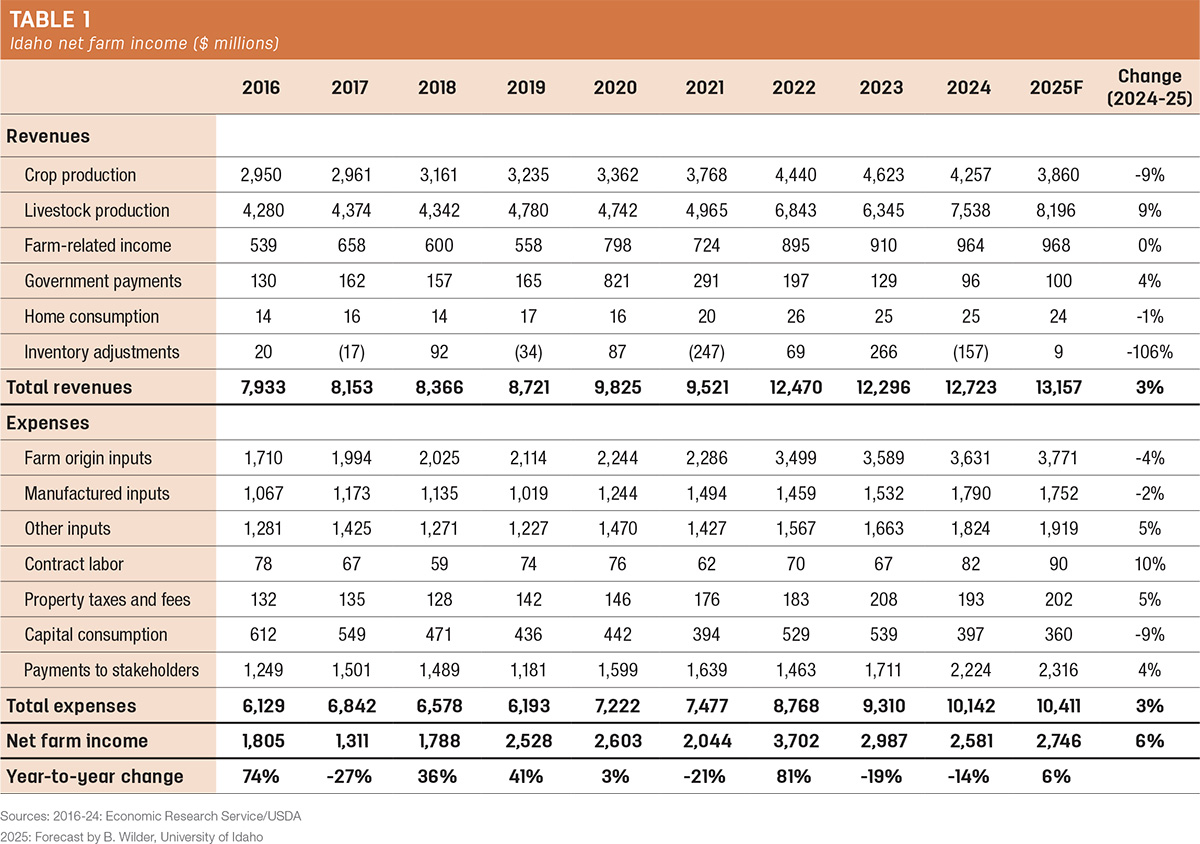
Net farm income, revenues minus costs, is the farmer’s bottom line. Revenues include cash receipts from crop and livestock sales, inventory changes, the estimated value of home consumption, government payments, machine hire and custom work, forest product sales and the imputed rental value of farm dwellings. Farm expenses include farm-origin inputs (purchased livestock, feed and seed), manufactured inputs (fertilizers, fuel and electricity) and “other inputs,” including repairs and maintenance, machine hire and custom work, marketing, storage, transportation and contract labor.
The projected 6% increase in 2025 Idaho net farm income reflects a 3% increase in total revenues and a 3% increase in total expenses. Net farm income in 2025 is estimated at $2.7 billion, which is 1% below the previous five-year average. The USDA's current U.S. net farm income estimate for 2025 is $180 billion, up 40% from 2024. This estimate, released in September 2025, reflects a large increase in government payments, which we now know won’t reach farmers until 2026.
Historically, net farm income is much more volatile than gross cash receipts. In seven of the past eight years, Idaho experienced double-digit percentage swings in net farm income. Real-dollar Idaho net farm income (inflation-adjusted to 2017) is projected to be $2.1 billion, down 46% from the all-time high in 2022 ($3.1 billion). Idaho’s real net farm income in 2025 is estimated at 1% above the previous 10-year average (2015-24).
Most farm expense categories are expected to remain flat, with few large year-over-year moves. Fuel expenses ($351 million), feed expenses ($2 billion) and fertilizer expenses ($1.4 billion) are expected to be down 4%, 6% and 8%, respectively. Interest expenses ($717 million), labor expenses ($263 million) and storage and transportation expenses ($225 million) are projected to be up 5%, 6% and 9%, respectively. Idaho farmgate interest expenses are up 78% since 2021 and continue to have an oversized negative impact on highly leveraged producers.
Idaho government payments
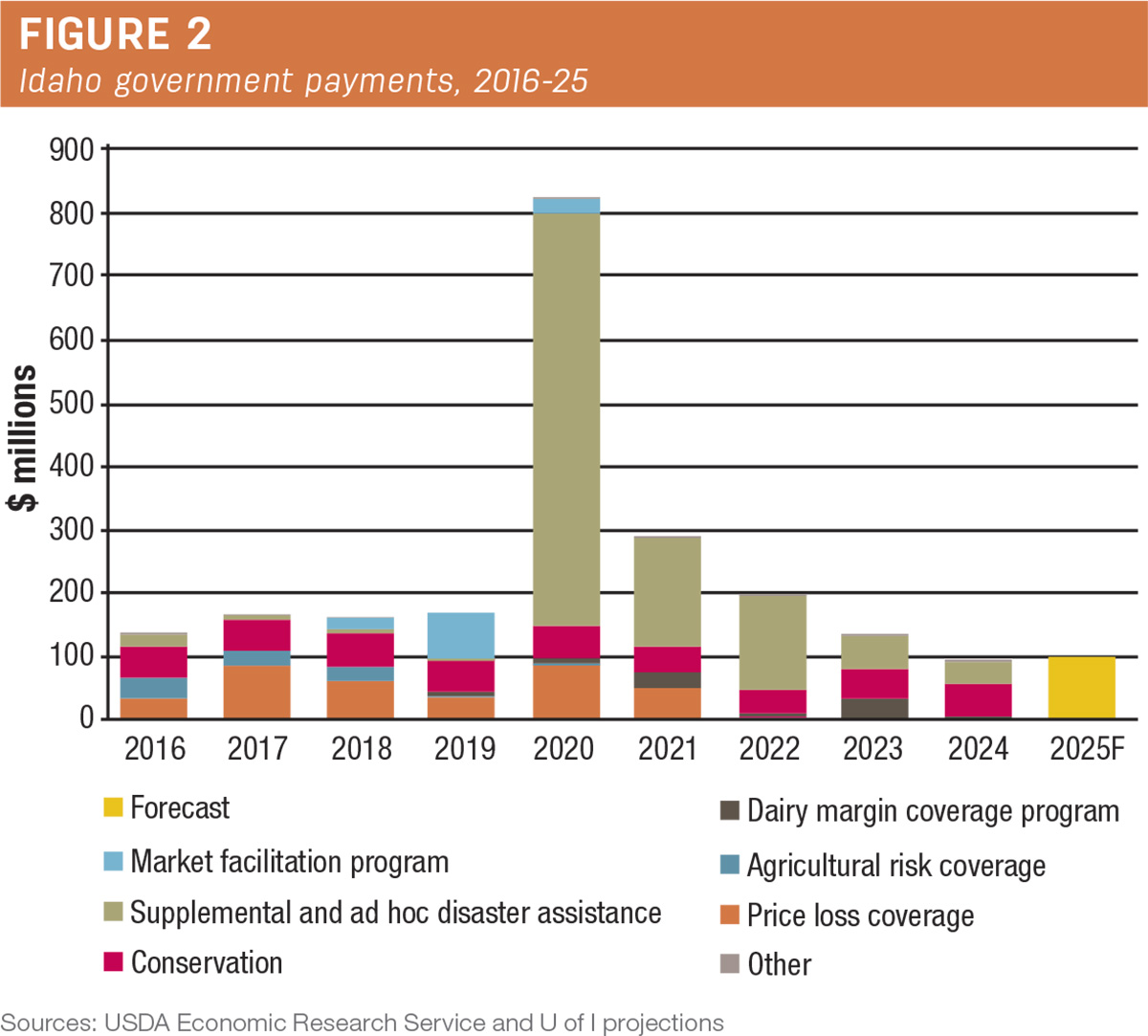
Federal government payments to Idaho agriculture in fiscal year 2025 are estimated at $100 million, which is 4% higher than in 2024 – the lowest point since 2015. This reflects a continued reversion to normal following extreme COVID-19 relief-driven highs in 2020 and 2021. A large influx of government payments is expected for farmers in 2026 related to allocations set aside in the One Big Beautiful Bill (OBBB) in 2025. These payments are meant to offset trade-related losses incurred by farmers and ranchers. Federal payments in 2026 to Idaho farmers are expected to be somewhere between $500 million and $1 billion. As of this publication, final program details are not known but funds are expected to be allocated primarily to major crops.
Idaho agriculture’s gross domestic product
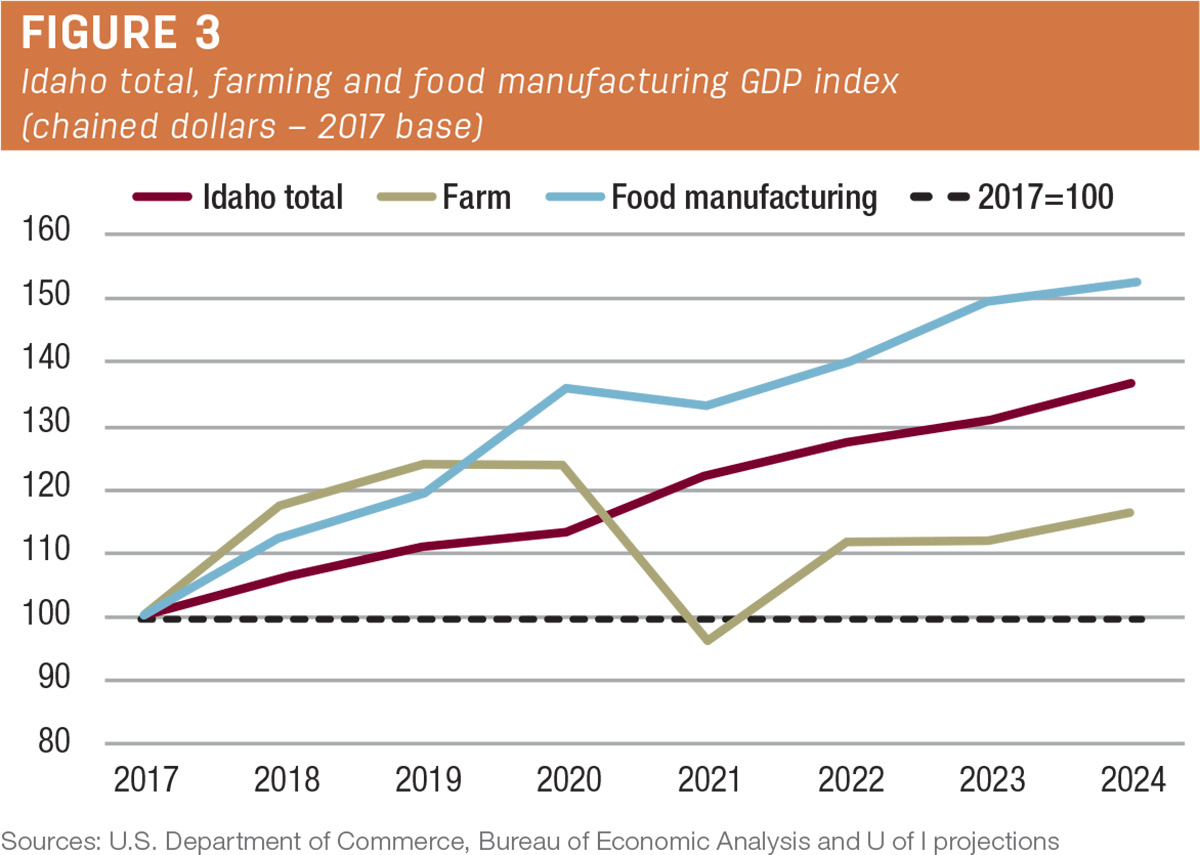
GDP measures value added, the value of output minus the value of intermediate goods and services used in production. The GDP grows when farms and businesses become more efficient: increasing output while reducing the use of intermediate inputs. In 2024, Idaho’s nominal GDP was approximately $129 billion, of which 3.3% was generated by farming. Nominal farm GDP in 2025 decreased 3% to $4.3 billion from $4.4 billion in 2023. It is estimated that final nominal 2025 Idaho farm GDP will be on par with or above 2024 levels. Over the past eight years (2017-24), Idaho’s inflation-adjusted (2017 dollars) total GDP has grown 37%, while Idaho farm GDP increased at a slower rate of 16%. In contrast, the food manufacturing GDP continues to add value to farm products at an exceptional rate, growing 52% over the same period.
Idaho livestock and crop revenues
Cattle and calves
In 2025, revenue from cattle and calves is estimated at $3.9 billion. Most of this increase is attributed to record beef cattle prices, but a portion can be attributed to the impact of high-value beef on dairy cross calves. The USDA NASS (National Agricultural Statistics Service) reports that the Idaho beef cow inventory fell 4% from Jan. 1, 2024, (457,000) to Jan. 1, 2025 (440,000). The U.S. beef industry is in a state of contraction; however, the U.S. beef cow herd is expected to grow again in 2026. Idaho’s efforts to begin rebuilding its cow herd were slowed by the loss of range due to wildfires in 2024.
Milk
Despite lower milk prices, a 7% increase in year-over-year milk production allowed milk revenues to see a marginal increase to $3.85 billion in 2025, up from $3.8 billion in 2024. Prices received ranged from $19 to $25 per hundredweight (cwt) throughout 2025; on average, this is a 7% decrease from 2024. Milk cow inventories in Idaho as of Jan. 1, 2025, were 680,000, which is a 2.6% increase compared to 663,000 in 2024.
Other livestock
Revenues for other livestock (e.g., trout, sheep, goats, chickens, eggs) are estimated at $411 million, an 18% increase from 2024. The majority of this category (40%) is now chicken eggs. The USDA forecasts a 35% increase in national chicken egg receipts due to higher prices and steadier supplies, which will have a positive impact on Idaho’s cash receipts as well. The remaining other livestock species (sheep, goats, hogs, turkeys, trout, etc.) are expected to show small year-over-year gains from 2024 to 2025.
Barley
Idaho barley production in 2025 decreased by an estimated 700,000 bushels (1%) relative to 2024. Harvested acres fell from 510,000 to 490,000 while yields rose from 109 bushels per acre to 112 bushels per acre. The production decrease, paired with lower 2025 harvest prices, resulted in a cash receipt estimate of $327 million, down 6% from $347 million in 2024.
Hay
Hay cash receipts for 2025 are projected to be $387 million, up 2% from $381 million in 2024. Approximately 45% of the hay produced in Idaho is fed to animals on the farms where it was produced rather than sold. Thus, the total value of hay production is estimated at $716 million in 2025, making hay Idaho’s second-most valuable crop. Idaho hay production in 2025 was estimated at 4.5 million tons, which is 2% lower than in 2024. Although hay is the only crop where year-over-year gains are expected, projected hay cash receipts are down 48% from their high ($750 million) in 2022.
Potatoes
With 2025 revenues estimated at $1.1 billion, a 12% decrease from 2024, potatoes remain Idaho’s largest cash crop. Planted and harvested acres of 315 million were unchanged from 2024. In addition, yields came in higher year over year at 440 cwt per acre, up 10 cwt per acre from 2024. This resulted in an estimated production of 138 million cwt, a 2% year-over-year increase. Roughly 60% of annual cash receipts are based on 2024 (old-crop) market and contract pricing, which was on average 5% to 10% higher than 2025 (new-crop) prices.
Sugarbeets
Sugarbeet yields rose significantly in 2025 to 43.8 tons per acre, up from 40 tons per acre in 2024. Sugarbeet production for 2025 is projected to be 7.3 million tons. Harvested acres were lower at 166,000 acres in 2025 as opposed to 173,000 acres in 2024. Sugarbeet yields and pricing primarily impact the following year’s cash receipts due to the timing of payments to producers. Idaho’s projected 2025 average sugarbeet price of $58 per cwt (which reflects the price paid for beets harvested in 2024) is 21% lower than the $73 per cwt estimated to have been received in 2024. Sugarbeet revenues are estimated to be $422 million, down 17% from the all-time high of $508 million in 2024. Sugarbeet prices and receipts are projected to fall an additional 30% to 40% in 2026.
Wheat
Wheat is Idaho’s second-largest crop by revenue in 2025. Wheat revenues for 2025 are expected to be $566 million, down $31 million (a 5% decrease) from 2024. Harvested acres increased 1% to 1.14 million acres and yields increased 5% year over year to 93.5 bushels per acre, leading to an overall 6% production increase to 107 million bushels. Prices fell 9% from 2024 to 2025 on average.





.webp?height=auto&t=1783636475&width=285 "63802-Thomas-GPS-equipment--Automated-Magnum-Tractor--Matt-Skinner-photo(1).jpg")
