
Agriculture and its related industries are a major economic driver for the state of Idaho, accounting for around 13% of gross state product (2022), 32% of all state exports (2024) and roughly 1 in 9 (11%) of all state jobs (2022).


Members of rural communities see the most direct impact, as businesses engaged in agricultural production, including sellers of goods and materials used by crop and livestock producers, are often the largest providers of income and employment. Buyers of the agricultural commodities produced in these communities are also critical for a thriving agricultural economy, and key among these are food manufacturers and processors (for the purpose of this article we refer to “food” as inclusive of food and drink products such as malt barley and fluid milk). Food manufacturers are consistent purchasers of commodities produced by Idaho crop growers and livestock producers, especially for barley, milk, potatoes and sugarbeets.
In communities where these food manufacturers and processors open their doors, we’ve seen a symbiotic relationship where 1) consistent agricultural production gives buyers the ability to plan for the future and keep processing lines running, 2) agricultural producers have been able to lessen their marketing uncertainty, and 3) as both sides of the value chain thrive, job and income growth occurs.
Food manufacturing and processing has become a more important part of the Idaho economy over the past few decades. This is in large part due to the substantial growth of the Idaho dairy industry, with the dairy cow herd more than tripling in size from 170,000 to 680,000 milk cows from 1990 to 2025. This dairy industry growth has coincided with increased investment in cheese and milk product processing plants, primarily in south-central and southwestern Idaho.
Given this context of important changes in the food manufacturing and processing environment over the past decades in Idaho, this article analyzes and discusses employment trends for food manufacturing for the U.S. and Idaho since 2010 and compares them. We also highlight some important recent events and identify several areas to observe in the employment data.
Employment trends for food manufacturing in U.S. and Idaho
We focus on estimates for employment rather than other indicators such as the number of businesses because the number of employees better captures both longer-term (e.g., several years) trends and short-term (e.g., several month) changes. We gathered monthly employment data from the U.S. Bureau of Labor Statistics via the Federal Reserve Economic Database (FRED) of the Federal Reserve Bank of St. Louis for 2010 to 2025 (available through November for the U.S. and September for Idaho). These data are for both manufacturing of all nondurable goods, which are goods with a normal life expectancy of less than three years and include apparel, food, paper products and petroleum, and those only for food manufacturing.
U.S.
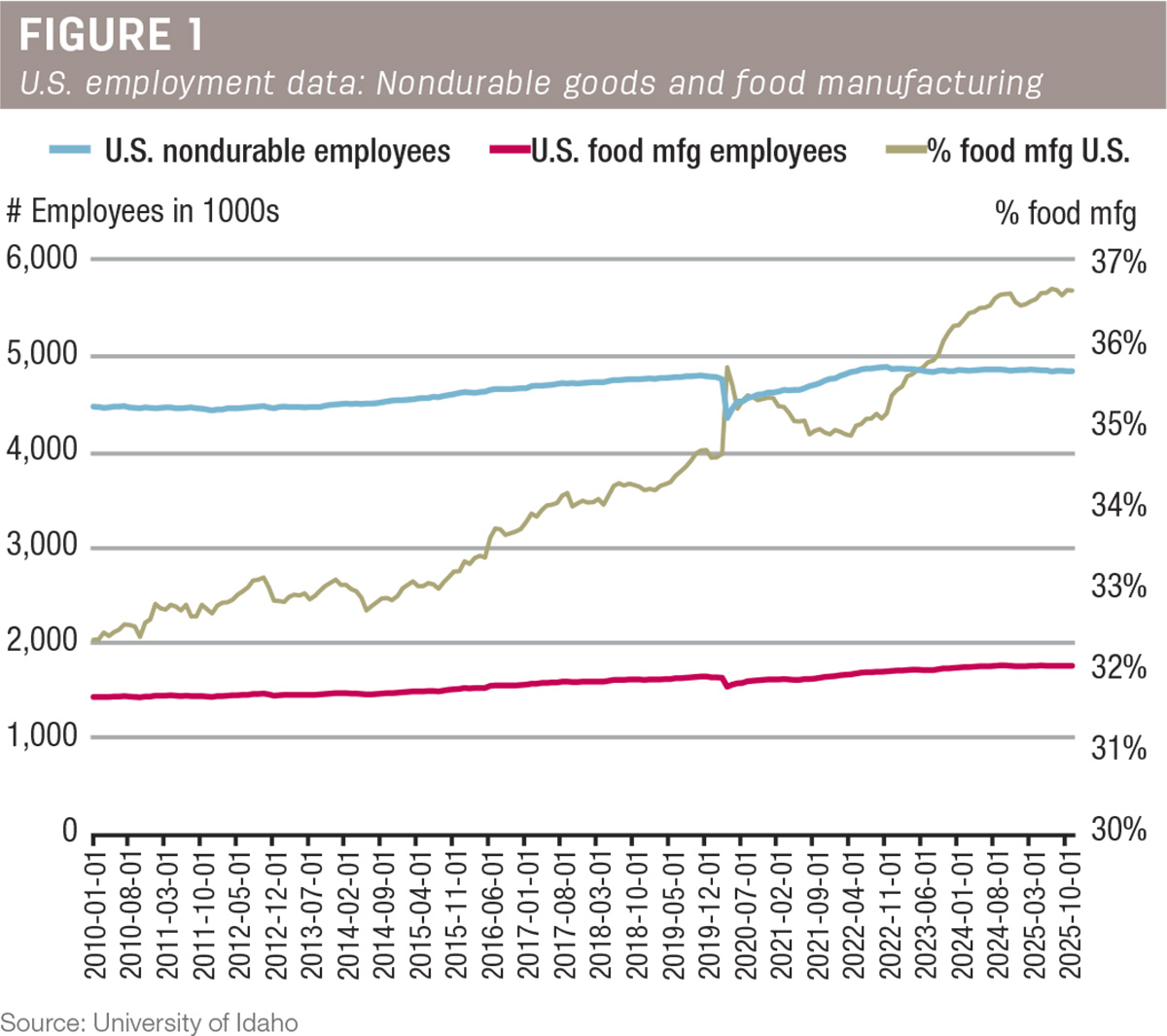
Figure 1 includes plots of U.S. employment for nondurable goods manufacturing, food manufacturing and the percentage of nondurable goods manufacturing that is for food from 2010 to 2025 (through November). Figure 1 shows that employment for nondurable goods manufacturing in the U.S. has increased from about 4.5 million to 4.8 million and that specifically for food from 1.5 million to near 1.8 million over this period.
Additionally, the percentage of employees in nondurable goods manufacturing engaged in food manufacturing has increased from 32% to about 37%. Thus, for the nation, food manufacturing employment has grown relatively more than that for employment in manufacturing of other nondurable goods.
These trends can be explained by declines in employment of some nondurable goods industries (perhaps apparel), while food manufacturing employment increased.
Idaho
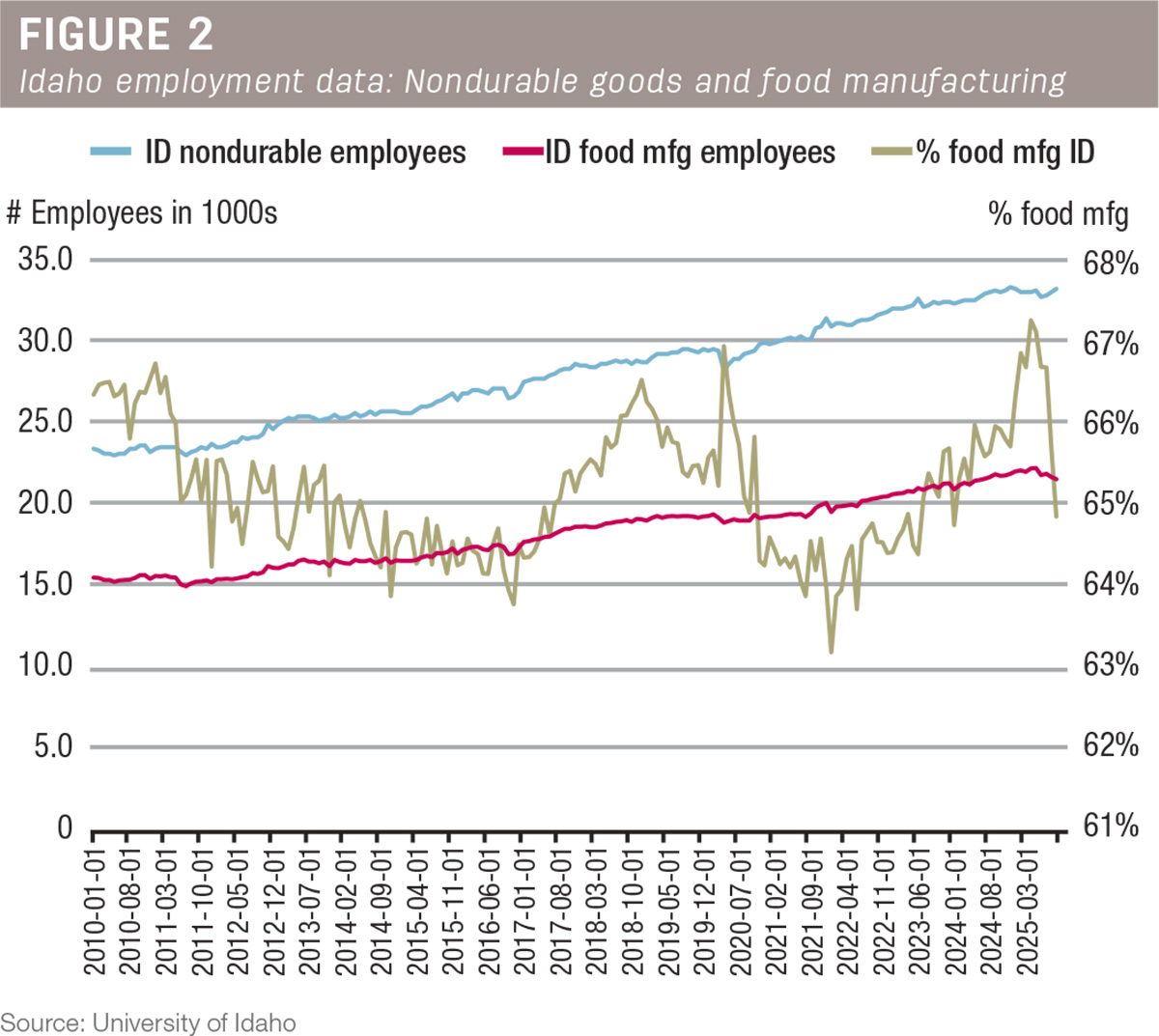
Figure 2 is the same as Figure 1 but with the data only for Idaho. Regarding comparison with the U.S., it is observed that the percentage of employees in nondurable goods manufacturing engaged in food manufacturing has consistently been higher for Idaho, at above 63%, than for the U.S. (range from 32% to 37%) from 2010 to 2025. Thus, food manufacturing is a relatively more important source of employment than manufacturing of other nondurable goods in Idaho than the whole U.S.
Additionally, food manufacturing employment in Idaho increased for much of the observation period from about 15,500 employees in 2010 to over 22,000 employees by early 2025. Overall nondurable goods manufacturing employment also increased but the percentage of employees engaged in food manufacturing remained between 63% and 67%. This implies that most of the growth in nondurable goods manufacturing employment in Idaho has been due to there being more food manufacturing employees.
Recent events in Idaho food manufacturing and processing
A further point to note regarding the Idaho food manufacturing employment data is that it is observed to have achieved a near term peak in May 2025 at 22,217 employees and then was lower by almost 700 employees at 21,531 by September 2025. This decline toward the end of 2025 may likely be at least in part due to layoffs such as those by Eagle-based potato processing company Lamb Weston, which has Idaho-based processing plants in Twin Falls and American Falls, as announced in July 2025 by the Idaho Statesman and other news outlets (impacted locations were not disclosed in the media reports).
On the contrary, a new processing plant was opened by Teton Valley Brands in Caldwell, as announced by the Capital Press and other media outlets in August 2025. Single-month declines in employment, due to market seasonality trends and similar factors, are common in the Idaho food manufacturing employment data. Consecutive multi-month downturns in food manufacturing employment are rarer but have also been observed to have occurred during several other years including 2011, 2016 and 2020.
We will keep an eye on the data as it is released for the last quarter of 2025 and first part of 2026 to determine if the downward trend observed in mid-2025 continued or not.






.webp?height=auto&t=1783636475&width=285 "63802-Thomas-GPS-equipment--Automated-Magnum-Tractor--Matt-Skinner-photo(1).jpg")
