Is cloud seeding good for Idaho? Is it an effective way to increase the snowpack and, eventually, the water supply? What are cloud seeding’s effects on the landscape, human and wildlife populations?

According to water hydrologists, cloud seeding is good for Idaho. Having enough water to supply the state means a healthier ecosystem and economy. Also, with more than 20 years of data, cloud seeding is an effective way to increase snowpack levels by approximately 1 million acre-feet according to the Idaho Department of Water (IDWR). And finally, silver iodide is a relatively insoluble compound. It disperses at very low concentrations, and multiple studies by the National Center for Atmospheric Research (NCAR), funded by IDWR, have found no significant buildup of silver in the environment above naturally occurring levels. As a precaution, long-term environmental buildup is being monitored.
Seeding the clouds
Cloud seeding is a way to help clouds release the moisture they carry, explains Derek Blestrud, atmospheric science supervisor from Idaho Power. “Mother Nature is very inefficient at getting water that’s in the atmosphere and putting it on the ground as precipitation. Cloud seeding helps Mother Nature out a little bit by coaxing a little bit more precipitation out of the atmosphere than what would occur naturally.”
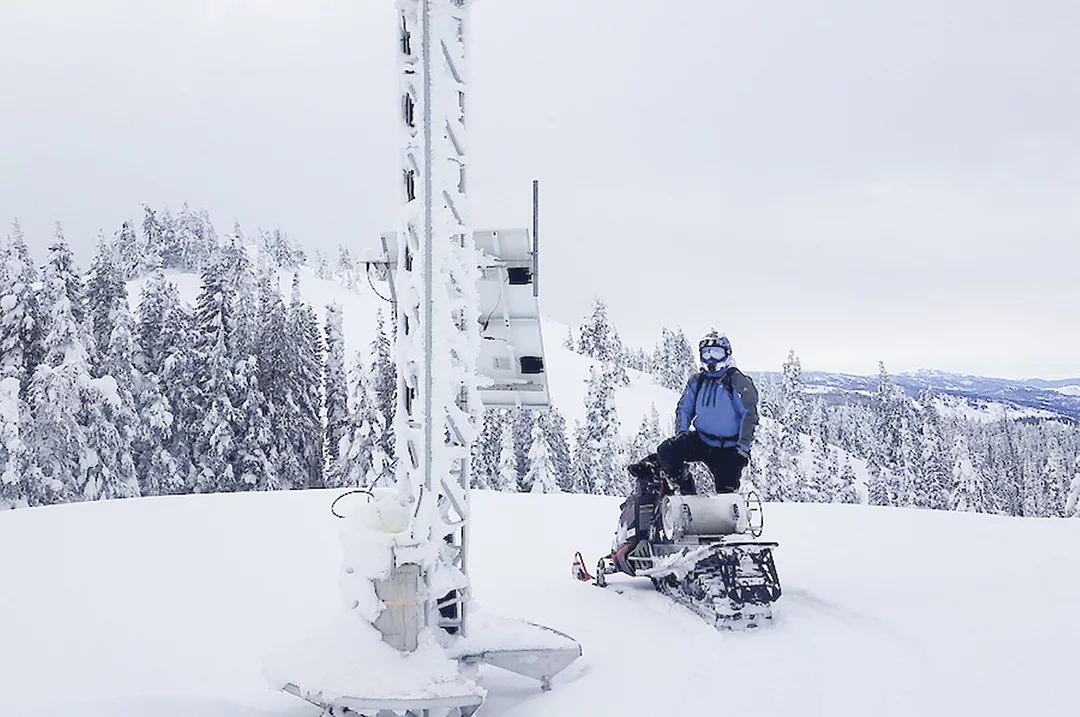
Snowflakes need a particle or impurity in the atmosphere, often a dust particle, to start collecting water droplets and forming the ice crystal. With cloud seeding, we introduce particles into the atmosphere as silver iodide, Blestrud adds. This kick-starts the formation of ice crystals and helps more snow fall. The clouds are seeded using two methods: Ground generator towers use a propane flame to carry the aerosol particles up into the clouds, and aerially with an aircraft flying through the cloud bank and exhausting the silver iodide particles.
“In Idaho, we do wintertime cloud seeding. The Idaho Power project runs from the 1st of November through the end of March, sometimes into April, depending on the winter season,” says Blestrud. He notes that winter cloud seeding increases snowpack in basins and drainages that ultimately flow into the Snake River by about 10%. It’s not a lot, but across the entire state, it adds up, and it’s one tool in the box we can use to increase our water supply, he says.
Proving it
Conni and Marty Owen, operators of Let It Snow Incorporated, contract with High Country RC&D and Clark County to manage 25 manually operated ground-based generators located on private property in eastern Idaho. They have been working with the program for 31 years. High Country RC&D, a nonprofit, collaborates with Idaho Power to provide eastern Idaho program funding and an aircraft based in Pocatello. On the western side of the state, Idaho Power operates 39 remote-controlled ground-based generators in isolated locations in the Payette, the Boise and the Wood river basins and two aircraft out of Boise. That program has been in effect since 2003.
The Owens are certified by the Weather Modification Association and register with the National Oceanic and Atmospheric Administration for their cloud-seeding work. Marty is also a pilot by trade.

Burn-in-place flares are mounted on the wing of the aircraft. They are lit one at a time to exhaust silver iodide particles in the cloud bank. Image courtesy of Idaho Power.
Cloud seeding has been ongoing for decades, but definitive results were hard to obtain. However, by the mid-’90s, county commissioners in the Upper Snake River counties could see the impact and decided it would be a good economic decision to invest in the practice, recalls Conni. Continued research and meteorological advances have shown that forward thinking paid off. In 2017, the SNOWIE project in the Payette Basin led to multiple peer-reviewed articles presenting radar images of rapid ice crystal formation following the aircraft’s flight path as it released aerosolized silver iodide, she adds.
Marty notes that cloud seeding, whether from the ground or from aircraft, does not target hundreds of miles of terrain but rather covers 30 to 40 square miles in high-mountain locations far from population centers.
“When that storm comes through, you’re looking at about a 5- to 10-mile downwind area before it starts to affect it. And then from that point, another estimated 10 to 20 miles on average to the area affected,” he explains. “We’re targeting remote areas.”
Shaun Parkinson, meteorology leader and cloud-seeding leader for Idaho Power, notes that even small target areas show additional snowpack compared to non-target areas. “We have 20 years of data that we can look back at statistically and see the cause and effect from the target area versus control areas, and what has been the change in precipitation. That story is pretty compelling.”
According to Idaho Power, the overall collaborative cloud-seeding program estimates the average annual water added to the Snake River Basin is 613,000 acre-feet from the Upper Snake and 533,000 acre-feet from the Central Mountains, for a total of 1,147,000 acre-feet.
For perspective, the American Falls reservoir has a one-time capacity of 1,672,590 acre-feet.
Experts from IDWR, Idaho Power, High Country RC&D, county officials, canal companies, cities and more agree that cloud seeding works and contribute funding for the program. But is it cost-effective?
Conni believes it’s well worth every penny. “The cost of an acre-foot of water is upwards of 75 dollars per acre-foot. Our whole budget last year was 311,000 dollars, and we supplied 7.1 percent more snowpack in eastern Idaho.”
Marty notes that cloud seeding isn’t just happening in Idaho or the U.S. “The Weather Modification Association is a worldwide group that meets once a year. We have scientists and operators working on this. They understand how it’s working. They know it’s safe. It’s beneficial, and what cloud seeding produces definitely offsets the costs of the program.”
Learning and doing more
In eastern Idaho, much of the funding for cloud seeding comes from donations collected by High Country RC&D. They accept donations year-round and are looking to expand the Upper Snake River program. They also offer free presentations to interested groups about science and the application of cloud seeding in Idaho.
For more information on cloud seeding, visit the following websites: