Idaho is known for growing great quality alfalfa hay. According to a report by the USDA, Idaho is the sixth top state in total forage production and the top state in alfalfa yield ranking. In 2024, the cash receipts for hay were valued at $380.5 million, and in 2025, it is forecast to be about $387 million. Even with these impressive numbers, it doesn’t tell the entire story about the hay in Idaho. University of Idaho Extension ag economists estimate that about 45% of hay produced in Idaho is fed directly to livestock on the same farms/ranches where that hay was produced. Therefore, this hay is never accounted for in cash receipts. If a value was put on all the hay produced in Idaho, it would be more than $700 million.

These numbers clearly lay out the importance of hay production in Idaho. Many neighboring states also have impressive hay production numbers. With such a high value, one might be more likely to protect this resource than others. There are many ways that hay is stored, each with its own cost and level of protection. Some haystacks across the state are left uncovered and are usually fed to livestock within a short period of time. Many producers choose to cover the top of the stack with a tarp or similar covering to protect it from rain or snow. Larger operations may have a hay shed/pole barn available to them in which to store their hay. All these methods have their place and purpose in protecting these valuable investments. Reducing the exposure of hay to the rain, snow and hot sun certainly aids in protecting the visual integrity of the baled forage. However, what do the weather, elements and time do to the nutritional integrity of these same bales?
This question was asked back in 2023 when a presentation was made at a Range Livestock Symposium hosted by the University of Idaho Extension. The presentation was on educating livestock producers about the importance of testing baled forages for nutritional quality. The discussion also included information on how to use those results to build rations that meet nutritional demands of livestock during the winter months when range/pasture are unavailable and baled forages and other feedstuffs are the primary feeds. Regarding these hay tests, a question was raised: “How long will the results from that sample be valid?” This could also be phrased as, “How quickly does hay degrade in the stack?”
The presenter and other University of Idaho faculty did not have a research-based answer for this individual at the time. Some investigation after this event found that this question had been addressed in a study from the eastern U.S. done in 1998. While this document contains some great information, many of the research studies cited are 30 to 40 years old and focus in on mostly round bales. Much of this information isn’t as applicable to the western U.S. where there is a mixture of large square and round bales that are grown in a vastly different climate than more humid states like Indiana and Kentucky mentioned in the research. Differences in climate and humidity could have an effect on the changes in dry matter and overall hay quality. These differences in growing situations and the fact that a lot can change with forage genetics and harvesting technology/methods in 30 years bring about the need for updated research to an area previously unstudied.
Courtesy image.
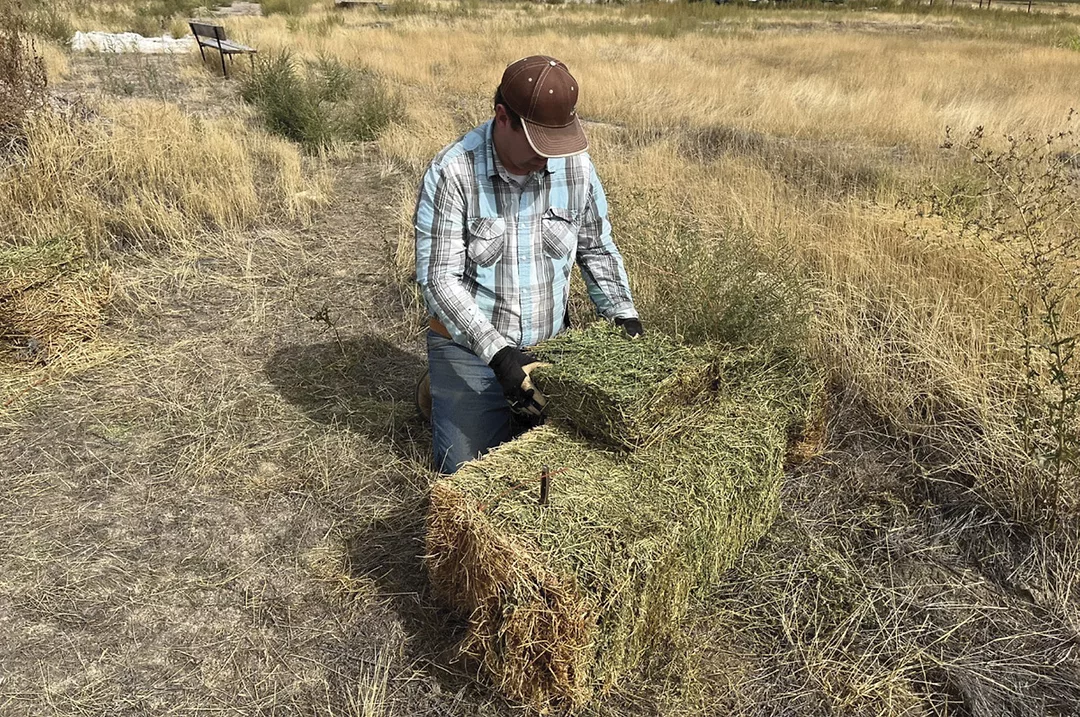
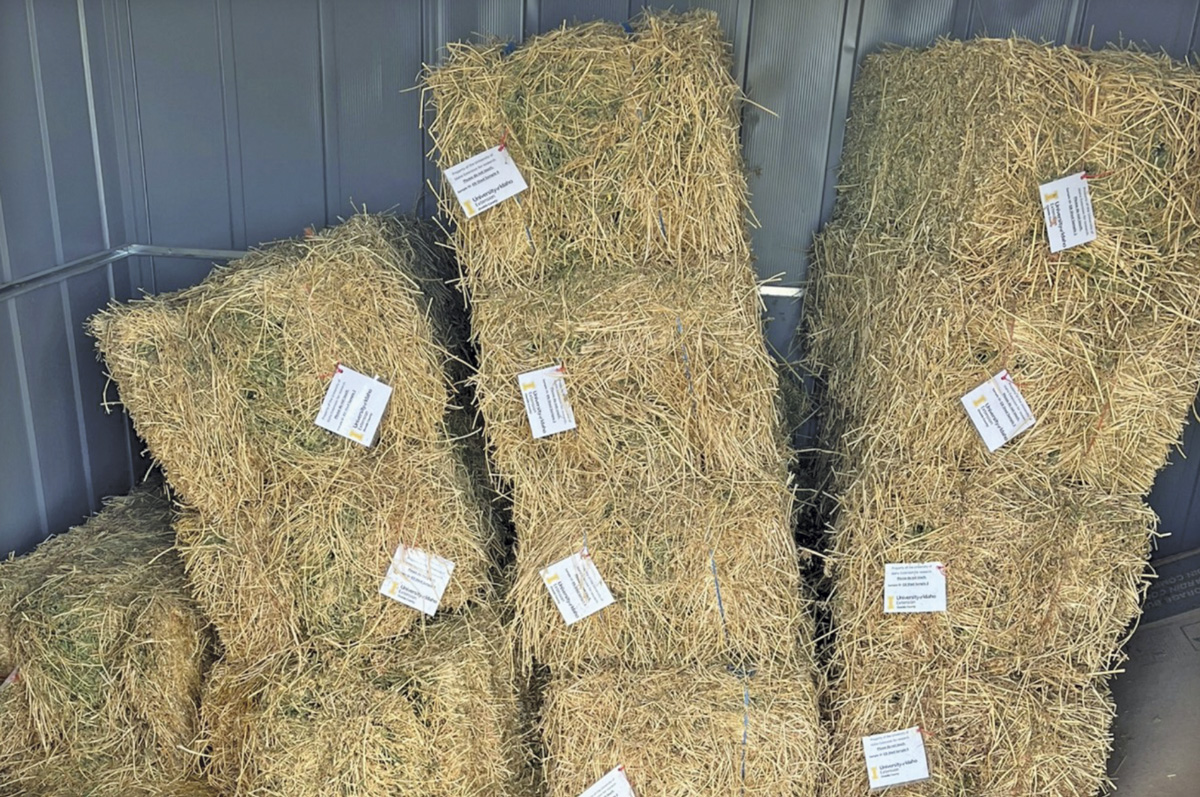
With a need for applicable data identified, a research idea was born. With limited funding available, the decision was made to create a “seed study” or a smaller version of a research project, which would be used to gain preliminary data to guide more detailed research in the future. With a mini grant from the Western Sustainable Agriculture Research and Education (SARE) program, hay was purchased and placed into three different storage methods. These small two-string bales were either stored completely protected from the elements in a shed, placed in a stack that was covered on the top by a tarp and placed on wooden pallets to protect it from ground moisture or stacked directly on the ground with no form of protection. These bales of hay were then tested every four months by sending a sample in to a laboratory for near-infrared (NIR) analysis.
Results from this small study were presented at the 2026 Idaho Range Livestock Symposium hosted by the University of Idaho Extension. It was noted that these results were preliminary and were only from hay grown and tested in Oneida County. Future recommendations that could be applied statewide will come in the future with further research. In reviewing the laboratory analysis, there were some relevant findings. Dry matter in the uncovered bales decreased between 2.5%-11%, while those bales that were protected (with a tarp or shed) had less than 1% change. Minerals for all three storage methods were unchanged throughout the two-year study and maintained the quantities they started out with.
The acid detergent fiber (ADF) and neutral detergent fiber (NDF), which are indications of the digestibility of the forage and the structural fibers present, increased nearly double the amount in unprotected hay than in protected hay. This trend is consistent with reports from a previous study that the weathering of a hay bale sees quicker degradation in the soluble carbohydrates, which then leaves behind the structural carbohydrates reported by the ADF and NDF values.
Relative feed value (RFV) is a way to quantify the total quality of forages. In starting out, all the hay was ranked as Good according to the Idaho Hay and Forage Association standards for grading alfalfa and grass hay. After two years, hay which was uncovered dropped in RFV value to a Utility classification, while protected hay maintained its Good ranking. These results have given some data to support protecting (tarp or shed) baled forage. It has also provided a starting point to begin to track nutritional decline over time under different conditions.
This simple study has begun to bring clarity and data to the question of what happens to the quality of hay under different storage methods. The suggestions and questions from local hay producers and livestock owners have been very helpful in shaping the future of this research project. Plans are currently being developed to expand this study into one which examines larger quantities of hay in multiple locations to gather more sample points, which will bring clarity to the research project. This project will be completed sometime in the future. If you have questions about hay testing or storage methods, please reach out to your local extension educator.
References omitted but are available upon request by sending an email to the editor.