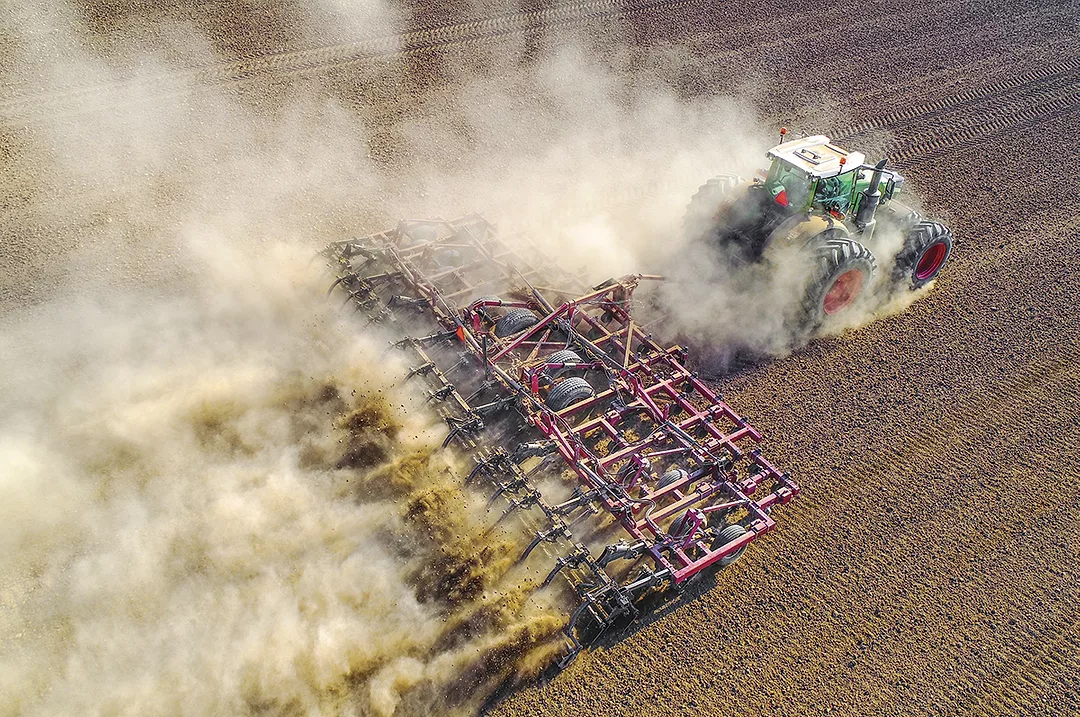
In the pulse of American agricultural activities, tractors roar to life every day for baling hay, hauling feed, hauling manure and more. These workhorses are indispensable, yet they exact a heavy toll: An average of 218 tractor-related fatalities strike U.S. farms each year, with overturns involved in nearly half, claiming about 130 lives.

The silver lining? Every one of these tragedies – and countless machinery mishaps – is preventable. Arming yourself with core safety know-how, hazard identification, rollover protective structure (ROPS) retrofits and transforming risks into routines that protect you, your crew, your land and your legacy will significantly reduce the incidence of injury or death.
Aaron Yoder, associate professor at the University of Nebraska Medical Center (UNMC) Department of Environmental, Agricultural and Occupational Health; research director at the Central States Center for Agricultural Safety and Health at UNMC; and associate professor at the University of Nebraska – Lincoln Department of Biological Systems Engineering, categorizes common mechanical hazards into nine types:
- Pinch points
- Wrap points
- Shear points
- Crush points
- Pull-in points
- Burn points
- Freewheeling parts
- Stored energy
- Thrown object hazards
“Recognizing these hazards is the first step to avoidance,” Yoder says. “Always inspect your equipment, keep guards in place, and completely shut down machines before conducting maintenance.”
Pinch points are formed when two parts of equipment – chain drives, feed rollers, etc. – move together, with at least one rotating. To avoid pinch-point injuries, keep guards in place and stay clear of known pinch points when equipment is operating.
Wrap points include rotating shafts, such as power takeoff (PTO) connections, which can snag loose clothing or hair and pull an individual into the moving shaft. To avoid this type of injury, stay clear of the PTO as much as possible while in use. Tuck any loose clothing in, and secure dangling threads or drawstrings, as well as long hair and jewelry.
“It’s not recommended to wear any kind of jewelry when using farm equipment,” Yoder says. “That includes rings, which can result in entanglement.”
Shear points are sharp or moving parts of equipment that slice like scissors (i.e., hedge trimmers). To prevent these types of injuries, maintain guards and fully de-energize equipment before inspecting or performing maintenance.
“On a hedge trimmer, one set of blades stays stationary and another moves back and forth,” Yoder says. “This creates a shearing effect or shear point. Another example is scissors or larger shears. The best safety practice is to shut off and de-energize the machine before getting close to these points. If there’s a guard to protect exposure, keep that in place.”
Crush points on equipment refer to gaps that are closing between moving and stationary objects, such as when hitching a drawbar. To protect against this type of hazard, keep your hands and body out of the gap until the equipment is secured. Additionally, prohibit bystanders from being near moving gear.
Pull-in points are areas where materials (or people) can be drawn into machinery, such as the feed chambers of a hay baler. When operating balers or other equipment with pull-in points, stay away from those areas. If repair or maintenance is required, fully stop the machine and implement lockout/tagout procedures to ensure that no residual energy remains in the machine.
Burn points are hot surfaces – i.e., mufflers or engine fluids. These types of hazards may be overlooked but can cause significant harm during repair or maintenance activities. Safety practices for burn points include wearing protective clothing and allowing machinery to fully cool before repair or maintenance.
“We often see these types of injuries during equipment inspection, checking oil or fluids after the machine’s been used,” Yoder says. “We want to be sure we’re aware of where these burn points are so we can avoid contact with them.”
Freewheeling parts are components that keep spinning after equipment shutdown, as in baler flywheels. These components must expend stored energy when the equipment comes to a stop, or parts could be damaged or broken. Allow several minutes for them to stop entirely. Keep all guards in place and in working condition.
Stored energy is the term used to describe energy that’s ready to release. This could be compressed springs or pressurized hydraulics. To avoid injury by stored energy, bleed systems and secure loads before working on the implement.
“Stored energy is probably the most difficult category to see or visualize,” Yoder says. “This is energy that’s ready to be released. Most injuries of this type result from an unintentional release of energy. When a cylinder lifts a load, pressure is stored and the cylinder’s fluid is under high pressure. If a line is cut or removed to complete repairs, it could release the load's weight, causing it to come down on the operator. We need to be sure that everything is at rest and all high pressure is out of the system before doing any maintenance.”
Tractor overturns are the most hazardous type of tractor-related incident in the U.S. Several safety practices will significantly reduce the risk of overturn accidents. These include:
- Install and use a ROPS system with a seat belt
- Maintain stability through design and operation
- Keep the center of gravity (CG) low and centered
- Operate cautiously on uneven terrain
- Manage speed and turns to counter the shifting centrifugal force
- Practice safe towing and hitching to prevent rear overturns
- Utilize protective gear and practices
- No extra riders
“ROPs are 99 percent effective in preventing death and injury in tractor overturns,” Yoder says. “Factory-made ROPs are properly designed and strong enough to perform in an overturn. Many states now offer rebates for ROP purchases, making it very affordable to retrofit one.”
Wide-front-end tractors will naturally be more stable than “tricycle” designs, due to the broader stability baseline. These types of tractors leave more room for a load to shift without tipping. The CG is typically 10 inches above and 12 inches forward of the rear axle on two-wheel-drive tractors (shifts forward on four-wheel-drive).
“Avoid raising the CG by keeping front-end loader buckets low to the ground, even when they’re empty, to prevent forward/upward shifts on slopes or bumps,” Yoder says. “If we have front-end loaders or any heavy weight on the machine, keep that as low as possible. Avoid steep slopes where the CG can easily exit the baseline.”
When operating a tractor on hillsides, Yoder recommends scouting the area for hidden hazards such as holes, depressions or obstructions that could shift the CG.
“If we’re already operating on a hillside and hit an obstruction or depression, that can move our CG outside the stability baseline,” Yoder notes.
Slow down for turns, which pull CG outward, especially on uneven terrain or at high speeds.
“Doubling speed from 3 to 6 miles per hour quadruples the force,” Yoder says. “Driving 9 miles per hour increases the force ninefold. When we start running faster and turning sharper, we see that speed kills. Speed has a huge impact on the number of forces that go into a collision or rollover.”
Avoiding overcorrections on rough terrain that causes bouncing or dodging objects on roads intensifies CG, which can push tractors over.
To prevent towing and hitching-related overturns, hitch low and properly. Always attach to the drawbar rather than to higher points, such as the three-point hitch. This minimizes the “angle of pull.” A high angle can lift the front end, shifting CG rearward. If the rear tires are stuck, disengage the power quickly to avoid torque flipping the front end.
“Don’t allow extra riders,” Yoder says. “Tractors are not designed to carry extra people. Be familiar with equipment manuals and understand highlighted safety hazards on all your equipment. Tractors and ag equipment are designed to be operated safely if they’re used according to recommendations. Everyone is safer if we follow recommendations and recommended practices.”