It’s a tale as old as time: Some new product is on the market and will completely redefine, reinvigorate or improve the way that we do X. Though today’s trendy culture refers to these innovations as “disrupters,” the continued improvement of products and services is a natural evolutionary process that persists across all market segments. Caution must always be part of the process, too, as snakes often hide in the grass of improvement. Some of the snakes, the bad actors, are venomous and seek only to part the unwitting consumer from their money. Other nonvenomous snakes have honest and pure intent yet still separate the consumer from their money, leaving nothing to show for it. These are failed products and services. A little background knowledge can help you to avoid snakes and focus on harvesting the grass.

Agriculture is perhaps the industry that has been in this evolutionary process the longest of all. The man-versus-nature plot arc that plays out year after year implores us to find the one tool, gadget or practice that will give man the edge against insect damage, drought, flood, fungal infection, poor soil conditions or any other of the countless antagonists in the familiar story. Some of these tools are able to hit the ground running with a nearly perfect design and propel the industry forward. The tractor, for example, remains functionally unchanged from when it first came on the scene more than 100 years ago. Another tool that landed nearly perfectly more than 100 years ago was soil testing.
While the tractor remains functionally unchanged, there have been attempts made over the years, some successful and some not, to improve the overall tractor experience. These efforts focus largely on the infrastructure around the tractor rather than the tractor itself. For example, different tire configurations and implements work better in different soils. The same can be said for soil testing. At its core, soil testing is a laboratory procedure that gives us insight into the nutrient pool that the plant has access to. The chemistry forming the foundation of the test is as sound now as it was the day it was developed, but there’s a catch that sometimes confuses people: Soil has chemistry of its own.
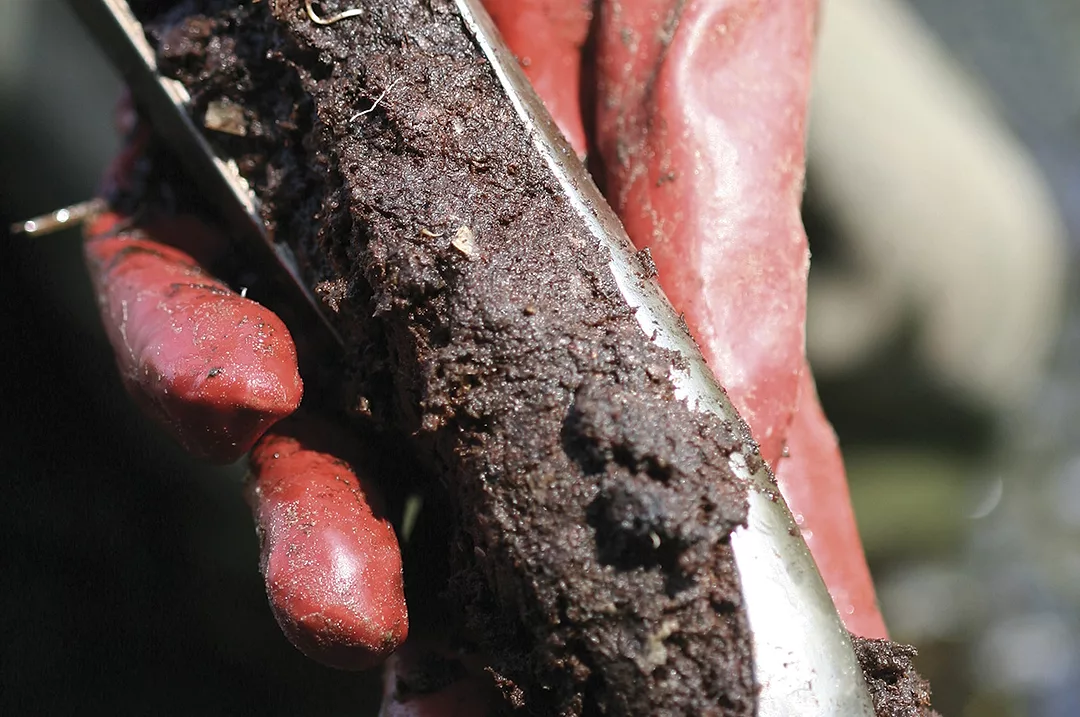
Soil extraction is the process of transferring plant-available nutrients from the soil into a solution that can be analyzed with instruments in the laboratory. In essence, it’s a reaction among a slew of chemicals that takes place in a controlled environment. The soil is the primary chemical in this reaction, and it has its own agenda. This is why we have different extraction methods.
Just like tractor tires, different soil tests work better in different soils. The relationship between Bray-1 P and Olsen P is a well-known example of this. Tried and true, the Bray-1 P test uses acidity to release phosphorus (P) that is bound to iron (Fe) and aluminum (Al), providing an estimate of the P that a plant could take up. In moderately to strongly alkaline soils, the acidity of the Bray-1 solution is neutralized, thus rendering the solution incapable of releasing P. This is where the Olsen test often comes in. Using a completely different chemistry, the Olsen solution is strongly alkaline and releases P that is bound to calcium (Ca). The practice in the industry is to simply replace a Bray-1 result for an Olsen result when the soil pH is above a certain threshold, usually 7.2 or 7.3.
This is an example of a nonvenomous snake. The intent is honest enough: to replace a poor result (Bray-1) with a valid result (Olsen). These two tests have completely different modes of action, though, so they should not be used interchangeably. Interpreting an Olsen P value as though it’s a Bray-1 value is convenient, but it’s just as foolhardy as using narrow tires in a wet field and can lead to a poor experience overall.
This is only one example of how the nuances of soil chemistry add complexity to the soil testing process. Where there is complexity in a process, there are people with ideas to simplify it. This brings us back to the evolutionary process and our proverbial grass and snakes. Several start-up companies over the past decade have popped up with the intent to make soil testing easier, faster and cheaper. These initiatives often focus on using sensors, mapping or a combination thereof to give real-time results in the field.
While some of these sensors may have success in other fields of study, making them seem like great candidates for soil testing, the complexity of soil usually makes itself present and creates unexpected hurdles to success. These in-field solutions typically fail, defeated by soil chemistry, but have been making progress and may one day prove useful.
Another approach to soil testing evolution is to build upon our laboratory methods and identify research gaps that can be filled to improve the experience of the existing process. This has historically been difficult, if not impossible, because there was no central knowledge base housing the soil testing research that had been conducted. That changed in 2017 with the development of the fertilizer recommendation support tool (FRST). More than 65 universities, government bodies and organizations have gotten together to create this one-of-a-kind tool to take soil testing to the next level.
To take us back a step, a soil chemist by the name of Adolf Mehlich was working with the North Carolina Department of Agriculture through the 1970s to mid-1980s with the intent to create a universal extractant that could be used across a broad range of soil types. In 1984, his work was published, and the Mehlich III extractant came into the agricultural community. This solution borrowed heavily from the Bray-1 method that already existed, adding several additional compounds to deal with troublesome soil chemistry and improve efficacy.
The Mehlich III extractant quickly became the method of choice for North Carolina. Though this created a better chemical procedure, there was still the challenge of knowing how to interpret the results across a broad range of soils. That is a process known as soil test calibration – a very important part of the soil test and a very slow research process.
Until the creation of FRST, soil test calibrations were performed in a silo. Each state university would develop their own system that they felt worked best in their state with little or no communication across borders. What FRST did is bring all the underlying research that was used to develop those systems into one place. By bringing all the research into one large database, it’s possible to fast-track the implementation of Mehlich III across broad regions. Implementation of this universal extractant will help to ease the complexities of soil testing and create more uniformity in the industry.
Soil testing has historically been used to drive yield, but as the economics of agriculture tighten and tighten, its purpose is turning instead toward driving profit. There is a subtle but distinct difference between the two, and exploiting that difference requires that data replace instinct as the decision driver on-farm. This increased demand for data is understood by universities and the private industry, and solutions seem to abound.
As long as people are in this world, new ideas and innovations will continue to flow. Soil testing is a hot target these days simply because it’s been stable for so long. It’s difficult to believe that the scientists who did the research more than half a century ago got it right, so there’s a strong temptation to poke and pry at it.
Innovation will come – some will be great and lead to meaningful improvement in our lives. Others, not so much. Intent will be key to success. Where the intent is to build upon the rich history of soil testing research and embrace the nuances of soil chemistry to build a better tool, we will find the grass. Where the intent is to leverage new technologies to build a faster, cheaper tool, we may find the snakes.