
Reproductive efficiency is a main driver of profitability in beef operations, as an open cow still eats and grazes but doesn’t produce a weaned calf. Herds often focus on genetics, body condition and synchronization, yet trace mineral status is a common, hard‑to‑see limiter of conception, embryo survival and calving season length.

Copper, zinc, manganese and selenium are highly linked to reproductive outcomes, with cobalt and iodine supporting energy and thyroid function. Even marginal deficiencies can quietly appear as fewer conceptions, more cows returning to heat, greater early embryo loss and a calving season that stretches out with fewer calves on the ground.
The problem: Deficiencies plus antagonisms are common
Mineral shortfalls are widespread in North America and often compounded by antagonists that reduce absorption, especially the copper-molybdenum-sulphur interaction.
A University of Saskatchewan study reported 64% of cows in western Canada and 59% in eastern Canada had less-than-adequate copper status, while nearly three‑quarters of eastern Canadian cows and one‑third in the West were short on selenium. Among feedlot calves in Ontario, 56% sourced from western Canada (Manitoba, Saskatchewan and Alberta) and 33% of Ontario‑sourced calves were low in copper.
These results are tied to soil and forage mineral levels. Western Canada sampling studies report over 95% deficiency in zinc, 35% to 80% deficiency in copper, up to 100% deficiency in selenium, nearly 50% deficiency in manganese and 80% with molybdenum concerns. Antagonistic minerals in water can further aggravate suboptimal status, a common problem especially in western Canada.
Molybdenum and sulfates are common issues because they form complexes that make dietary copper unavailable, particularly where molybdenum‑rich forages and high‑sulphate water occur.
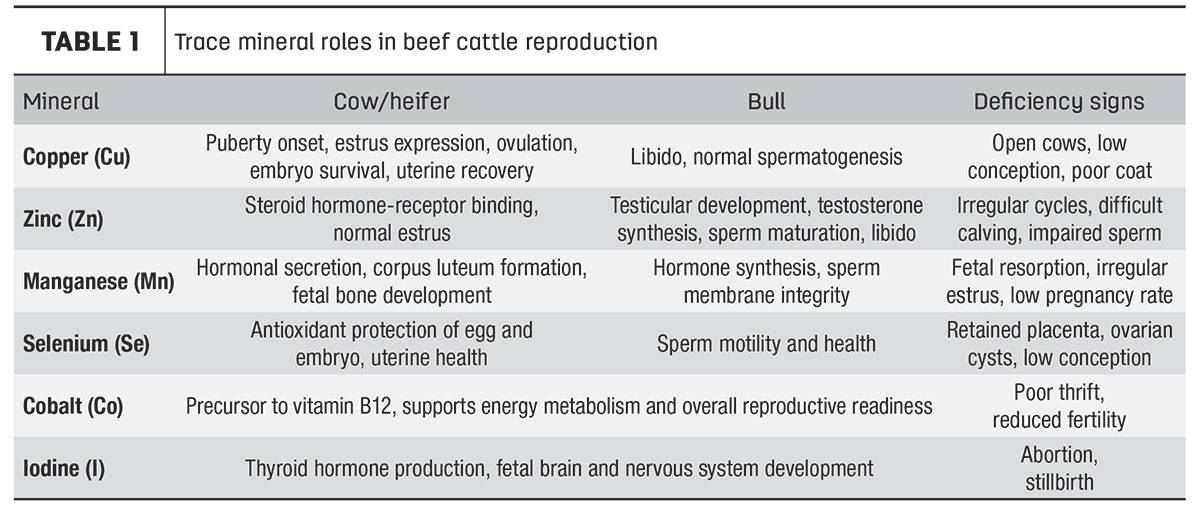
Trace minerals don’t “fuel” reproduction, but they enable it, as they are linked to multiple enzymatic and antioxidative processes necessary for optimal performance. Table 1 summarizes the role of each trace mineral on reproduction.
Conception, embryo survival and postpartum recovery
Reproductive losses often happen quietly: More than 70% of total losses occur within the first 45 days of gestation. When embryos are lost early, cows return to heat later, which shifts calving later and spreads the season.
Evidence across studies indicates that improving trace mineral status can reduce early loss:
- Optimized trace mineral strategies have been associated with an up to 18% improvement in embryo retention during early gestation.
- One study reported around 11% higher embryonic survival by day 60 in heifers on improved trace mineral nutrition, while a two-year study in Colorado showed higher artificial insemination (A.I.) pregnancy outcomes in supplemented cows, while overall 60-day pregnancy slightly improved.
Besides improved fertility, post-calving uterine recovery also responds to better mineral status. For this reason, whenever possible, it is a good idea to make sure your cows have optimal levels before calving.
Delivery method and quality matters
Free-choice mineral programs are practical, but intake is inconsistent. Multiple studies found cows on free-choice minerals were more likely to be below adequate levels, leading to poorer performance compared to cows receiving minerals in a total mixed ration (TMR). Availability does not guarantee intake, and consumption is influenced by many factors. It is also well established that organic minerals have better availability than inorganic sources, and there is no one-size-fits-all program.
Injectable trace minerals
Injectable trace minerals can support reproductive performance when deficiencies or antagonism risk are real, which is common in many Canadian regions based on the forage studies mentioned above. Benefits include:
- Known dose to each animal: Helps overcome intake variation across cows, heifers and bulls.
- Bypasses rumen antagonism: Useful where copper and selenium antagonists limit oral availability or when high-sulphate water is present.
- Rapid correction before breeding: Strategic injections 10 to 30 days prebreeding can support cycling, fertilization and early embryo survival.
- Bull fertility support: Injectable trace minerals around 60 days prebreeding can help ensure good sperm quality.
- Targeted support for high-risk groups: Young cows at turnout, thin cows, late-calving cows and developing bulls often have the least margin for error, so injectables provide a solid “baseline.”
The economic aspect: Calving distribution drives pounds and profit
Normally, recommendations target a 45- to 63-day breeding season with at least 95% pregnancy, resulting in 60% to 70% calving in the first 21 days and 95% within three cycles. Yet the Western Canadian Cow‑Calf Management Survey reported close to 10% open females, with 80% of operations using breeding seasons longer than 63 days. Costs of calving later are high:
- Each day younger at weaning reduces calf weight by about 2.4 pounds.
- A calf born 21 days later is 40 to 50 pounds lighter at weaning, resulting in a reduction of $240 to $400 in revenue per calf.
Early‑calving advantages also compound. Earlier‑born heifers tend to breed back quicker, stay longer and produce more calves over a lifetime. Long‑term herd data show earlier‑calving females weaned about 50 pounds more in their first calf crop and pounds 150 pounds more over six years. Tools like the BCRC calving distribution calculator help quantify these losses.
Trace minerals connect directly to this economically because the deficiencies increase embryo loss, delay return to estrus and raise the odds of open cows, pushing calving later.
Bulls: Half the genetics, often a bottleneck
A single bull with poor semen quality can stretch calving season, especially in a short breeding season at a 1:25 ratio. Minerals influence libido, testicular development, testosterone synthesis and sperm membrane integrity. Research comparing more bioavailable trace mineral strategies versus less available sources reported improvements in sperm motility and related semen traits. In developing bulls, a two‑injection protocol improved sperm motility, morphology and breeding soundness exam pass rate. So it is key to fine-tune this side of the equation.
Points to consider
- Test whenever possible, particularly forage (including antagonists like molybdenum, sulphur and iron), water minerals and periodic animal sampling at the herd level.
- Watch for antagonists, not just “parts per million (ppm) on paper,” especially for copper in the West and selenium in the East.
- Use injectables strategically: as a precision tool when intake is unreliable, antagonism risk is high or a quick correction is needed, which are common realities.
- Don’t skip the bulls; ensure they are ready for the season well ahead of turnout.
Take-home messages
Trace minerals are not a shortcut around management, but they remove a biologically meaningful obstacle to high conception, strong embryo survival, faster postpartum recovery and a tight calving season. In Canada, programs combining testing, timing, reliable intake and targeted injectable support can be a cost‑effective way to protect reproductive performance and capture more pounds at weaning.